Wandering prevention devices: three clinical monitoring systems
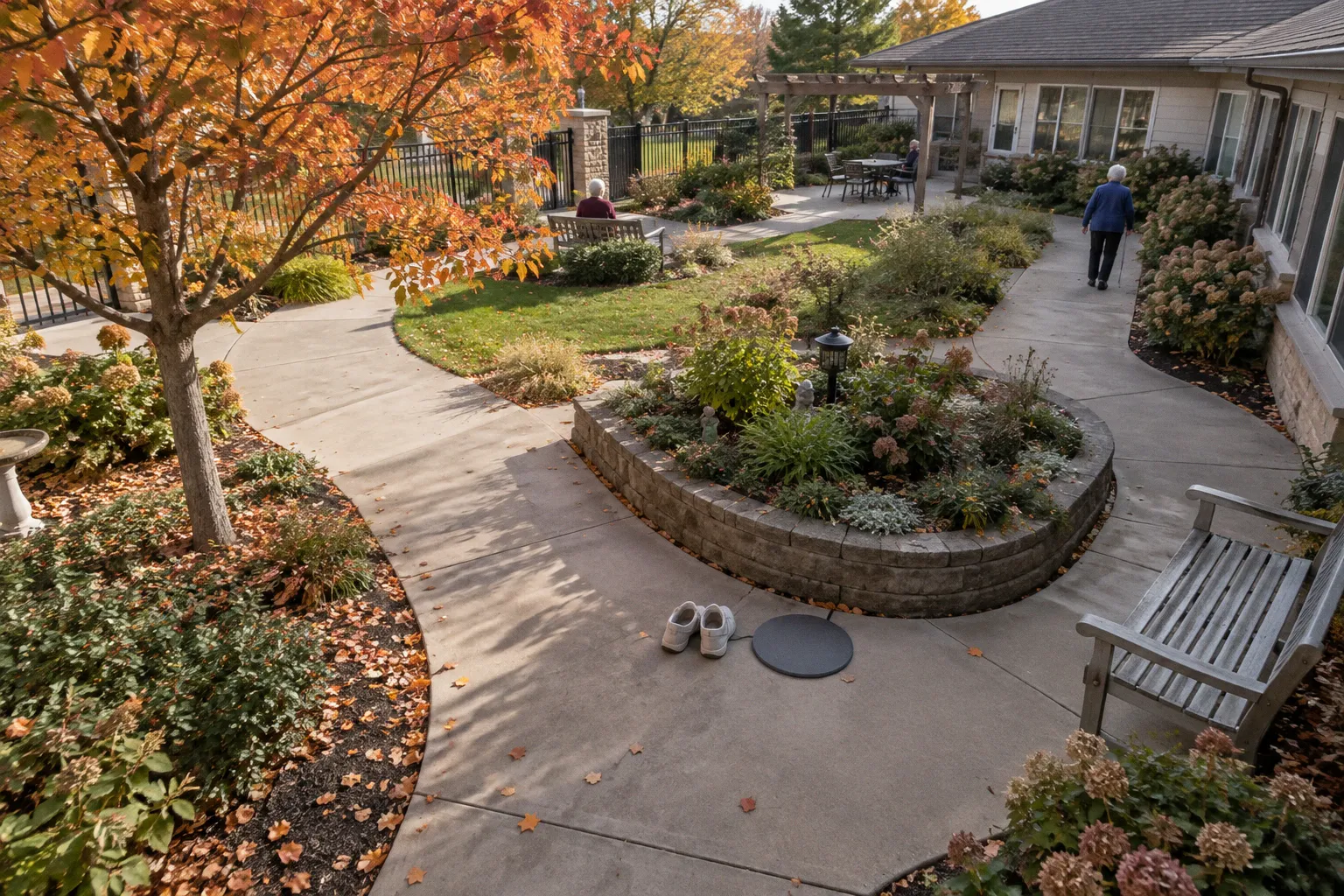
When a resident leaves a supervised area, the concern is not simply that they may become disoriented. Exposure, traffic, falls, dehydration, and delayed medical attention can turn an elopement event into a life-threatening emergency. If a person who has wandered is not located within 24 hours, the risk of serious injury or death becomes substantial.
For caregivers and memory care teams, the practical question is not whether technology can prevent every episode. It cannot. The more useful question is which monitoring system matches the resident’s actual pattern of movement, the building’s layout, the staffing model, and the level of risk documented in the care plan.
The three main categories are:
1. Indoor perimeter and door systems, often using low-frequency or RFID-enabled wristbands and protected exits.
2. Localized pressure and exit sensors, including bed, chair, and floor mats that alert staff when a resident begins to move.
3. Wearable GPS devices with geofencing, designed primarily for outdoor location tracking and boundary alerts.
Each system detects a different part of the wandering pathway. A door sensor may identify an attempted exit. A pressure mat may identify the first movement out of bed. A GPS device may locate the person after they have already left the building. That distinction matters more than the product label.
The clinical reality of elopement: risk comes before equipment
Wandering is a behavioral expression, not a single behavior with one cause. A resident may walk because they are searching for a familiar person, attempting to follow an old routine, looking for a bathroom, responding to pain, trying to leave an uncomfortable environment, or acting on a mistaken belief that they need to go to work. The same resident may wander at different times for entirely different reasons.
The first step in dementia wandering prevention is therefore a clinical assessment rather than a purchase decision. We need to understand:
- When movement occurs: during personal care, after meals, overnight, during shift change, or late afternoon.
- Where the resident goes: toward exterior doors, bathrooms, another resident’s room, a particular hallway, or a familiar-looking object.
- What happens immediately beforehand: noise, crowding, staff approach, hunger, toileting needs, fatigue, pain, or a change in routine.
- Whether the resident can recognize boundaries: some people respond to visual cues and redirection; others continue through doors without registering the risk.
- How quickly the resident moves: a person who walks slowly and remains within a familiar corridor presents a different monitoring challenge from someone who moves rapidly toward an exit.
- Whether there is a history of successful exit: attempted wandering and completed elopement should not be treated as equivalent risk levels.
This assessment creates the resident’s sensory baseline and identifies likely environmental triggers. It also tells the team what an alert must accomplish. Does staff need notice before the resident leaves a room? Before they reach an exterior door? Or is the primary need rapid location outdoors?
A device that generates an alert without connecting to that clinical picture can create a false sense of security. It may be technically active while failing to address the resident’s actual route, timing, or behavioral expression.
The best wandering prevention device is not the one with the most features. It is the one that detects the resident’s real risk early enough for staff to respond.
RFID and door perimeter systems for facility security
Indoor perimeter systems are designed around a clear objective: identify when a resident approaches or passes a protected doorway. Depending on the configuration, a resident may wear an RFID or low-frequency wristband, pendant, or other identification tag. Receivers installed near doors detect the tag and send an alert to a pager, mobile device, or nursing station. Some systems can also activate a controlled-door response, although that function must be considered alongside fire safety, accessibility, evacuation requirements, and the facility’s policies.
These are often the strongest option for residents whose primary risk is leaving a defined indoor area. They are especially useful in memory care settings with multiple exterior doors, secured courtyards, stairwell access, or common routes that lead toward an exit.
Where perimeter systems perform well
A door-based system offers several practical advantages:
- It creates a specific alert at a high-risk location, rather than reporting every movement.
- It can protect more than one exit within the same monitoring network.
- It does not depend on the resident remembering to press a button or interact with the device.
- It can be integrated into an existing staff response process.
- It is generally better suited than GPS for detecting movement inside a building.
For a resident who repeatedly walks toward the front entrance after dinner, a protected-door alert may be more clinically relevant than a wearable GPS tracker. GPS can be weak or unavailable indoors, while a perimeter receiver is designed for that exact setting.
A well-configured system may support local paging over a range of up to approximately 400 meters, with boosters extending coverage where the building layout requires it. The usable range depends on walls, equipment, installation quality, and the way the facility is constructed. We should never assume that a published range translates directly to reliable coverage throughout every corridor, courtyard, or service area.
Limitations and failure points
Perimeter technology detects proximity to a monitored area; it does not explain why the resident is moving or guarantee that staff will intervene in time. The alert must reach the right people, at the right volume, during every shift. A device that is heard at the nursing station but not by staff working in a distant wing may not provide adequate protection.
The resident’s wearable tag also requires routine management. Staff need to check that it remains in place, is charged if necessary, is not damaged, and is correctly linked to the resident’s profile. A wristband may be removed during bathing or personal care. A resident may refuse it. A loose fit, depleted battery, or incorrect tag assignment can turn a functioning system into an unreliable one.
We also need to distinguish security control from care. Locking or restricting exits may be necessary in some circumstances, but it does not replace assessment, meaningful activity, toileting support, pain management, or individualized redirection. A resident who repeatedly approaches a door may be communicating an unmet need. The alert identifies the moment; the care plan must address the reason.
Passive monitoring: pressure mats and bed-exit alarms
Pressure mats, chair sensors, and bed-exit alarms detect a change in position or weight. A sensor may be placed beside the bed, under a mattress, beneath a chair cushion, or across a floor area. When the resident stands, steps onto the mat, or leaves the expected position, the system sends an alert to a pager, phone, or nursing station.
These systems are most useful when the risk begins with a predictable transition: getting out of bed overnight, rising repeatedly from a chair, or moving toward a room exit without calling for assistance. They are not primarily perimeter systems. Their strength is early detection of movement within a room or immediate care area.
Bed and chair sensors versus floor mats
The choice between sensor types depends on the resident’s movement pattern and the environment.
| System | Detects | Best fit | Main limitation |
|---|---|---|---|
| Bed-exit alarm | A resident leaving the bed or changing position | Overnight wandering, falls risk, repeated unsupervised transfers | May produce frequent alerts when the resident needs routine toileting or repositioning |
| Chair sensor | A resident standing from a chair | Residents who rise repeatedly in common areas or require transfer assistance | Can be bypassed if the resident slides forward or stands outside the sensing zone |
| Floor pressure mat | A resident stepping onto a defined floor area | Early warning beside a bed, chair, or room exit | May be moved, covered, or treated as a trip hazard if poorly placed |
| Door perimeter sensor | A tagged resident approaching or passing an exit | Residents with a known route toward secured doors | Does not identify movement elsewhere in the building |
| Wearable GPS locator | Outdoor location and boundary crossing | Residents at risk of leaving the campus or becoming lost outdoors | Requires charging, wearing, cellular/GPS coverage, and an active response process |
The clinical advantage of passive sensors is that they do not require the resident to make a decision. A person with advanced cognitive impairment may not remember how to press an alert button or may not understand what the device is for. A sensor can detect movement without cooperation.
That benefit comes with a cost: alert volume. If a resident leaves the bed several times each night for toileting, pain, anxiety, or normal repositioning, the alarm may activate repeatedly. Staff may begin to experience alarm fatigue, particularly when the same alert does not lead to an emergency. Over time, a system that produces too many non-actionable notifications may receive a slower response.
The answer is not to silence the device and leave the problem unresolved. The team should adjust the response pathway. A resident may need scheduled toileting, a low bed, improved lighting, a clear path to the bathroom, a different mattress height, or a review of medications and discomfort. The sensor then becomes one part of a safer overnight routine rather than a substitute for it.
Placement is a clinical decision
A pressure mat should not be placed simply because there is open floor space. The position needs to reflect the resident’s usual transfer pattern. If the resident swings their legs toward the window and exits from the opposite side of the bed, a mat placed at the foot of the bed may miss the first movement. If a resident uses a walker, the mat must not create a surface change that increases fall risk.
The same applies to chair sensors. A resident who frequently leans forward, shifts weight, or moves between chairs may trigger false alarms. Staff need to observe the resident’s movement rather than relying on a generic placement recommendation.
For facilities evaluating dementia wandering alarm systems, the useful question is not how loud the alarm is or how many alert modes it offers. Ask whether the alert arrives early enough, whether staff can identify the resident immediately, and whether the system remains usable during bathing, room changes, night shifts, and emergency situations.
Wearable GPS trackers and geofencing for outdoor safety
Wearable GPS locators address a different stage of risk. They use satellite positioning, cellular connectivity, and geofencing technology to help caregivers identify a resident’s outdoor location and receive an alert when that person crosses a defined boundary.
Modern systems may provide live location updates at intervals of approximately 30 to 60 seconds, although the actual interval varies by device, network coverage, battery condition, and service configuration. A shorter update interval can support a faster response, but it may also consume battery more quickly.
GPS devices are particularly useful for residents who leave a building or campus, walk beyond a familiar area, or live in a less controlled environment. They may also add a valuable layer of protection during transport, outdoor activities, or supervised community access.
What geofencing can and cannot do
A geofence is a virtual boundary. When the device crosses it, the system notifies a designated caregiver or monitoring team. The boundary might surround a facility, a residential property, or a regular walking route.
Geofencing is not the same as prevention. It does not stop a resident from opening a door, entering a parking area, or walking toward a road. It supports location awareness and response after the resident moves beyond the defined perimeter.
GPS also has practical weaknesses:
- Indoor positioning can be inaccurate, especially in reinforced buildings or areas with limited signal.
- The device must be worn and sufficiently charged.
- The resident may remove it, leave it in a room, or hand it to someone else.
- Cellular coverage affects live tracking and alert transmission.
- A boundary that is too broad may delay notification; one that is too narrow may create unnecessary alerts.
- Someone must monitor the alert and know what action to take.
For this reason, wearable GPS trackers for dementia patients should generally complement, rather than replace, indoor systems. A GPS locator may help locate a resident after an exit, while a door sensor can provide the earlier opportunity for staff intervention.
The wearable must fit the resident’s routine
The most sophisticated tracker is not useful if the resident refuses to wear it. Staff should assess whether the person tolerates a wrist device, pendant, clipped unit, or another form factor. Some residents remove anything unfamiliar from their body. Others accept a device when it is introduced gradually and incorporated into their normal dressing routine.
The presentation matters, but we should avoid treating the device as a disguise or manipulating the resident. The goal is to support comfort and dignity while preserving a reliable safety function. If a wearable causes distress, skin irritation, or repeated conflict, the team should reconsider the form factor and the underlying monitoring plan.
Comparing the three systems in real clinical settings
A direct comparison is more useful when we look at the point in the wandering sequence each system can detect.
| Clinical need | RFID or door perimeter | Pressure, chair, or bed sensor | Wearable GPS with geofencing |
|---|---|---|---|
| Detecting movement inside a resident room | Limited | Strong | Weak or inconsistent |
| Detecting a resident leaving a bed | No | Strong | Usually not reliable indoors |
| Detecting approach to a protected exit | Strong | Possible, depending on placement | Limited indoors |
| Locating a resident outdoors | No | No | Strongest option |
| Dependence on resident cooperation | Low, although a wearable tag may be required | Low | Moderate to high |
| Risk of false alerts | Moderate if doors or tags are poorly configured | Moderate to high if movement is frequent | Moderate if boundaries or signal are unstable |
| Best use | Secured indoor perimeter | Early movement and transfer alerts | Outdoor tracking and post-exit location |
| Main operational demand | Tag checks, receiver coverage, staff response | Placement, alarm management, response to repeated alerts | Charging, wearing, cellular service, active monitoring |
There is no reliable basis for declaring one technology universally superior. The available evidence does not establish a single clinical efficacy rate that applies across RFID, pressure sensors, and GPS systems in every care setting. Their functions differ, and their performance depends heavily on installation, staffing, resident behavior, and follow-through.
In practice, a layered approach is often more defensible:
1. Use environmental design to reduce unnecessary risk. Improve lighting, remove trip hazards, make bathrooms easy to find, and reduce confusing visual cues near restricted doors.
2. Use passive sensors when risk begins with a transfer. Bed and chair alerts are appropriate when the first unsafe step happens in the room or common area.
3. Use perimeter systems when the resident repeatedly approaches exits. This creates a targeted alert at the point where elopement becomes more likely.
4. Add GPS when outdoor movement is a realistic concern. This provides location support if the resident leaves the supervised perimeter.
5. Define the response before activating the device. An alert without a named responder, escalation pathway, and search procedure is incomplete protection.
Integrating technology into personalized care planning
Clinical guidance such as NICE NG97 emphasizes personalized care planning and links monitoring tools to documented risk assessments. That principle is central to responsible technology use. A facility should be able to explain why a particular system is being used for a particular resident, what risk it addresses, who receives the alert, and how the care plan will be reviewed.
A monitoring plan should include more than the device name. It should describe:
- The resident’s known wandering pattern and likely environmental triggers.
- The time periods associated with increased risk.
- The preferred response to an alert, including who approaches the resident.
- The language and redirection techniques that reduce distress.
- Battery, tag, sensor, and connectivity checks.
- What staff should do if the device is missing or offline.
- How the team will review false alerts and missed alerts.
- When the system should be changed, reduced, or discontinued.
De-escalation remains part of the safety system
A device may bring staff to the resident, but the staff response determines whether the encounter preserves dignity. Approaching quickly from behind, blocking the resident’s path, or insisting that they return without explanation may increase agitation and accelerate movement.
We generally want to lower the sensory load first. Use a calm voice, reduce competing noise, approach from the front when possible, and offer a simple choice. The resident may respond better to an invitation to walk together, use the bathroom, have a drink, or sit in a quieter space than to a direct command to stop.
The response should also address the likely need. If the resident is searching for work, a structured activity that resembles a familiar task may be more effective than repeated verbal correction. If the movement occurs before meals, hunger may be part of the pattern. If it appears after a room change, environmental unfamiliarity may be driving the behavior. Technology can identify the episode; observation and clinical reasoning help reduce recurrence.
Avoiding blanket surveillance
The purpose of a monitoring system is not to track every resident continuously simply because the technology exists. Broad surveillance can increase restriction, privacy concerns, alarm burden, and staff desensitization without improving safety for residents who do not have a documented wandering risk.
A targeted plan is more clinically meaningful. It uses the least restrictive effective measure, reviews whether that measure is working, and changes it when the resident’s condition or routine changes. The team should also consider consent, representative involvement where appropriate, privacy, data access, and the facility’s own policies for tracking and emergency response.
Which system should a facility choose?
For most memory care facilities, indoor door perimeter systems are the best primary choice when the main risk is exit-seeking within the building. They focus the alert on a high-risk location and do not require the resident to understand or operate the device.
Pressure mats and bed-exit alarms are the better choice when wandering begins with unsupervised transfers, especially overnight or during periods when the resident is likely to fall. Their value is greatest when staff can respond promptly and when the care plan addresses the reasons behind repeated movement.
Wearable GPS with geofencing is the strongest additional layer for outdoor elopement risk, transport, larger campuses, or settings where a resident may move beyond a secured perimeter. It should not be treated as an indoor alarm, and it should never be the only safeguard for someone who can leave a building unexpectedly.
For residents with multiple risk points, combining systems may be appropriate: a bed sensor to identify the first movement, a door perimeter alert to identify attempted exit, and GPS to support location if an exit occurs. The combination only improves care when the alerts are coordinated and staff know which response follows each one.
The final decision should be documented as part of the resident’s individualized risk assessment, not made from a feature list. We should ask whether the system gives staff enough time to respond, whether the resident can tolerate it, whether the environment supports it, and whether the alert leads to a practical intervention.
Technology can reduce response time and improve location awareness. It cannot remove the need for supervision, environmental adaptation, meaningful engagement, or clinical review. The strongest dementia wandering prevention plan uses monitoring as one layer of support while continuing to treat the resident’s movement as communication. When we respond to both the risk and the underlying need, we protect safety without reducing the person to a security problem.
FAQ
What is the primary difference between door perimeter systems and GPS trackers?
When should a facility use pressure mats or bed-exit alarms?
Can GPS devices be used to monitor residents inside a building?
What are the risks of relying solely on technology for wandering prevention?
How can staff prevent alarm fatigue when using monitoring systems?
Related articles
 Memory & Cognitive CareDementia care facility transitions: common pitfalls to avoid
 Monroe Community Hospital Launches Friendship Place for Specialized Memory Care
 Memory & Cognitive CareSensory Stimulation Tools for Dementia by Stage
 Memory & Cognitive CareCircadian Lighting for Sundowning: What Our 6-Week Test Showed