Dementia alarm systems: four monitoring solutions for safety
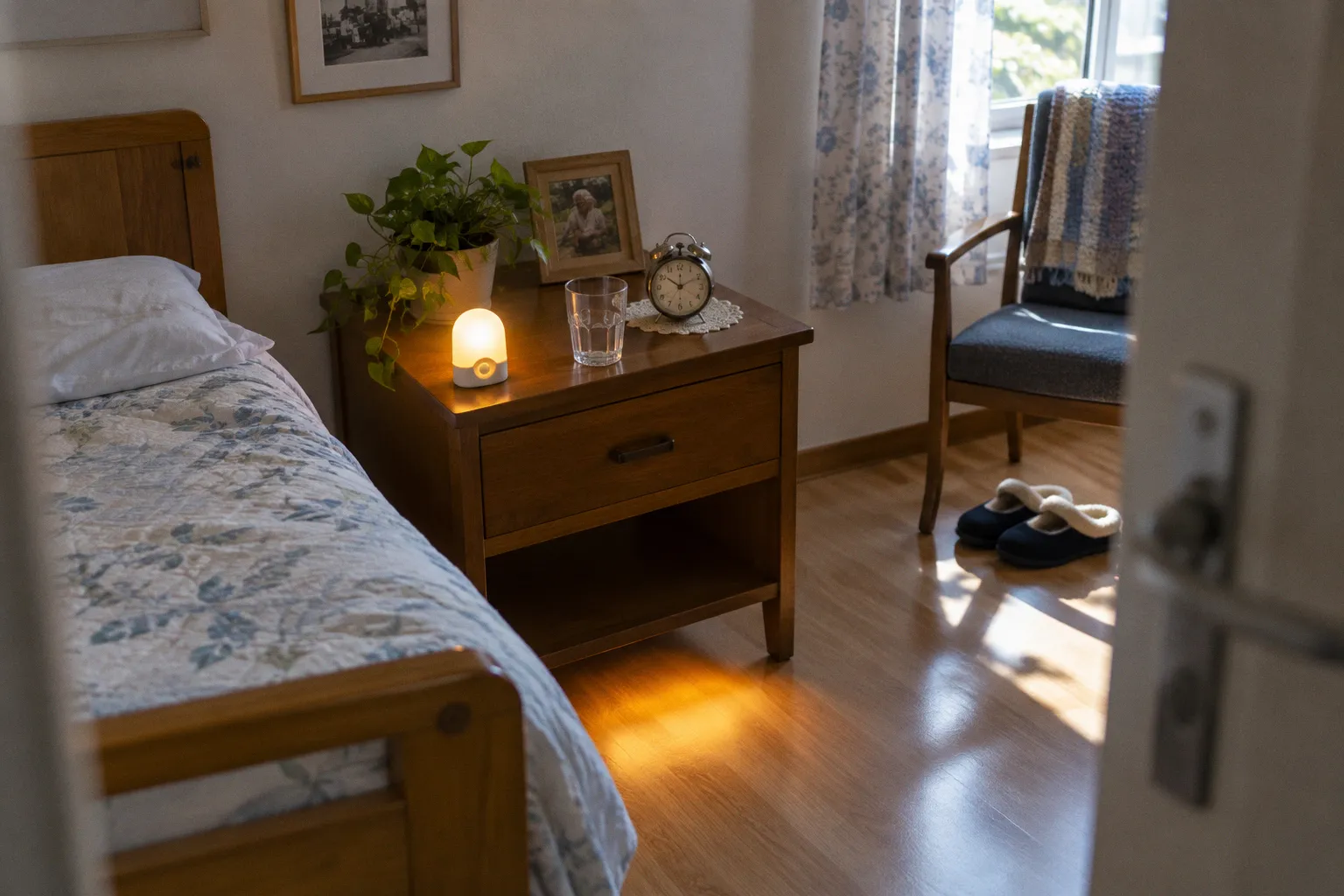
It should help caregivers respond to a behavioral expression before it becomes a missing-person emergency, reduce the time between a fall and assistance, and preserve as much privacy and normal routine as possible.
That balance matters because wandering is not an unusual event in dementia care. According to the Alzheimer’s Association, six in ten people living with dementia will wander at least once as the condition progresses, and many will wander repeatedly. When a person is missing, they are often found within 1.5 miles of the place where they were last seen—but that distance is still enough to create serious risk, particularly at night, near traffic, around water, or in severe weather.
For most homes and memory care settings, we would not begin with one universal device. We would match the monitoring approach to the person’s disease stage, mobility, sensory baseline, toileting pattern, sleep routine, and willingness to wear or interact with equipment. In practice, the strongest dementia alarm systems for home and facility use usually combine passive environmental monitoring with one additional layer: a door alarm, a bed sensor, a wearable device, or a caregiver paging system.
The best monitoring system is not the loudest one. It is the one that gives caregivers useful information early enough to respond without turning daily life into a security procedure.
Start with the behavioral expression, not the device
Wandering is often treated as a movement problem: a resident stands up, walks away, and needs to be located. That description is incomplete. Walking may express an unmet need, a search for familiarity, a disrupted sleep-wake cycle, a response to environmental triggers, or an attempt to follow a long-established routine.
A person may leave a room because they believe they are going to work. They may walk toward an exit because they are looking for a bathroom, trying to return home, or responding to an unfamiliar noise. Someone who repeatedly rises from bed may not be attempting to leave at all; they may be experiencing pain, urinary urgency, restlessness, or a change in medication effect.
An alarm cannot resolve those causes. It can, however, shorten the interval between movement and caregiver response. That is the central clinical value of monitoring technology.
Before choosing equipment, we recommend documenting a few practical observations:
- When does the movement occur? Evening and nighttime episodes may point toward sundowning-related changes, fatigue, lighting problems, or an inconsistent bedtime routine.
- Where does the person go first? The bathroom, kitchen, front door, another resident’s room, and a familiar workplace-related area each suggest different needs.
- What happens immediately before the movement? Noise, staff changes, bathing, meals, medication administration, and visitors can function as environmental triggers.
- Can the person use a button or wearable reliably? A device requiring deliberate action may work in early-stage dementia but become unreliable as cognition, dexterity, vision, or insight changes.
- How does the person respond to alerts? A loud alarm may prompt a safe pause for one resident and increase agitation for another.
This baseline determines whether you need an active alert, a passive alert, location information, or a combination. It also helps prevent a common mistake: installing equipment that generates notifications but does not improve the care response.
The four monitoring solutions at a glance
Each category solves a different part of the safety problem. The table below is a practical starting point rather than a substitute for an individualized risk assessment.
| Monitoring solution | Best suited to | Main strength | Main limitation |
|---|---|---|---|
| Door and exit sensors | People who approach exterior doors, restricted areas, or stairwells | Detects a possible exit attempt before the person is outside | Does not explain why the person is leaving or track them after departure |
| Bed and chair pressure sensors | Residents at risk of nighttime wandering or falls during transfers | Gives caregivers an early signal that a person has risen | Can create nuisance alerts if placement, timing, or sensitivity is poorly configured |
| Wearable GPS and SOS devices | People who can tolerate a wearable and may leave the monitored area | Can support location-finding and emergency communication away from home | Requires charging, wearing, network connectivity, and often some user cooperation |
| Motion-activated and passive environmental systems | Later-stage dementia, shared care settings, or people who reject wearables | Works without requiring the resident to press a button or carry a device | Passive alerts still require trained staff, clear escalation rules, and careful calibration |
The practical verdict is straightforward: door sensors are usually the first layer for exit risk; bed or chair sensors are more useful when falls and nighttime transfers are the central concern; wearables add value when the person will consistently use them; and passive environmental monitoring becomes increasingly important when active devices no longer match the person’s abilities.
Door and exit sensors: the most direct response to wandering risk
Door contact alarms for memory care are simple in concept. A sensor is placed on a door, and the system sends an alert when the door opens or when a designated threshold is crossed. Depending on the setup, the notification may reach a pager, mobile application, central console, or wireless caregiver paging system.
These systems are particularly useful when a person repeatedly:
- moves toward the front or back exit;
- attempts to enter a stairwell, garage, or parking area;
- leaves a bedroom or secured zone during the night;
- follows other people through an access-controlled doorway;
- opens a door during periods when staffing is reduced.
In a private home, the best installation is usually the least disruptive one that still provides a dependable signal. A conspicuous lock or institutional-looking barrier may protect a doorway but create new problems during ordinary routines. Research on home safety technology programs has found that caregivers often reject physical locking modifications when those modifications make the home feel institutional or inconvenient to use. That finding matters: a system that residents and families stop using is not a safety system in practice.
What door sensors can and cannot do
A door sensor provides a time-sensitive event: the door opened. It does not identify the person automatically unless paired with another technology, and it does not reliably tell you whether the person is heading outside, entering a room, or simply opening the door and turning around.
For that reason, placement should follow the behavioral pattern. Installing an alarm on every door can create alert fatigue and make it harder to identify the one event that requires immediate action. We generally prefer prioritizing:
1. exterior doors and doors leading to unsafe areas;
2. routes used repeatedly by the resident;
3. doors that are difficult for staff to observe directly;
4. exits near environmental hazards such as roads, water, or uneven ground.
The alert itself should be matched to the care environment. In a small home, a discreet phone notification may be enough. In a memory care community, staff may need a central alert that identifies the room or door and routes the message to the caregiver responsible for that area. A system that alerts everyone indiscriminately can produce confusion, especially during shift changes.
Privacy and dignity at the threshold
The goal is not to make the person feel watched or confined. We should avoid treating normal movement as misconduct. A resident may be allowed to walk freely indoors while the system quietly identifies movement toward a higher-risk exit.
That distinction is clinically meaningful. The device should support a response from caregivers, not replace one. When an alert sounds, staff should approach calmly, assess the person’s apparent need, and redirect with familiar language rather than immediately framing the movement as a problem.
Bed and chair pressure pads: useful when the critical moment is the transfer
Bed exit sensors for dementia patients are designed for a different situation. They do not primarily monitor where a person goes; they identify the moment when a person leaves a bed or chair. That early signal can be valuable for residents who are unsteady, who attempt nighttime toileting without assistance, or who begin walking before fully orienting to the environment.
A pressure pad may be placed beside or beneath a mattress, on a chair, or in another position specified by the manufacturer. When pressure changes, the system sends an alert. The caregiver can then check whether the resident needs toileting, pain relief, repositioning, reassurance, or assistance with a transfer.
This is most effective when the care team knows what action follows the alert. If the person usually rises at predictable times and staff are already nearby, an alarm may add little. If the person rises unexpectedly and has a history of falls, the same device may provide a meaningful safety interval.
The transfer is the clinical event
The important question is not simply whether the person leaves the bed. It is what happens next.
A resident who sits on the edge of the bed, waits, and calls for assistance presents a different risk from someone who immediately stands and walks in the dark. A person with orthostatic hypotension, reduced vision, neuropathy, or a recent change in mobility may need a response within moments. Someone else may need a less urgent check because they rise independently and remain stable.
Configure the alert around that distinction. Consider:
- whether the system can delay the notification briefly to avoid alerts from normal repositioning;
- whether it distinguishes a bed from a chair event;
- whether alerts are audible, visual, or routed to a pager;
- whether the pad can be cleaned and repositioned without losing reliability;
- whether the resident finds the device uncomfortable or attempts to remove it.
The exact false-alarm rate varies by model and setup, and there is no universal figure that applies across commercial bed alarm systems. In practice, nuisance alerts commonly arise from poor placement, movement of the pad, changes in mattress configuration, pets, or staff not following the same installation procedure. That is why the equipment should be reviewed after implementation rather than assumed to be correctly calibrated on day one.
When pressure sensors are the wrong first choice
A bed or chair sensor may not be the best solution if the primary concern is an exterior exit several rooms away. It may alert you that the person has stood up, but it will not tell you whether they are heading for the bathroom, a closet, or the front door.
It can also be a poor fit for a person who becomes distressed by alarms or who experiences repeated, medically appropriate movement throughout the night. Excessive alerts can lead caregivers to silence the system, delay responses, or stop taking notifications seriously. If the resident is waking frequently because of pain, urinary urgency, medication effects, or an untreated sleep problem, the clinical response must address those contributors rather than adding more alarms.
Wearable GPS and SOS devices: location support outside the monitored zone
Wearable fall and wandering monitors include GPS watches, pendants, and devices attached to clothing. Some provide an SOS button, while others send location information when the person leaves a designated area or moves beyond a defined boundary.
These systems are most useful in early-stage dementia, when the person can tolerate wearing the device and may still spend time outside a supervised environment. A wearable may support a person who walks independently, attends appointments, visits family, or lives at home with periods when the caregiver is not physically beside them.
The value is different from that of a door sensor. A door sensor tells you that a threshold was crossed. A GPS-enabled wearable may help you determine where the person is afterward. That can be an important distinction when the person has already left the building.
Still, these devices should not be presented as a complete solution. GPS tracking is not guaranteed to be perfectly accurate indoors, and operation depends on factors such as battery status, cellular connectivity, device placement, and whether the person continues to wear the device. The system may identify a general location rather than provide the precision needed to find someone inside a large building.
The person must be able to live with the device
The most technically capable wearable fails if the resident removes it, forgets to charge it, leaves it in a drawer, or becomes distressed by its presence. We should consider the person’s sensory baseline before introducing a watch, pendant, or clothing attachment.
Some people tolerate a familiar watch but resist a medical-looking pendant. Others dislike anything on the wrist but accept a device attached discreetly to clothing. A person with impaired vision or dexterity may be unable to press an SOS button even if they understand what it is intended to do.
During selection, look for a device and routine that the caregiver can sustain:
- The wearable should be comfortable across the full day, including sleep if overnight monitoring is needed.
- Charging should be simple enough that staff or family will complete it consistently.
- The alert pathway should be clear: who receives the notification, who calls the person, and who begins the search if the location is outside the expected area?
- The device should be checked after bathing, dressing, laundry, and transfers.
- Families and staff should know that a missing wearable is itself a safety signal.
A GPS device is best understood as one part of a response plan, not as permission to reduce supervision. It can improve location awareness, but it does not address the reason the person left or guarantee a safe return.
Motion-activated alerts and passive environmental monitoring
Motion-activated alert systems for seniors use infrared or other environmental sensors to detect movement in a defined area. They can be directed toward a hallway, doorway, bathroom route, or room where a fall may occur. Unlike a wearable, the system does not require the resident to remember, carry, or press anything.
Passive monitoring has become particularly important in later-stage dementia. As cognitive impairment advances, button use may no longer be dependable. The person may not understand the purpose of an SOS device, may remove it, or may be unable to communicate the event after a fall. Environmental sensors can continue to provide information without asking the resident to perform a task.
Camera-free systems add another layer of privacy protection. Some residential technologies, including under-floor smart detection systems such as Elsi Smart Floor, are designed to identify movement or falls without constant CCTV video surveillance. That can be a better fit for residents and families who are uncomfortable with cameras in bedrooms, bathrooms, or other private spaces.
Passive does not mean invisible or automatic
The absence of a camera does not remove the need for clinical judgment. A passive alert may indicate that a person moved in an unusual pattern, remained on the floor, entered a restricted area, or did not follow their normal route. Staff still need to interpret the information.
For example, an alert in a hallway may represent:
- a safe walk to the bathroom;
- a fall followed by limited movement;
- repeated pacing associated with anxiety or sundowning;
- a person entering another resident’s room;
- a change in gait or activity that should prompt a clinical review.
The system becomes more useful when the care team establishes a sensory and behavioral baseline. If staff know that a resident normally walks to the dining room after breakfast, they can recognize when the same person begins pacing in a dark corridor at 2 a.m. If a resident’s nighttime movement changes abruptly, that change may warrant assessment for pain, infection, medication effects, constipation, dehydration, or another medical issue.
Technology should help staff see the pattern. It should not be mistaken for the assessment itself.
Passive monitoring works best when it turns movement data into a timely care response—not when it becomes another stream of alerts that nobody has time to interpret.
Matching the system to the stage of dementia
The appropriate device often changes as the person’s abilities change. A system that worked well several months ago may become unreliable after a decline in memory, motor planning, judgment, or tolerance of sensory input.
Early-stage dementia
In early-stage care, a wearable GPS watch or SOS button may be practical if the person remains willing and able to use it. Door sensors can provide an additional layer at home, especially when the person has begun leaving unexpectedly but still moves independently.
At this stage, the care plan should focus on preserving autonomy while identifying risk. We do not need to treat every independent walk as an emergency. Instead, we establish where the person can move safely, which routes are familiar, and what events suggest a departure from their usual routine.
Mid-stage dementia
As cognition changes, passive door contacts, bed pressure mats, chair sensors, and motion detectors often become more dependable than devices requiring active participation. The resident may still wear a GPS device, but the team should not assume that it will remain on or charged without direct support.
Environmental triggers become increasingly important. Lighting transitions, unfamiliar caregivers, noisy dining rooms, locked doors, and abrupt schedule changes may increase pacing or exit-seeking behavior. Monitoring can identify when the behavior occurs, while care planning addresses the conditions that precede it.
Late-stage dementia
In later-stage care, passive environmental monitoring usually becomes the strongest foundation. Wearables and buttons may be difficult to use, uncomfortable, or confusing. A door sensor can identify an exit attempt, a bed sensor can indicate a transfer, and motion detection can help staff recognize unusual movement without placing a task on the resident.
At this point, the system should be quiet, consistent, and integrated into routine care. Residents may be more vulnerable to startling sounds and unfamiliar equipment. A discreet notification to staff is often preferable to a loud alarm in the room, particularly when a loud alert could increase distress or trigger further movement.
A practical selection process for homes and memory care communities
Choosing among dementia alarm systems for home and facility use is easier when we define the risk before comparing products. We suggest moving through the decision in this order.
1. Identify the highest-consequence event
Is the main concern an unsupervised exit, a nighttime fall, a delayed response to a bathroom transfer, or a resident becoming unlocatable after leaving the building? Select the first layer around that event.
A door sensor is not a substitute for a fall-detection strategy. A GPS wearable is not a substitute for overnight bed monitoring. The system should address the event most likely to cause serious harm.
2. Decide whether the resident can participate
Ask whether the person can remember to wear, charge, carry, and use the device. If the answer is inconsistent, choose a passive layer even if a wearable is also used.
The more advanced the dementia, the less we should depend on the resident’s ability to activate an alert. This is not a matter of cooperation or motivation. It reflects changes in executive function, sequencing, perception, and motor planning.
3. Map the care response
Every notification should have a defined destination and response. Determine:
- who receives the alert;
- how quickly that person can reach the resident;
- what information appears with the notification;
- who covers the alert during breaks and shift changes;
- what happens if the alert is not acknowledged;
- how the event is documented and reviewed.
A device cannot compensate for an unclear staffing workflow. In a facility, the alert must fit the actual layout and staffing model, not an idealized one.
4. Protect the person’s privacy
Consider camera-free options where appropriate, particularly in bedrooms and bathrooms. Use the least intrusive technology that provides enough information for a safe response. The purpose is not continuous surveillance; it is timely awareness of meaningful changes and high-risk movement.
5. Reassess after the person’s routine changes
New nighttime walking, repeated exit-seeking, or a sudden rise in alerts may indicate more than a need for new equipment. The team should review pain, toileting, infection symptoms, medication changes, sleep disruption, hearing and vision, hydration, and environmental triggers.
A monitoring system should evolve with the person. Reassessment is part of safe use, not evidence that the original selection was a failure.
What we would choose in common situations
For a person living at home who occasionally walks outside but can reliably wear a device, we would generally consider a wearable GPS monitor with an SOS function, paired with door contact alarms at the most concerning exits. The GPS device adds location support; the door sensor provides an earlier signal.
For a resident who rises repeatedly at night and has an unstable transfer, a bed pressure sensor may be more relevant than GPS. If the resident also approaches an exterior door, the bed sensor and door sensor address separate points in the same risk pathway.
For a person in later-stage dementia who removes wearables, we would prioritize passive environmental monitoring, with door and motion sensors placed around the highest-risk routes. In a facility, camera-free monitoring may offer a useful compromise between staff awareness and resident privacy.
For a person whose alerts are frequent but whose clinical condition is stable, we would not immediately increase the number of devices. We would first review whether the alerts correspond to meaningful risk, whether the equipment is positioned correctly, and whether the resident is responding to an environmental trigger that can be addressed through routine, lighting, activity, or reassurance.
Our verdict
There is no single best dementia alarm system for every home, resident, or stage of cognitive change. The most reliable approach is layered and individualized:
- use door and exit sensors when the primary risk is leaving a safe area;
- use bed and chair pressure sensors when transfers and nighttime falls are the immediate concern;
- use wearable GPS and SOS devices when the person can tolerate them and may move beyond supervised areas;
- use motion-activated and passive environmental monitoring when active device use becomes unreliable or privacy concerns make cameras inappropriate.
The strongest system is the one that matches the person’s behavioral expression, sensory baseline, and actual care environment. It should alert early enough to support a calm response, but not so aggressively that caregivers stop trusting the information.
Our goal is not to eliminate every instance of movement. People living with dementia still need agency, familiarity, activity, and dignity. Good monitoring creates a safer boundary around those needs while helping caregivers respond to the person rather than merely reacting to a device.
FAQ
What is the best way to prevent a person with dementia from wandering?
How do I choose between a wearable device and a passive monitoring system?
Why do I keep getting false alarms from my bed pressure sensor?
Do door sensors track where a person goes after they leave?
Should I use cameras to monitor a person with dementia?
Related articles
 Memory & Cognitive CareDementia care facility transitions: common pitfalls to avoid
 Monroe Community Hospital Launches Friendship Place for Specialized Memory Care
 Memory & Cognitive CareSensory Stimulation Tools for Dementia by Stage
 Memory & Cognitive CareCircadian Lighting for Sundowning: What Our 6-Week Test Showed