Validation therapy for dementia: clinical benefits and limits

Validation Therapy for Dementia: Clinical Utility and Limits
The Evolution of Validation: Moving Beyond Reality Orientation
For decades, the dominant instinct in dementia care was correction. When a resident insisted they needed to catch a bus to work, or that their long-deceased mother was waiting in the lobby, the conventional wisdom held that caregivers should gently reorient them: present date, location, and circumstance until the confusion lifted. We have all seen this approach — the well-meaning family member holding up a newspaper, the nurse patiently repeating today's date, the activity director leading a reality orientation board game. In moderate to late-stage dementia, however, this instinct often produces the opposite of what we intend. The person does not become oriented. They become frightened, agitated, or withdrawn. Validation therapy emerged, in part, from this clinical gap.
Naomi Feil developed the validation method between 1963 and 1980 while working as a social worker in Cleveland nursing homes. She observed that residents labeled "disoriented" were often responding coherently to an internal emotional reality — grief, longing, the wish to be useful, the need to feel safe — even when their factual statements no longer mapped to the present world. Where traditional reality orientation pressed the facts forward and demanded alignment, validation asked a different question: what is this person feeling right now, and how can we meet them there.
This shift reframes behavioral expression not as a symptom to be corrected but as communication to be decoded. A man searching for his briefcase at three in the morning may not need reminding that he retired twenty years ago. He may need to feel, for a moment, that his life still has purpose and routine. Validation does not abandon accuracy; it acknowledges that emotional accuracy and factual accuracy are not the same task.
Validation does not ask us to abandon the truth. It asks us to recognize which truth the person in front of us can actually receive.
Where Reality Orientation Falls Short
In early-stage dementia, orientation cues — calendars, clocks, name tags, structured daily announcements — retain genuine utility. The person can still absorb and update new information, and gentle reminders support independence. As cognitive decline progresses, the neurology changes. Short-term memory, factual recall, and the ability to integrate new information deteriorate. Pushing factual correction at this stage asks the brain to do something it increasingly cannot do.
That mismatch generates distress. The resident who is told, again, that their husband died years ago does not learn the date. They relive the grief, often without the cognitive scaffolding to integrate it. The repeated correction becomes, in practice, repeated trauma. We have watched this play out in our communities — residents who were once calm becoming weepy, combative, or shut down after well-meaning reality checks.
Validation therapy does not reject factual grounding entirely. It repositions grounding as one tool among several, weighted toward the stage of the disease and the emotional state of the person in front of you.
| Parameter | Validation Therapy | Reality Orientation |
|---|---|---|
| Primary goal | Acknowledge emotional reality | Reinforce factual awareness |
| Stage indicated | Moderate to late-stage dementia | Early-stage dementia primarily |
| Approach to factual errors | Listen for the feeling beneath; do not confront | Correct gently and redirect to present |
| Caregiver posture | Curious, empathic, mirroring | Informative, directive, anchoring |
| Observed strengths | Reduces agitation and emotional distress; supports dignity | Maintains cognitive engagement early; supports daily function |
| Documented limits | Limited large-scale RCT evidence; depends on caregiver skill | Can increase distress in later stages; risk of repeated trauma |
Navigating the Four Stages of Disorientation
Feil's framework identifies four stages of disorientation that progress alongside cognitive decline. Understanding where a resident sits on this continuum helps caregivers calibrate their approach — because validation, like any clinical method, is not a one-size-fits-all protocol.
Malorientation
In this earliest stage, the person uses facts selectively. They may hide loss behind a façade, claim the dead are living, or invent cover stories for memory lapses. Reality orientation often still works here, but Feil argued that the underlying anxiety deserves acknowledgment. A resident who insists their spouse is at work may be processing the terror of abandonment. Validation at this stage involves gentle listening, identifying the emotion beneath the fact, and offering reassurance without forcing confrontation.
Time Confusion
Here, the person moves out of the present and into the past. They may believe they are children again, seek parents long gone, or relive decades-old roles — the teacher, the soldier, the mother of young children. Reality orientation becomes counterproductive. Validation techniques center on joining the person's timeline, asking about the people they are looking for, listening to the memories being revisited, and offering emotional resonance rather than date-stamping.
Repetitive Motion
In this stage, the person may pace, rock, or repeat the same phrase or gesture for hours. Verbal engagement often gives way to non-verbal cues. Validation shifts heavily toward tone, eye contact, touch (where welcomed), and music. The caregiver's task is less about conversation and more about presence — about being a steady, calm anchor in a world the person can no longer narrate.
Vegetation
In the final stage, the person withdraws. Movement may slow to near-stillness, and verbal communication often ceases. Feil's approach here is one of respect and sensory connection: a familiar voice, a beloved song, the warmth of a hand. Validation at this stage is less a technique than a posture — the recognition that even in withdrawal, the person's emotional life persists.
These stages are not a rigid ladder. A resident may move among them within a single day, especially during sundowning episodes or acute illness. Our clinical practice is to read the moment rather than the chart.
Core Techniques for Empathetic Caregiver Communication
Validation is best understood as a set of habits rather than a script. The method is teachable, but its character is conversational. Here are the techniques our care teams rely on most often.
Centering and Matching
Before we can validate, we have to be present. Centering means clearing our own agenda — the medication pass, the next appointment, our own grief about the disease — and arriving at the interaction ready to listen. Matching means adjusting our pace, tone, posture, and breathing to the resident's. A person who is agitated will not calm in response to a brisk, businesslike tone. Slowing down, lowering our voice, and softening our posture invites the nervous system to follow.
Open and Genuine Questions
Instead of confronting the person with facts they cannot hold, we ask about the experience itself. "Tell me about your mother. What was she like?" The open question invites storytelling rather than defense. It also gives us access to the emotional content underneath the factual confusion — which is, in practice, what we need to respond to.
Rephrasing and Reflecting
Repeating the person's words back, slightly reorganized, signals that we heard them. "You miss your father. You're worried about him." This is not parroting; it is reflective listening. It confirms that their experience has been received, which often reduces the urgency of the repetition itself.
Maintaining Eye Contact and Using Touch Appropriately
In moderate to late stages, non-verbal cues carry more weight than words. A steady gaze, a hand placed gently on the forearm (when the person invites it), a sitting position at their level rather than standing over them — these are validation in action. We always check for the individual's response to touch. Some residents find it grounding; others find it intrusive. Reading the response matters more than applying the technique.
Using Sensory Anchors
Music from the person's youth, familiar scents, photographs from earlier decades, the texture of a well-worn blanket — sensory memory often outlasts verbal memory in dementia. Validation uses these anchors deliberately. We do not insist that the resident identify the photo; we ask who they see in it, what the moment felt like, what the day was like. The goal is emotional connection, not factual accuracy.
Avoiding the Lying Trap
This is where families and even seasoned staff get nervous. If a resident asks where their mother is, are we being dishonest when we offer comfort? Feil's framework distinguishes between fabrication and validation. Fabrication serves the caregiver's convenience. Validation acknowledges the emotional reality without confirming facts that cannot be confirmed. We do not promise a dead parent is coming to visit. We also do not insist on delivering grief news in a moment when the person cannot integrate it. The clinical call depends on the person and the moment.
Clinical Outcomes and the Evidence Gap
Validation therapy is widely adopted across memory care settings in the United States and Europe, and the observational literature is largely positive. Studies and clinical reports describe reductions in agitation, pacing, verbal aggression, and distress among residents receiving validation-based communication. Caregivers — both family and professional — report lower emotional strain and a decreased reliance on psychotropic medications to manage behavioral expression. These outcomes matter. Behavioral symptoms are among the most common reasons families cite for moving a loved one into residential care, and any non-pharmacological approach that meaningfully reduces them has real clinical weight.
The empirical picture, however, is more complicated. Systematic reviews by the Cochrane Collaboration have examined validation therapy in randomized controlled trials and concluded that while individual small studies show benefit, the overall RCT evidence base is statistically thin. Sample sizes are small, protocols vary, blinding is difficult (you cannot easily blind a therapist to the method they are delivering), and outcome measures are heterogeneous. That does not mean validation does not work. It means we do not yet have the kind of large-scale, multi-center trial data that would let us claim, with high confidence, that validation outperforms every other emotion-oriented approach.
This is an honest place to stand. Validation therapy is a well-developed clinical method with a coherent theoretical base, decades of practitioner experience, and consistent observational support for its value. It does not, at present, carry the level of RCT proof that would satisfy a strict evidence-based medicine threshold. Families and care planners should know this. They should also know that absence of definitive RCT proof is not the same as absence of effect, and that the gap reflects the difficulty of rigorously testing complex relational interventions — not necessarily the failure of the intervention itself.
One finding from caregiver video studies illustrates the practical challenge clearly. When homecare interactions were coded, direction-and-information strategies — telling the person what to do, where they are, what is happening — appeared at roughly twice the frequency of validating responses. In other words, even trained caregivers tend to default toward correcting and instructing rather than meeting the person where they are emotionally. The technique has to be deliberately practiced, not assumed.
Absence of definitive trial proof is not the same as absence of effect. Caregivers deserve to know both halves of that sentence.
Strategic Boundaries: When and How to Apply Validation
Validation is not a license to avoid every difficult conversation, nor is it appropriate in every moment. A few boundaries deserve attention.
First, validation applies to emotional reality, not unsafe behavior. If a resident wants to leave the building to catch a bus that does not exist, we can validate the feeling — the wish to be useful, the need to be somewhere — while still ensuring their physical safety. Wandering prevention protocols and elopement safeguards remain non-negotiable, and no relational technique overrides resident safety. The framework is empathic, not permissive.
Second, validation works best as a default, not a switch. If we apply reality orientation in the morning and validation only at sundown, residents experience the inconsistency as jarring. Care teams that integrate validation into their daily communication — the way they greet residents, the way they respond to repeated questions, the language they use during personal care — see better outcomes than teams that treat validation as a special intervention deployed during crises.
Third, validation is teachable but not instinctive for everyone. Caregivers come to this work with different cultural backgrounds, family histories, and personal comfort with emotional exposure. Training matters. The four formal levels of Naomi Feil's certification framework — Validation Worker, Group Practitioner, Teacher, and Master — exist precisely because the method rewards depth of practice. We do not expect every staff member to achieve Master status, but we do invest in ongoing coaching because shallow validation can read as condescension, and condescension is the opposite of what the person needs.
Fourth, validation is a complement to medical care, not a replacement. Underlying pain, infection, dehydration, medication side effects, and environmental triggers — all of these can produce behavioral expression that mimics or amplifies disorientation. We have to look at the whole picture. Validation sits on top of competent clinical assessment; it does not substitute for it.
Validation is not a special intervention we deploy during a crisis. It is the posture we bring to every interaction.
A Practical Starting Point for Families
If you are a family member reading this and wondering where to begin, we would suggest three habits. First, when your loved one says something that does not match the present, ask yourself what feeling is driving the statement before you decide whether to correct it. Second, slow down. Match their pace and tone. Third, give yourself permission to feel whatever comes up — frustration, grief, helplessness. Validation is not performed; it is offered. The moments when you cannot offer it are human, and they do not undo the moments when you can.
Closing Position
Validation therapy is one of the most useful communication frameworks we have for moderate to late-stage dementia. It treats behavioral expression as meaning rather than error, and it equips caregivers with techniques that preserve dignity while reducing distress. The evidence base is observational and practitioner-driven rather than RCT-conclusive, and we should be honest about that. What we should not do is withhold a method that clearly helps people in our care simply because the trial data has not yet caught up to the bedside experience.
Our recommendation, both for families and for clinical teams, is to learn validation well, integrate it into daily practice, and pair it with rigorous medical and behavioral assessment. The method does not promise a cure, and it does not halt neurodegenerative progression — no relational approach can — but it offers something that medication cannot: the experience of being met, even when the facts have slipped away.
FAQ
What is the difference between validation therapy and reality orientation?
Is validation therapy effective for all stages of dementia?
Does using validation therapy mean I have to lie to the person with dementia?
Can validation therapy replace medical treatment for dementia?
What should I do if a person with dementia is in danger while being disoriented?
Related articles
 Memory & Cognitive CareDementia care facility transitions: common pitfalls to avoid
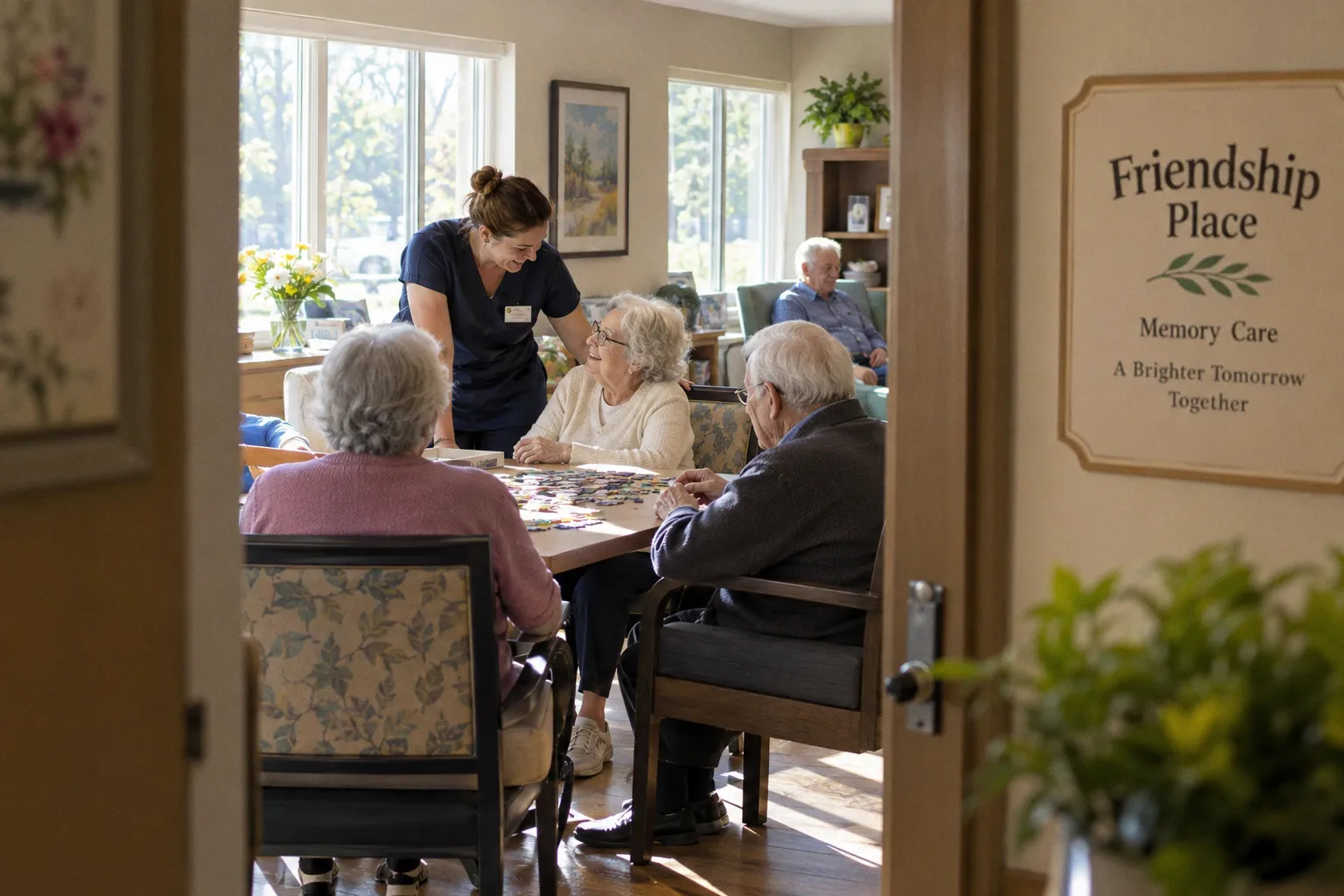 Monroe Community Hospital Launches Friendship Place for Specialized Memory Care
 Memory & Cognitive CareSensory Stimulation Tools for Dementia by Stage
 Memory & Cognitive CareCircadian Lighting for Sundowning: What Our 6-Week Test Showed