Circadian Lighting for Sundowning: What Our 6-Week Test Showed
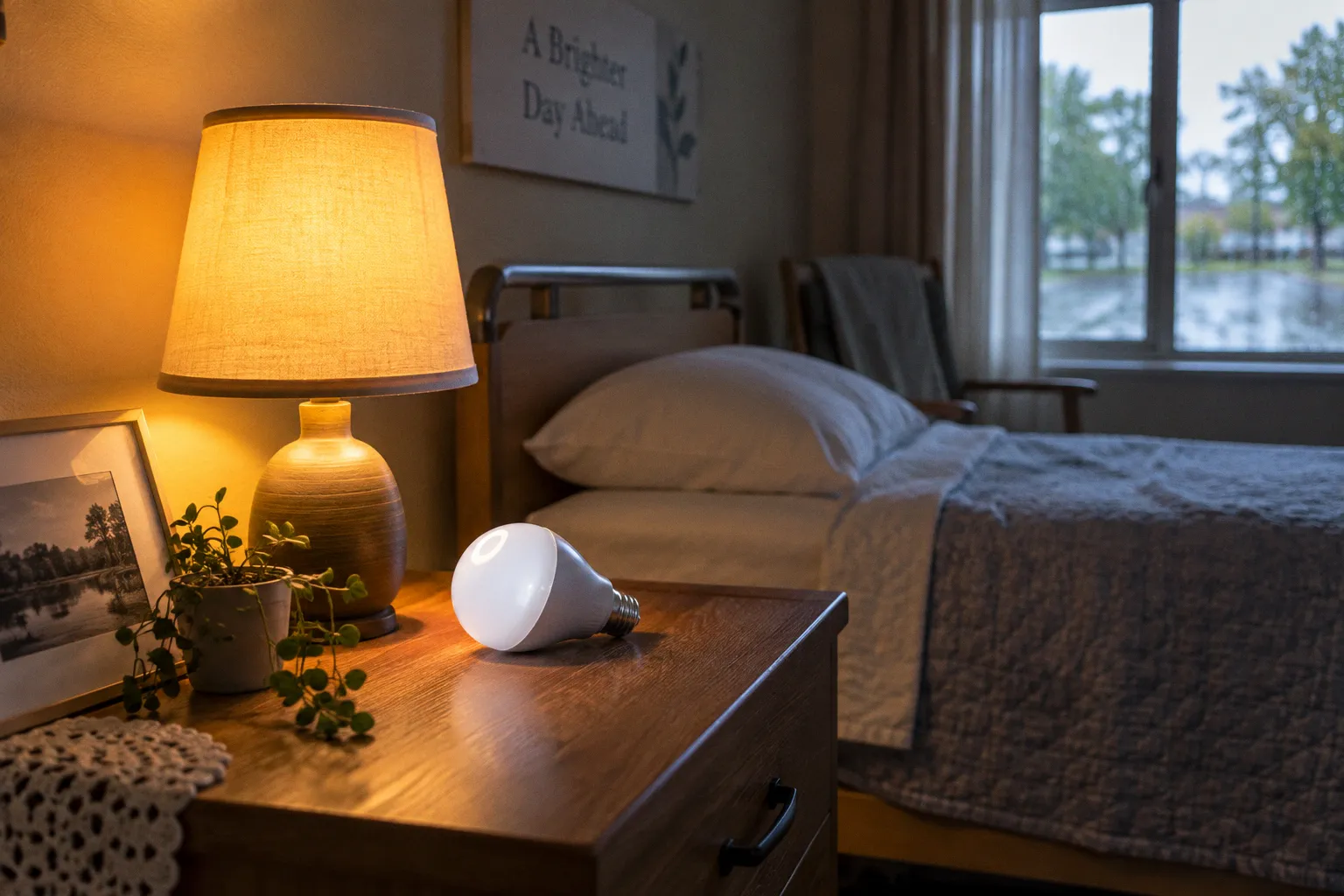
By dinner, other residents may be tearful, restless, or refusing to sit down.
This is sundowning, and anyone who works in memory care recognizes its rhythm. The pattern is common, but it is not inevitable, and it is not explained by behavior alone. Late-day agitation can reflect fatigue, unmet needs, pain, medication effects, changes in routine, overstimulation, or a failing internal clock. The physical environment matters too, particularly the light residents receive across the day.
The six-week test described here should be read as an illustrative clinical case study rather than a documented Forsyth Nursing trial. It shows how a memory-care team can think about circadian lighting, structure an observation period, and interpret behavioral changes without presenting an unverified facility-specific result as established evidence. The broader clinical rationale comes from research on light exposure, sleep-wake disruption, and dementia care.
The goal is not to present circadian lighting as a miracle or a marketing pitch. It is to look closely at what the intervention is designed to do, what a care team can reasonably measure, and where caution is still necessary.
The Physiology of Sundowning and Circadian Disruption
Sundowning is not a single symptom. It is a cluster of behavioral expressions: agitation, confusion, restlessness, pacing, mood changes, exit-seeking, and difficulty settling in the late afternoon or evening. The term is imperfect because the pattern does not always begin at sunset, and it does not appear in exactly the same way for every resident. Still, the timing is familiar enough that memory-care teams often recognize it before they can explain it.
Several factors may converge at the end of the day. A resident may be tired after hours of activity but unable to communicate that fatigue. The dining room may become louder and more crowded. Staff shift changes can alter the rhythm of the neighborhood. Shadows become longer, visual contrast changes, and familiar spaces may look different. A resident who already has difficulty interpreting the environment may experience these small shifts as disorienting.
Circadian disruption adds another layer. The circadian system coordinates sleep, wakefulness, hormone release, body temperature, and daily alertness. In people living with Alzheimer’s disease and other dementias, this system may become less stable as the disease progresses. The suprachiasmatic nucleus, a region of the hypothalamus that helps regulate the body’s master clock, can be affected by neurodegenerative changes. The signal that distinguishes daytime from nighttime becomes weaker, less precise, or more easily disrupted.
The result may be a combination of daytime sleepiness, nighttime waking, early-morning confusion, and evening agitation. A resident may nap through activities, remain awake during the night, and then become unsettled when the day is already ending. This is not simply a matter of poor behavior. It is often a sign that the resident’s sleep-wake rhythm and the surrounding environment are no longer reinforcing one another.
Light is one of the strongest external cues for the circadian system. Specialized retinal cells respond to light and send information to the brain’s clock-regulating structures. Daytime light supports alertness and helps the body distinguish the active part of the day from the period intended for rest. In the evening, lower and warmer light allows the body to begin moving toward sleep.
That distinction is often missing indoors. A common area may look adequately illuminated to staff while still providing a weak biological signal to residents. Overhead fixtures may remain at nearly the same intensity and color temperature from breakfast through bedtime. A person can spend most of the day under relatively static light and then be expected to fall asleep in the same visual environment a few hours later.
The question is not simply whether a room is bright enough to see. It is whether the light is giving the body a useful message about what time of day it is.
Circadian lighting works from that premise. It does not replace dementia care, behavioral assessment, medical review, or human reassurance. It attempts to restore a daily environmental cue that indoor living and dementia may have weakened.
Implementing Dynamic Light Protocols: Intensity and Spectrum
“Circadian lighting” is sometimes used loosely to describe any bright fixture. That is a mistake. A brighter room is not automatically a biologically effective room, and a high-intensity light that remains unchanged all day can create a different set of problems in the evening.
A dynamic system is designed to change over time. During the daytime, it provides stronger illumination and often a cooler, blue-enriched spectrum associated with alertness. As the afternoon progresses, the system gradually reduces intensity and shifts toward warmer tones. In the evening, ambient lighting should be lower and less stimulating, while still being sufficient for safe movement, toileting, dining, and staff observation.
The relevant measure is not only what the fixture produces but what reaches the resident’s eyes. Lux readings can vary with mounting height, room layout, surface color, furniture placement, daylight from windows, and the position of the person receiving the light. Measuring at a desk or tabletop may not provide the same information as measuring at eye level in the place where residents actually sit.
Research protocols have often used daytime exposure in the approximate range of 1,000 to 3,000 lux, sometimes for a defined period in the morning or across several daytime hours. Ordinary indoor lighting may be considerably lower. These ranges should not be treated as a universal prescription for every room or resident. They are reference points that help a team understand why a standard overhead installation may not deliver the same effect as a deliberate circadian protocol.
A practical system should account for several variables:
- Daytime intensity: The light must be strong enough to provide a meaningful daytime cue without creating glare or discomfort.
- Spectral composition: The system may use a cooler, blue-enriched daytime setting and a warmer evening setting, but the change should be gradual.
- Transition speed: Abrupt shifts can be disorienting, especially for residents with impaired visual processing.
- Glare and contrast: High output is not useful if residents avoid the room because the fixtures are uncomfortable or create harsh reflections.
- Nighttime safety: Lower light does not mean darkness. Hallways, bathrooms, and routes to common areas still need safe, appropriately placed illumination.
- Individual tolerance: Cataracts, macular degeneration, photosensitivity, headaches, medication effects, and other conditions can change how a resident experiences the same light.
The programming should follow the rhythms of the neighborhood rather than a generic clock schedule. A memory-care unit with early breakfasts and early bedtime may need a different transition than one where residents remain active later in the evening. Seasonal daylight also changes the background environment, particularly in rooms with large windows.
The first step is therefore not purchasing fixtures. It is measuring the existing environment and mapping how residents use each space. Which room receives the strongest daylight? Where do residents spend the morning? Where does evening agitation cluster? Are residents sitting under the same dim light throughout the day? Does the dining room become visually harsh when the room is full?
These questions prevent a common implementation error: treating circadian lighting as an equipment upgrade rather than a care intervention.
A Six-Week Illustrative Case Study
A useful six-week evaluation begins with a clear limitation: it is an observation period, not proof of clinical efficacy. Without randomization, a comparison group, blinded assessors, or strict control of other variables, the team cannot claim that lighting alone caused every change. Seasonal conditions, staffing patterns, medication changes, illness, activity programming, and resident turnover may all influence behavior.
The case-study model is still useful because it gives a care team a disciplined way to observe. Instead of saying that a new lighting system “seemed to help,” staff can define what they are watching, record it consistently, and discuss whether the pattern is strong enough to justify continuing or adjusting the intervention.
A reasonable six-week structure might look like this:
Before installation
The team first establishes a baseline using existing documentation. The aim is not to create an elaborate research system that staff cannot maintain. It is to capture enough information to understand the usual pattern.
Relevant observations may include:
- The time of day when agitation most often begins.
- Pacing, exit-seeking, calling out, or refusal of care.
- Whether several residents escalate at the same time.
- Daytime napping and participation in activities.
- Nighttime awakenings, redirection, and out-of-bed episodes.
- Environmental triggers such as noise, crowded dining periods, or shift changes.
- Individual differences between residents rather than only neighborhood-wide impressions.
The baseline should cover enough ordinary days to show variation. A single difficult afternoon is not a baseline, and neither is one unusually quiet night.
Week one: adjustment
The first week after a lighting change may be uneven. Some residents may appear more alert in the morning. Others may react to unfamiliar brightness, changed shadows, or the gradual evening transition. Staff may also need time to understand how the new environment affects activities, mealtimes, television viewing, and rest periods.
This adjustment period should not be treated as a failure. Residents with dementia may need repeated exposure before a change becomes familiar. Staff should watch for discomfort, squinting, headache-like behavior, increased avoidance of the room, or signs that the transition is too abrupt.
At the same time, the team should avoid explaining every new behavior as an adjustment to light. A sudden change may indicate pain, infection, medication effects, constipation, dehydration, poor sleep, or another clinical issue. Environmental interventions work best when they are part of ordinary clinical vigilance, not a substitute for it.
Weeks two and three: looking for patterns
Once the novelty has faded, staff can begin comparing current observations with the baseline. The useful question is not whether every episode disappears. The useful questions are whether episodes begin later, resolve more easily, cluster less often, or become less intense.
The team should also look for unintended effects. A resident may be calmer in the dayroom but more restless in a hallway with poor contrast. Another may remain awake longer in the morning but become overtired in the evening. A neighborhood-wide average can hide these individual responses.
Weeks four through six: assessing consistency
By the later weeks, the team can ask whether any apparent improvement is stable across different days and different staff members. A pattern that appears only on activity-heavy days may have a different explanation from a pattern that persists across routine changes.
The evaluation should include both behavioral and sleep-related observations. If evening agitation decreases but nighttime waking increases, the intervention may need adjustment. If residents are more engaged during the day and sleep more consistently at night, the findings are more coherent, though they still do not establish causation.
The most credible conclusion is usually modest: the lighting change was associated with a favorable, unfavorable, or unclear pattern, and further monitoring is warranted.
Measuring Behavioral Shifts and Nocturnal Sleep Quality
Behavioral documentation is difficult because behavior is not a laboratory variable. Two staff members may describe the same episode differently. One may record “agitated,” while another records pacing, repetitive questioning, or resistance to care. A useful protocol translates broad labels into observable actions.
For example, staff might record:
- What happened immediately before the episode.
- The behavior that was observed.
- How long redirection or reassurance took.
- Whether the resident accepted food, fluids, toileting, or a quieter space.
- Whether the episode involved risk of exit, fall, or harm.
- What intervention was used and whether it helped.
- Whether similar behavior occurred again later.
This approach is more informative than simply marking a resident as calm or agitated. It also protects against the tendency to remember unusually difficult evenings more clearly than ordinary ones.
The late-afternoon window deserves particular attention, but the rest of the day cannot be ignored. If residents are sleeping through morning activities, the problem may be occurring before sundowning begins. Daytime alertness, exposure to light, movement, social interaction, and meal timing all influence the evening period.
Sleep documentation should be equally concrete. Staff can track awakenings that require assistance, calling out, wandering, prolonged wakefulness, and the amount of redirection needed. A resident who wakes briefly and settles independently is not experiencing the same disruption as a resident who remains awake and distressed for a prolonged period.
A simple comparison framework can help a team organize observations without pretending to produce laboratory-grade evidence:
| Domain | Baseline questions | During the lighting evaluation |
|---|---|---|
| Late-afternoon behavior | When does agitation usually begin? Does it cluster among residents? | Does the timing, intensity, or clustering change? |
| Daytime alertness | Who naps through activities or meals? | Are residents more awake and engaged during daytime programming? |
| Evening transition | What happens during dinner, shift change, and the move toward bedtime? | Is the transition smoother, unchanged, or more difficult? |
| Nighttime sleep | How often do residents wake, call out, or require redirection? | Are sleep periods more continuous, or are new disruptions appearing? |
| Staff workload | Which periods require the most simultaneous intervention? | Does the timing or concentration of workload change? |
| Resident comfort | Are there signs of glare, visual discomfort, or avoidance? | Does the new system appear tolerated across different spaces and times? |
The staff’s experience matters, but it should not be the only measure. A quieter shift may reflect better sleep, fewer residents present, a change in assignments, or simple day-to-day variation. Conversely, a resident may be more comfortable even when the documentation does not show a dramatic reduction in episodes.
This is where cautious language matters. “Staff observed fewer clustered episodes during several evening transitions” is more defensible than claiming that the lighting reduced agitation by a specific percentage. “Several residents appeared more engaged in morning activities” is more useful than presenting an exact improvement unsupported by formal assessment.
Integrating Light Therapy into Standard Memory Care
Circadian lighting is most useful when it becomes part of ordinary care rather than a standalone project owned by one enthusiastic staff member. The system needs a purpose, a schedule, a monitoring process, and someone responsible for reviewing whether the environment is working as intended.
A practical implementation can begin with six decisions.
1. Measure the current light before changing it.
Take readings in dayrooms, dining areas, activity spaces, corridors, and bedrooms at different times. Note daylight from windows, fixture placement, glare, shadows, and the locations where residents actually sit. A room can have a strong reading in one spot and a weak one where residents spend most of their time.
2. Start with the space that shapes the daytime routine.
A central dayroom or dining area may be more influential than a rarely used lounge. Retrofitting an entire building at once is not always necessary. A carefully evaluated starting area can reveal practical problems before the intervention expands.
3. Use a programmed day-to-evening transition.
A static bright-light installation misses half of the concept. Daytime light should support alertness, while evening light should become warmer and less stimulating. The change should be gradual enough that residents experience it as a normal part of the day.
4. Train staff to recognize both benefit and discomfort.
Staff should know why the lighting changes, what observations to document, and which signs require attention. A resident who squints, avoids a seat, rubs the eyes, or becomes distressed in a particular area may be telling the team that the setting is not appropriate for everyone.
5. Keep the clinical review in place.
A change in agitation should never be attributed to lighting without considering pain, infection, medication changes, constipation, dehydration, sleep deprivation, depression, delirium, or unmet needs. Circadian lighting is a non-pharmacological strategy, not a diagnostic explanation for every late-day behavior.
6. Review outcomes with humility.
If the pattern improves, ask whether the improvement is consistent and whether other changes occurred at the same time. If nothing changes, do not force a positive conclusion. The system may need a different schedule, better placement, more consistent exposure, or may simply not be the right intervention for a particular resident or neighborhood.
Medication management also requires care. A favorable response to a lighting intervention does not automatically justify reducing a prescribed medication. Any change in medication should remain under the direction of the attending physician or medical director. The responsible sequence is to observe, document, review, and then make clinical decisions through the appropriate process.
There are also design issues that are easy to overlook. Bright daytime lighting can expose dusty fixtures, uneven paint, glare on polished floors, or confusing reflections. Residents with low vision may need stronger contrast rather than indiscriminately brighter light. A warm evening setting should not make bathroom routes difficult to navigate. Bedrooms may require a different balance from common areas because residents need both sleep support and safe nighttime movement.
The intervention should also fit the emotional character of the neighborhood. Memory care is not a laboratory in which every variable can be controlled. Residents have preferences, histories, visual impairments, sleep habits, and changing abilities. A technically elegant lighting schedule that makes a resident uncomfortable is not a successful care plan.
Where This Leaves Us
Circadian lighting does not cure sundowning. It does not eliminate evening agitation, and it will not produce the same response in every resident. The effect may depend on disease stage, vision, sleep history, individual circadian biology, medication, daylight exposure, and the quality of the surrounding care routine.
What it can do is address one part of the environment that memory care has often treated as background. Light is not decoration. It is information. It tells the body when to be alert, when to begin winding down, and when the day has changed. For a person whose internal clock is already vulnerable, a consistent external signal may be useful.
The strongest case for circadian lighting is not that it creates dramatic before-and-after results. It is that it offers a relatively low-burden way to improve the daily environment while preserving the other parts of good dementia care: reassurance, movement, meaningful activity, medical assessment, familiar routines, and human attention.
A six-week observation can help a team ask better questions. Are residents more alert during the day? Are evening transitions less chaotic? Are nighttime awakenings less disruptive? Does the intervention help some residents while irritating others? Are staff seeing a genuine pattern or simply remembering a few unusually good nights?
Those questions are more valuable than an unsupported claim of success.
Preserving dignity in memory care is rarely about a single dramatic intervention. It is the accumulation of small, evidence-informed decisions: the right light at the right time, a calmer transition into evening, a room that is easier to interpret, and expectations that match what the intervention can actually do.
Circadian lighting deserves a place in that conversation — not as a replacement for care, but as part of the care environment itself.
FAQ
What is circadian lighting for sundowning?
Can circadian lighting cure sundowning?
How is circadian lighting evaluated over six weeks?
What kind of light is used during the day and evening?
What problems can occur when introducing circadian lighting?
Related articles
 Memory & Cognitive CareDementia care facility transitions: common pitfalls to avoid
 Monroe Community Hospital Launches Friendship Place for Specialized Memory Care
 Memory & Cognitive CareSensory Stimulation Tools for Dementia by Stage
 Why Structured Exercise Routines Are Essential for Senior Care Facilities