Social activities for introverted seniors in assisted living
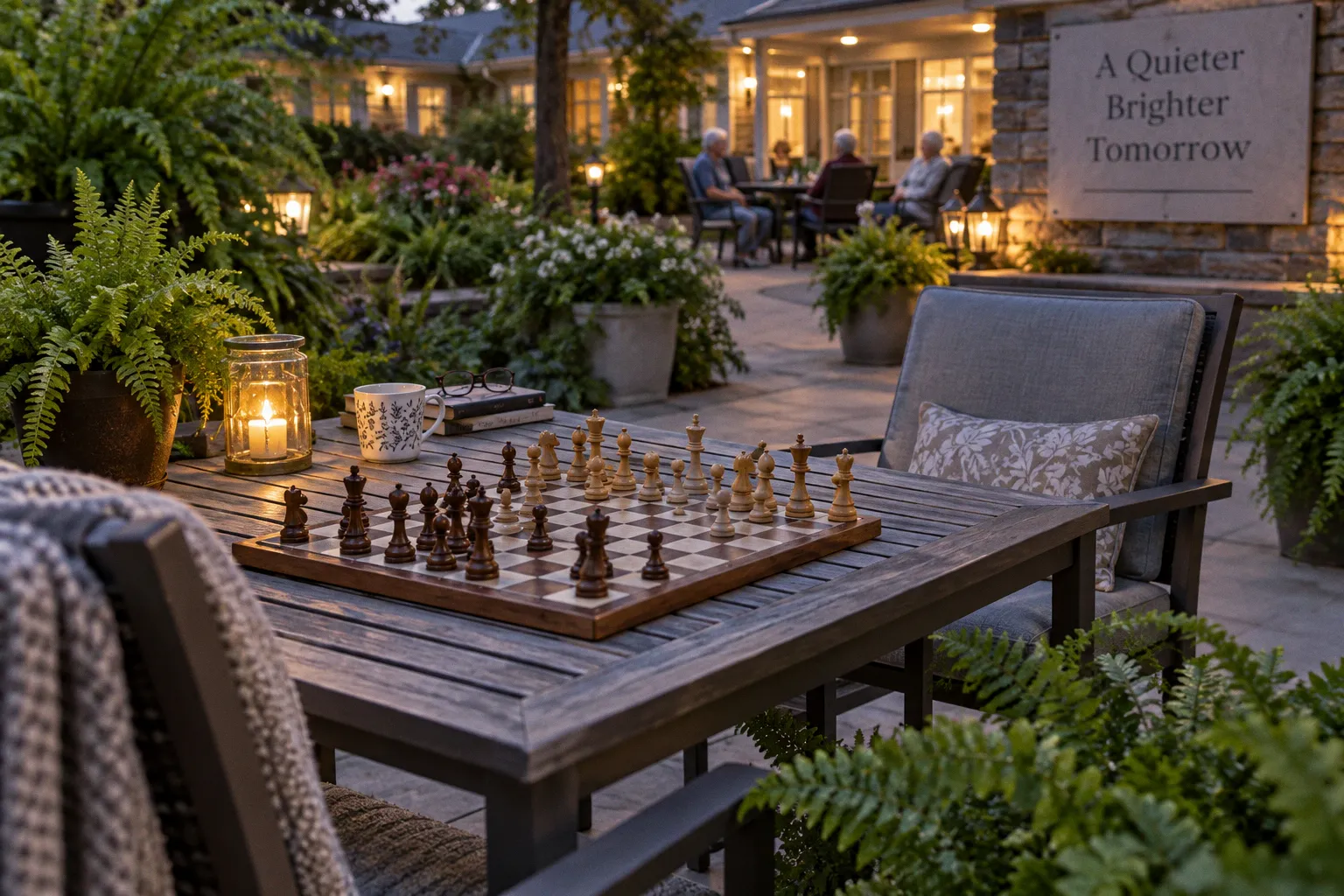
Or the gentleman who happily tends the courtyard garden alongside one aide but stiffens when invited to a community sing-along. Too often, the response from well-meaning activity directors is to coax, persuade, or gently insist—and when that fails, to quietly write the resident off as disengaged. That diagnosis is often wrong, and it can affect how staff interpret behavior, plan care, and understand quality of life.
Many older adults prefer social opportunities that are quieter, more predictable, and easier to enter and leave than a crowded group event. That preference may reflect introversion, sensory sensitivity, personality, fatigue, hearing difficulty, past experience, or simply a strong desire for control over one’s time. Whatever the reason, a calendar built almost entirely around large, highly social events will miss residents whose connection happens in less visible ways.
The good news is that an engagement strategy respectful of a resident’s sensory baseline and social comfort zone does not need to be expensive or complicated. It does require a more accurate definition of participation. A resident does not have to be animated in a crowded lounge to be socially connected. Sometimes meaningful engagement looks like tending a garden beside another person, joining a small discussion for half an hour, or sharing a familiar routine with one trusted aide.
The Science of Quiet Connection: Why Introversion Matters in Senior Care
Introversion is not the same as shyness, although the two can overlap. It is also not, by itself, a symptom of depression, early cognitive decline, or social withdrawal that demands clinical intervention. Those conditions can coexist with introversion, so a notable change in behavior should always be taken seriously. But a lifelong preference for lower-stimulation environments should not be treated as a problem simply because it does not resemble outgoing participation.
At its core, introversion describes a different relationship with stimulation and social energy. Introverted people may enjoy company while preferring fewer people, more structure, and longer intervals of quiet afterward. They may process conversation carefully rather than responding quickly. They may be deeply interested in others but uncomfortable with the demands of small talk, noisy rooms, or activities that require constant verbal participation.
In senior living, this distinction matters enormously. When a resident declines trivia night or leaves the lounge after ten minutes, the instinct may be to interpret the behavior as apathy, loneliness, or possible depression. Those concerns deserve attention when they are accompanied by distress, loss of interest in previously valued activities, changes in appetite or sleep, or a broader decline in functioning. But if the same resident returns to their room and spends a contented hour reading, doing a crossword, listening to music, or working on a familiar craft, that may be self-regulation rather than pathology.
The most useful question is not whether a resident participates in the activities staff consider social. It is whether the resident has access to forms of connection that feel safe, meaningful, and sustainable.
The opposite error is also common: pushing group activities on someone whose nervous system is already overwhelmed. Bright rooms, background television, competing conversations, rushed transitions, and unclear expectations can create genuine distress. In a resident living with dementia, sensory overload may contribute to restlessness or agitation later in the day. In other residents, it may show up as irritability, refusal, fatigue, or a desire to remain in their room. A quieter environment will not resolve every behavioral change, but it can prevent staff from mistaking overstimulation for unwillingness.
The goal is not to make introverted seniors more social. It is to make social life more accessible to the way they naturally connect.
Staff should also avoid using the word introvert as a shortcut for assessment. A resident who has always preferred solitary hobbies is different from one who suddenly stops speaking with friends, avoids meals, or loses interest in music and visitors. The first calls for personalization. The second may call for a conversation with the care team, family, or a clinician. Good programming respects personality without overlooking a meaningful change in health.
Designing Low-Pressure Environments for Meaningful Engagement
One of the most practical changes an assisted living community can make is to offer small-group programming as a real option rather than an occasional substitute for the main event. This does not mean simply moving a large activity to a smaller room. It means designing the experience around the needs of people who prefer a measured pace, a clear purpose, and room to observe before joining.
The distinction between a social activity and an interest-based gathering is important. A generic social hour places most of the work on residents themselves. They must enter a room, identify someone to approach, manage small talk, follow several conversations, and decide when it is acceptable to leave. For an introverted resident, that can feel less like relaxation and more like a demanding performance.
An interest-based gathering provides a bridge. Residents may be building a birdhouse, discussing a novel, arranging flowers, sorting photographs, or preparing herbs for the kitchen. The shared task gives people something to focus on besides one another. Conversation can arise naturally from the activity, but it does not have to carry the entire experience. Silence becomes ordinary rather than awkward.
The physical environment matters just as much as the activity description. Small changes can lower the social and sensory cost of participation:
- Noise level. Background music, television, kitchen sounds, acoustic echo, and several conversations at once can make it difficult for residents with hearing loss or sensory sensitivity to follow what is happening. A quieter room and one speaker at a time can change the entire atmosphere.
- Seating arrangement. A small cluster of chairs allows residents to see one another without creating the intensity of a circle where everyone feels watched. Tables also give participants something to do with their hands.
- Lighting. Glare and harsh overhead lighting may be tiring, particularly for residents with visual impairments or migraines. Softer, even lighting can make a room feel less exposed.
- Duration. A session with a defined beginning and end is easier to approach than an open-ended gathering. A shorter activity followed by optional lingering often works better than an event that assumes everyone will stay for the same length of time.
- Entry and exit flexibility. Residents should be able to arrive late, observe before participating, or leave early without being singled out. Flexible attendance communicates that the activity belongs to them, rather than requiring them to prove their commitment.
- Predictability. A consistent location, familiar staff member, and simple explanation of what will happen next reduce the uncertainty that often keeps hesitant residents away.
- Accessibility. Hearing support, comfortable seating, appropriate table height, clear walkways, and materials that are easy to handle are not separate from social programming. They determine who can participate in the first place.
These are not decorative details. They determine whether an activity genuinely serves its residents or merely appears on the calendar. A resident who cannot hear the facilitator, find a comfortable chair, or leave without attracting attention may reasonably decide that the event is not for them.
A useful program description should therefore tell residents what to expect. “Creative social hour” is vague. “Quiet watercolor session in the library, with supplies provided and no previous art experience needed” is more inviting because it removes several unknowns. The same principle applies to low-pressure senior social programs of every kind: be specific about the activity, the setting, the pace, and the level of conversation expected.
The Power of Parallel Play: Activities That Foster Inclusion Without Constant Talk
One of the most effective frameworks used in memory care—and one that applies equally well across assisted living—is parallel engagement. Borrowed from child development, parallel play describes people occupying the same space and taking part in related activities without requiring direct, continuous interaction.
For introverted seniors, this model is unusually effective. Residents can be present in a communal setting while maintaining their own internal rhythm. There is no pressure to sustain conversation, display enthusiasm, or respond immediately. The shared space provides belonging without demanding performance.
Parallel activities also make it easier for residents to regulate their involvement. Someone may sit at the puzzle table for ten minutes, place several pieces, and leave. Another resident may remain for the entire session while speaking very little. Both have participated. Neither should be treated as a failed version of the other.
Activities that tend to work well include:
1. Gardening clubs. Residents can work side by side in raised beds, containers, or indoor planting stations. Conversation may begin with a question about soil or a comment about a bloom, but extended silence remains comfortable. Gardening also offers sensory and physical engagement without making conversation the central task. For residents with limited mobility, tabletop propagation, seed sorting, herb care, or arranging cut flowers can provide the same shared focus.
2. Puzzles and structured card games. A jigsaw puzzle invites people to contribute a piece or two without requiring a formal introduction. Structured games such as rummy or bridge offer predictable turns and clear rules, which many residents prefer to open-ended socializing. Staff should make sure the game is adapted for vision, dexterity, and cognition rather than assuming every resident can manage standard materials.
3. Small book discussions. A discussion limited to a manageable number of residents can become one of the most intellectually satisfying activities on the calendar. The book provides a framework, so participants do not have to invent conversation from nothing. Some may speak at length; others may contribute a brief observation or simply listen. Offering large-print, audiobooks, or shorter selections makes the group more inclusive.
4. Bird watching and nature observation. A window, courtyard bench, or sheltered outdoor area can become a shared point of attention. Residents may use binoculars or a field guide, but the activity can also work through simple observation. People can compare what they notice or enjoy the quiet concentration of watching independently in the company of others.
5. Sketching and watercolor. Art-making is inherently individual even when it happens around a table. An instructor can provide guidance while residents work on their own pieces. Critique should never be assumed. Displaying work is best offered as an option, not treated as the measure of success.
6. Walking groups. A staff member accompanying two or three residents on a slow route through the grounds can reduce conversational pressure. Movement creates natural pauses, and the environment supplies topics without forced icebreakers. A resident who dislikes sitting in a circle may find it much easier to connect while walking.
7. Music listening and familiar recordings. Not every music activity needs to be a sing-along or performance. A small listening session organized around a genre, composer, decade, or resident suggestion can encourage memories and discussion without requiring anyone to perform. Headphones or a lower-volume speaker may help residents who are easily overwhelmed.
8. Practical making activities. Folding cards, arranging photographs, repairing simple items, knitting, and preparing a small recipe can provide a meaningful reason to gather. The work should be adapted to each resident’s abilities and should not be presented as busywork. A useful task offers agency, not just occupation.
What these activities share is a low-talk structure with high inclusion potential. The resident is part of something without being placed in the spotlight. That distinction is central to effective assisted living social activities for introverted seniors.
Staff can make parallel engagement even more successful by removing unnecessary social tests. Avoid requiring introductions around the table, applause after every contribution, or public praise that makes a quiet resident feel exposed. A warm greeting, a clear explanation, and the freedom to participate at a chosen level are usually more welcoming than enthusiastic pressure.
Creating Personal Sanctuaries to Recharge After Social Interaction
Communities often devote considerable attention to activity programming and far less to what happens between activities. For an introverted resident, the space they return to after a social event is as important as the event itself. If the room feels institutional, poorly lit, or difficult to personalize, the resident may have no satisfying place to recover.
Without recovery space, social tolerance can shrink. A resident may begin declining even the activities they once enjoyed because attending one event leaves them exhausted for the rest of the day. The answer is not necessarily to schedule less connection. It may be to create better transitions before and after it.
A personal sanctuary does not require a renovation budget. It may include:
- a comfortable chair positioned away from the hallway;
- a good reading lamp and a small shelf within reach;
- familiar photographs, artwork, textiles, or objects that make the room feel personally meaningful;
- a radio, music player, audiobook device, or other preferred form of quiet entertainment;
- a window view, patio chair, or a few planters that offer contact with something green;
- a designated low-traffic corner in a common area for residents who prefer company without conversation;
- a sign or staff communication plan that makes a resident’s quiet time easy to respect.
The last point is particularly important. A resident may not want to be physically isolated, but they may want to sit near other people without being repeatedly invited into conversation. A library corner, sunroom, or quiet table can provide sensory solitude without complete social separation.
Recharging also looks different from person to person. One resident may need actual time alone in their room. Another may prefer to remain near the activity but switch to reading or knitting. Someone else may recover through a slow walk, familiar music, or a one-on-one visit rather than silence. Staff should ask what helps the resident feel restored and observe what happens afterward. The goal is not to create a permanent retreat from community life. It is to give the resident enough control that participation remains possible.
A resident who has the space to recharge can rejoin the community on their own terms. A resident who does not may gradually stop showing up at all.
Timing matters as well. Some residents are more receptive in the morning, while others need time to settle after breakfast or personal care. A crowded schedule with one major event immediately after another can be especially difficult for residents who need transition time. Building quiet intervals into the day is a care decision, not a scheduling indulgence.
Building Trust Through One-on-One Staff and Resident Relationships
There is a staffing practice that can improve the experience of introverted residents without requiring a new program: consistent one-on-one contact with a familiar team member. This should be more than a wellness check or task-oriented visit. Trust develops through repeated, unhurried interactions in which the resident’s preferences are remembered and respected.
When a resident knows that the aide who walks with them on Tuesday mornings is someone they can talk with—or comfortably sit beside in silence—the entire social landscape changes. That trusted staff member can become a bridge to a larger setting. A resident who would never enter a crowded game room alone may be willing to try if a familiar person accompanies them, sits nearby, and provides an anchor in an otherwise unpredictable environment.
This is particularly important during transitions. A new resident who prefers quiet may be facing an unfamiliar building, unfamiliar people, changes in routine, and the unspoken expectation that they should quickly become involved. Without a consistent relationship, retreating to the room may become the easiest way to regain control. With a reliable one-on-one presence, the resident has a reference point: someone who understands their pace and can make introductions without turning the resident into a public project.
A practical approach might include:
- Assigning a primary aide or activity staff member to maintain continuity with the resident whenever staffing allows.
- Scheduling regular low-key visits in the resident’s preferred setting, with no assumption that every visit must be filled with conversation.
- Learning the resident’s history and interests through open-ended discussion, family input, life-history materials, and careful observation.
- Offering activities rather than selling them. Asking about a resident’s past hobbies and routines is more useful than repeatedly promoting the evening’s most popular event.
- Introducing small groups gradually. The staff member might describe the room, attend the first session, arrange a seat near an exit, or agree on a signal that the resident is ready to leave.
- Recording what works. Preferences about noise, time of day, group size, seating, and recovery time should be available to the wider care team so the resident does not have to explain the same needs repeatedly.
The staff member should not become a permanent gatekeeper between the resident and everyone else. The purpose is to create confidence and choice, not dependence. Over time, some residents will build peer relationships and participate without assistance. Others may continue to rely on a familiar staff presence, and that is not a failure. A reasonable accommodation is not a failure simply because it remains useful.
Families can support this process by sharing specific information. “She is quiet” is less helpful than knowing that she used to garden with a neighbor, enjoyed historical fiction, dislikes being called on in front of a group, and prefers to observe an activity before joining. These details turn personality into practical care information.
What This Means for How We Measure Success
Many assisted living communities track social engagement through participation metrics: attendance at events, average turnout, or the number of residents who appear actively involved. These figures can be useful for scheduling and staffing, but they are limited measures of social health. They favor visible, sustained, group-based participation and can overlook quieter forms of connection.
A resident who attends a small book discussion, tends the garden most mornings, exchanges a few words with a trusted aide, and spends peaceful afternoons reading in a common-area nook may have a rich and functional social life. On a participation dashboard, that same resident may appear under-engaged simply because they do not attend large events.
Assessment should consider quality, preference, and change over time. Staff can ask:
- Does the resident appear content with their routine, or are they showing signs of loneliness and distress?
- Does the resident still enjoy activities that were previously meaningful?
- Are there small-group, one-on-one, and parallel options alongside large gatherings?
- Can residents access quiet spaces during busy periods without feeling punished or marginalized?
- Are activities described clearly enough that residents know what to expect?
- Can residents enter, observe, and leave without unnecessary attention?
- Are staff members documenting preferences and following through consistently?
- Does the resident have opportunities for connection that match their hearing, vision, mobility, cognition, and energy level?
The aim is not to replace participation data with a different scorecard that reduces people to numbers. It is to interpret attendance in context. A low number of large-group visits does not automatically indicate poor engagement. A full activity calendar does not automatically indicate a socially healthy community.
Programs should also be reviewed from the resident’s point of view. Is the quiet option always scheduled at an inconvenient time? Are small groups treated as less important because they attract fewer people? Does the same staff member lead every activity, making the program inaccessible when that person is absent? Are residents praised for being outgoing while their need for quiet is framed as a barrier?
These questions reveal whether a community truly values different forms of participation or merely tolerates them.
A Realistic, Affirming Takeaway
Respecting an introverted resident is not about lowering expectations for quality of life. It is about raising the standard for what meaningful engagement can look like. A community that celebrates only the loudest and most visible forms of participation risks overlooking residents who connect through attention, routine, shared work, and quiet companionship.
Small groups gathered around a genuine interest. Parallel activities that let residents be together without performing togetherness. Personal spaces designed for recovery rather than simple occupancy. Staff relationships built on consistency and presence instead of task checklists. These approaches are not elaborate, but they require a deliberate shift in how communities define social success.
There is no need to assign a fixed percentage to the residents who may benefit from this approach. Preferences vary, and they can change with hearing loss, mobility limitations, fatigue, dementia, medication effects, grief, or a new environment. What is clear is that many residents may prefer quieter, lower-pressure ways of taking part in community life, and those preferences deserve the same seriousness as a request for a more active schedule.
When assisted living communities make room for quiet connection, everyone benefits. Extroverted residents gain more varied options. Residents with sensory or cognitive limitations face fewer unnecessary barriers. Staff receive a fuller picture of well-being. Most importantly, residents are allowed to belong without having to perform belonging in the same way.
FAQ
What are good social activities for introverted seniors in assisted living?
How can assisted living communities make activities more comfortable for introverted residents?
What is parallel engagement for seniors?
How can staff support an introverted resident who avoids group activities?
How can staff tell the difference between introversion and a concerning change in behavior?
How should social engagement be measured for introverted seniors?
Related articles
 Senior Wellness & LivingAssisted Living Dining Options for Specific Dietary Needs
 Senior Wellness & LivingSeated Exercise Gear for Seniors: What Works and When
 Long-Term CareFall prevention protocols: three clinical approaches compared
 Long-Term CarePressure ulcer prevention tools for skilled nursing facilities