Sensory Stimulation Tools for Dementia by Stage
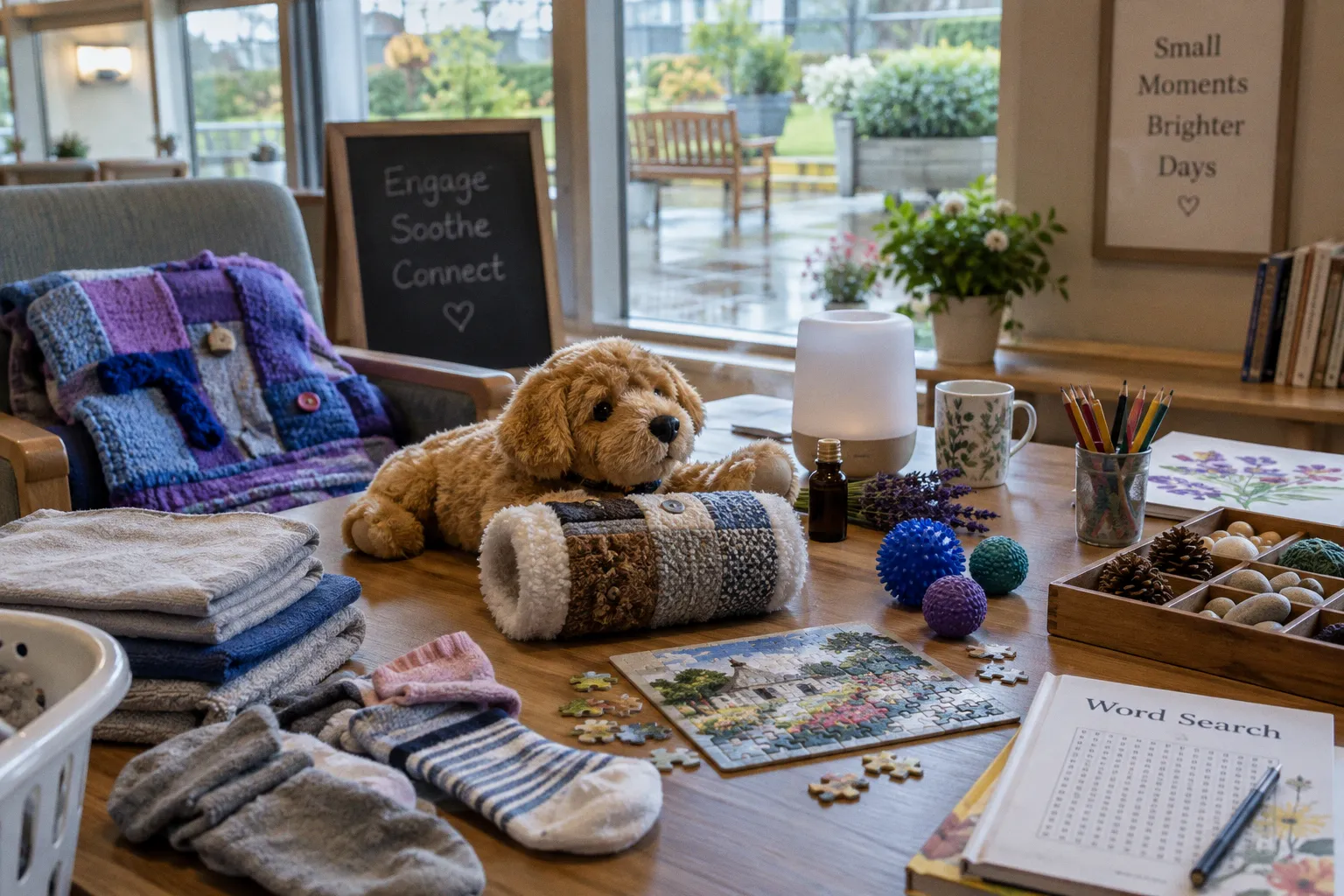
Sensory stimulation tools for dementia care work best when they are chosen for a person, a moment, and a particular need—not when they are bought as a universal collection of “dementia products.” A resident who is comfortable and engaged in the morning may become restless, frightened, or disoriented by late afternoon. The same blanket, music player, or tactile object that helps one person settle may irritate another.
That is especially true during sundowning, when changes in light, fatigue, noise, and routine can intensify confusion or agitation. The practical task for caregivers is not simply to offer more stimulation. It is to identify the kind of sensory input that helps a particular resident feel oriented, occupied, or safe at that point in the disease and at that point in the day.
The core principle: stimulation is useful, but dosage matters
Sensory input can be an important non-pharmacological part of dementia care. Familiar music may support emotional connection. Repetitive tactile activity may give restless hands something safe to do. A recognizable scent, texture, or household task may connect a person with a preserved memory pathway when spoken instructions no longer work as well.
But stimulation is not automatically calming. An environment filled with competing conversations, television noise, bright lighting, and unfamiliar movement can raise distress rather than relieve it. Even an apparently gentle item can become too demanding if the person is tired, in pain, hungry, or already overwhelmed.
A useful aim is to find the resident’s sensory baseline: the amount and type of input they can comfortably process. From there, caregivers can introduce one small, familiar experience and observe the response. The goal is engagement without pressure and comfort without unnecessary intensity.
The most effective sensory tool is rarely the most expensive one. It is the one that meets a resident at the level of attention, ability, and emotional need present in that moment.
This principle also explains why stage-based guidance should be treated as a starting point rather than a rigid prescription. Dementia does not progress in a perfectly uniform line. A person may have relatively strong visual recognition but limited verbal comprehension, or retain a love of music while losing the ability to complete a familiar task. A tool should follow the person’s abilities and preferences, not replace careful observation.
Sensory stimulation tools by stage
The Global Deterioration Scale is useful for broad orientation, but it should not be used as the only basis for care planning. For sensory stimulation purposes, the relevant mapping is:
- Stage 4: early or mild dementia, when a person may still participate in structured tasks but has noticeable difficulty with complex activities and recent information.
- Stage 5: moderate dementia, when orientation, sequencing, and independent task completion become more limited.
- Stages 6–7: severe to very severe dementia, when communication, recognition, mobility, and purposeful activity may be substantially reduced.
The distinction matters. Stage 5 should not be grouped with mild impairment, and Stage 6 should not be described as moderate dementia. The level of assistance, the amount of structure, and the safety requirements change significantly between these stages.
Stage 4: early or mild dementia
At Stage 4, many residents can still take part in familiar activities, make simple choices, and use tools with a clear purpose. The most helpful items often support independence without pretending that nothing has changed. They make an activity more accessible while preserving the person’s sense of competence.
Structured cognitive engagement
Large-print word searches, simple matching games, familiar card games, sorting trays, and puzzles with fewer pieces can provide a manageable challenge. The activity should be easy to understand at a glance. Too many rules, small pieces, or time limits can turn a promising activity into a public test of failure.
The best options usually have:
- Large, high-contrast pieces that are easy to see and handle.
- A clear beginning and end.
- Familiar categories such as colors, household objects, animals, or clothing.
- A level of difficulty that allows the resident to complete part of the task independently.
- No requirement to remember several instructions at once.
A caregiver can demonstrate the first step instead of explaining the entire activity. If the resident begins sorting objects by a different principle than expected, that does not necessarily mean the activity has failed. The purpose may be attention, rhythm, and confidence rather than a correct score.
Life-skills activities
Everyday tasks can be more meaningful than products designed specifically for dementia. Folding towels, arranging napkins, watering plants, pairing socks, wiping a table, or helping prepare a simple snack can connect sensory experience with long-established identity.
These activities engage more than one sense at a time. The person sees the objects, feels their texture, hears the movement, and follows a familiar sequence. The smell of herbs or baked food may be comforting, but food preparation must always be adapted to the resident’s physical abilities and swallowing safety.
The task should be simplified without being made childish. A resident who spent years caring for a household may respond better to being asked to help organize towels than to being handed a brightly colored “activity kit” with no personal meaning.
Environmental supports
Some sensory tools reduce distress by making the environment easier to interpret. A large, high-contrast clock can provide orientation. A clear sign with a photograph or simple symbol can help identify a bathroom, bedroom, or dining area. Consistent lighting and uncluttered surfaces can prevent visual confusion.
These supports are not merely decorative. They reduce the amount of information the person has to decode. At Stage 4, a resident may still understand the purpose of a clock or sign, but the design needs to be straightforward. A complicated digital display, a crowded wall, or a sign surrounded by competing images may add to confusion.
Creative and expressive materials
Watercolor with large brushes, soft clay, fabric collage, simple drawing, and familiar songs can provide expression without demanding precise language. Creative work should not be evaluated like a finished project. The value may be in the movement of the brush, the color choice, or the quiet period of concentration.
Offer a limited selection rather than an entire art supply cupboard. Two or three choices are often easier to process than a large range of materials. The resident can also be invited to stop at any time; persistence is not the goal.
At this stage, the central idea is scaffolding: providing enough structure to make success possible while allowing the person to remain an active participant.
Stage 5: moderate dementia
Stage 5 represents moderate dementia, not mild impairment. The person may have more difficulty following multi-step instructions, remembering the purpose of an object, finding their way through familiar spaces, or completing a task independently. Tools that depend on planning and accurate performance may become frustrating.
Sensory stimulation at this stage is often more effective when it emphasizes repetition, emotional familiarity, and hands-on exploration. The activity may look simple, but it should still be purposeful and respectful.
Tactile sorting and rummage activities
A basket containing safe fabric squares, large wooden rings, smooth stones too large to swallow, textured balls, or pieces of clothing can offer a controlled way to explore objects. Sorting socks, pairing towels, moving large items between containers, and feeling different fabrics may satisfy the need for repetitive hand activity.
A rummage box works best when its contents are connected to the person’s history. Someone who enjoyed sewing may respond to fabric and large, safe fasteners. Someone who worked with tools may prefer sturdy household objects that can be handled without sharp edges or small detachable parts.
Avoid filling the box with random clutter. Too many objects can be visually confusing, and items that are unfamiliar may invite unsafe exploration. Inspect everything regularly for loose parts, frayed fabric, choking hazards, and surfaces that could cut or pinch.
Fidget blankets, aprons, and hand activities
Fidget blankets, sleeves, and aprons can provide zippers, ribbons, pockets, soft textures, and large fasteners for restless hands. They are particularly useful when a resident repeatedly pulls at clothing, bedding, or medical equipment. The item should look and feel like something made for an adult, not like a child’s toy.
These tools require supervision and maintenance. Buttons, cords, beads, and decorative pieces can become hazards if they loosen. A fidget item should also be checked for whether it genuinely helps. If a resident becomes more focused on tearing, biting, or pulling at the material, the item may need to be removed or replaced.
Tactile stimulation should not be forced. A caregiver can place the item within reach, demonstrate a movement, and allow the resident to accept or refuse it.
Nurturing objects and therapeutic companionship
Some people find comfort in realistic baby dolls, soft animals, or weighted stuffed animals. The response may involve holding, rocking, covering, or caring for the object. For a resident with a strong history of parenting or caregiving, this can provide a meaningful role and a calming routine.
The approach must remain person-centered. A doll should not be presented as a joke, used to manipulate behavior, or imposed on someone who shows no interest. Some residents may find it upsetting or demeaning. Staff should follow the person’s response and language, treating the object as a source of comfort if that is how the resident experiences it.
Supervised contact with a calm animal can also support non-verbal connection. The animal’s temperament, the resident’s allergies, infection-control requirements, and the person’s ability to interact safely all matter. A pet visit is not automatically therapeutic simply because an animal is present.
Music and familiar sound
Music can be a powerful sensory cue at Stage 5, especially when it is linked to the resident’s life history. A familiar playlist may support calm during dressing, bathing, meals, or the late afternoon period when sundowning symptoms often appear.
Volume is less important than familiarity and context. Music playing continuously in a common room may become background noise or another source of overload. A quieter, intentional selection may work better. Watch for signs of pleasure, attention, humming, relaxation, or increased agitation. A song that was meaningful to one person may be irritating to another.
Aromatherapy should be approached with similar caution. Scent can be familiar and comforting, but strong fragrance may cause nausea, headache, respiratory irritation, or distress. Diffusers can also introduce safety and infection-control concerns. Never assume that lavender, vanilla, peppermint, or any other scent is universally calming. Use only an approved method, keep the scent light, and stop if the resident shows discomfort.
The guiding principle at Stage 5 is emotional substitution: when a formerly familiar cognitive task is no longer accessible, an activity can still provide rhythm, identity, comfort, and a sense of usefulness.
Stages 6–7: severe to very severe dementia
Stages 6 and 7 represent severe to very severe dementia. Verbal communication may be limited, recognition may fluctuate, and purposeful task completion may no longer be realistic. Sensory care becomes less about completing an activity and more about comfort, connection, regulation, and the prevention of avoidable distress.
A tool should require little or no explanation. It must be easy to hold, easy to remove, and safe if the resident cannot reliably communicate discomfort.
Passive tactile stimulation
A fidget muff or soft tactile sleeve can provide warmth and texture for a person who has limited fine-motor control. Soft fabric, a broad seam, or a large textured surface may be more useful than multiple small attachments.
Slow hand massage with unscented lotion can provide reassuring contact, but it should be offered only with attention to consent and physical comfort. The resident may communicate acceptance through relaxed muscles, an open hand, or stillness, and refusal through pulling away, guarding, grimacing, or increased tension. Skin condition, swelling, wounds, and pain must be considered before touch is offered.
Weighted items require particular caution. A weighted blanket or stuffed object may be difficult for a frail person to move, may interfere with repositioning, and may create a safety problem for someone with respiratory weakness or limited mobility. Such items should never be treated as automatically appropriate simply because pressure can feel calming to some people.
Familiar music and gentle sound
Calm, familiar music played at a low volume can provide connection even when the resident no longer responds verbally. A caregiver may also use a familiar voice, quiet humming, or the ordinary sounds of a preferred routine. The sound should be close enough to hear but not invasive.
Headphones are not suitable for everyone. They can be uncomfortable, difficult to remove, or disorienting if the resident cannot explain what they are experiencing. A speaker positioned at a respectful distance may be safer and more socially connected.
Taste and smell
Taste can be part of sensory care, but food must be handled as a clinical safety issue as well as a source of pleasure. A small portion of a familiar food may be appropriate only when it matches the person’s swallowing plan, dietary restrictions, allergies, and ability to manage the texture.
A soft fruit, warm drink, or familiar dessert may bring comfort, but do not offer food to someone who is drowsy, positioned unsafely, or showing signs of swallowing difficulty. Never place food in a resident’s mouth to test a response.
Scent should be offered indirectly and lightly, never applied to the face or skin without permission. Perfume, essential oils, and concentrated products may irritate the airway or create an unpleasant experience. Familiarity is more important than intensity.
Multisensory environments
A memory care sensory room may include fiber-optic lights, bubble tubes, tactile panels, soft music, projected images, or comfortable seating. These environments can be useful when they are controlled, quiet, and individualized. They should not be treated as entertainment installations that must be used in full.
For a person at Stage 6 or 7, one or two calm elements may be enough. A dim room with soft music could be more regulating than a room filled with moving lights, changing colors, and multiple sounds. The resident should be monitored throughout the experience. A sensory room is not successful because every piece of equipment is turned on; it is successful when the person appears more settled and comfortable.
At this stage, a meaningful outcome may be a relaxed hand, steadier breathing, a brief smile, softened facial tension, or a few minutes without distress. Those responses are not insignificant. They are the measure of whether the experience helped.
Building a practical sensory routine
A good sensory program is not a pile of products. It is an observation process that connects the resident’s history, current abilities, daily rhythm, and physical safety.
Start with the person’s sensory profile
Before choosing sensory stimulation tools for dementia care, gather information from the resident whenever possible and from people who know them well. Ask about ordinary preferences rather than looking only for formal “therapy” interests.
Useful details include:
- Music the person enjoyed, disliked, or associated with particular routines.
- Former work, hobbies, household roles, and religious or cultural practices.
- Preferred fabrics, clothing textures, room temperature, and lighting.
- Reactions to crowded spaces, television, alarms, strong smells, and touch.
- Times of day when the person is most alert, most tired, or most likely to become restless.
- Foods and drinks that are familiar, safe, and consistent with the care plan.
- Objects that have personal meaning and objects that clearly cause distress.
A sensory profile should be updated. Preferences can change with illness, medication, pain, vision or hearing loss, and the progression of dementia.
Introduce one variable at a time
When a resident is given a fidget blanket, music, a diffuser, and a new lighting setup at once, it becomes impossible to know what helped or what caused distress. Introduce one item during a relatively calm period. Keep the rest of the environment predictable.
Observe without turning the resident into a subject of examination. Look for:
- Reaching toward or holding the item.
- A softer facial expression.
- Relaxed shoulders, hands, or posture.
- More settled breathing or less repetitive movement.
- Vocalization, singing, humming, or eye contact.
- Pushing the item away, turning aside, grimacing, pulling at it, or becoming more restless.
There is no need to label the outcome as success or failure after one attempt. A person may be tired, in pain, or distracted on a particular day. Still, repeated signs of discomfort should be taken seriously.
Match the tool to the time of day
A tool that works in the morning may not work during sundowning. Early in the day, a resident may be able to participate in sorting, painting, or gardening. By late afternoon, the same person may need reduced noise, familiar music, dimmer but adequate lighting, a warm drink, or a simple tactile object.
The environment around the tool matters as much as the tool itself. Before offering a sensory item, check for physical discomfort, hunger, thirst, constipation, fatigue, temperature changes, or the need to use the bathroom. Agitation is not always a request for stimulation. Sometimes it is a sign that something is wrong.
Use choice without creating a test
Offering two options can preserve autonomy: a soft blanket or a textured shawl, music or quiet, a fabric activity or a familiar household task. The choices should be visibly different and easy to understand. If the resident refuses both, that response is meaningful.
Choice is not preserved by repeatedly asking a confused person to decide. It is preserved by making the decision manageable, respecting refusal, and returning later when the person may be more receptive.
The aim is not to fill a room with dementia products. It is to create a responsive environment that pays attention to the person’s non-verbal language.
Safety and dignity come before novelty
Sensory tools should be inspected and used within the resident’s care plan. A product marketed for dementia may still be unsuitable for someone with poor vision, limited grip, swallowing difficulty, skin fragility, seizure risk, respiratory disease, or a tendency to mouth objects.
Practical safeguards include:
1. Remove small detachable parts. Buttons, beads, beads sewn to fabric, cords, and loose fasteners may become choking or entanglement hazards.
2. Check texture and construction. Avoid rough seams, sharp edges, exposed wires, unstable bases, and materials that can overheat.
3. Consider mobility and posture. A blanket or cushion should not restrict movement, transfers, repositioning, or access to medical equipment.
4. Treat scent as an individual exposure. Use little or none when there is respiratory sensitivity, nausea, headache, or uncertainty about tolerance.
5. Protect privacy and adult identity. Choose attractive, age-appropriate materials and avoid turning care into a childish performance.
6. Do not use stimulation to suppress communication. A resident who is restless may be reporting pain, fear, loneliness, or an unmet need.
7. Document what matters. Record the item, time, setting, response, and any signs of discomfort so the next caregiver does not have to start from zero.
In a care setting, consistency is valuable. If one caregiver knows that a particular resident settles with quiet piano music and a folded towel to hold, that information should be available to the rest of the team. The goal is not a rigid protocol but a shared understanding of what supports this person.
A sensory room is only as good as its use
Memory care sensory room equipment can be helpful, but equipment alone does not create therapeutic care. A room with bubble tubes, fiber-optic lights, tactile panels, and sound systems can become overwhelming if everything operates at once. It can also become a place where residents are sent without a clear purpose.
Before entering a sensory room, staff should know what they are trying to support: settling after a difficult transition, offering a quiet period, encouraging gentle engagement, or providing comfort near the end of the day. One resident may benefit from a softly lit room with music. Another may prefer a tactile object in a familiar chair outside the room.
The resident should not be left to manage unfamiliar equipment independently. Staff need to watch for changes in breathing, posture, facial expression, attention, and movement. If the room increases distress, the correct response is to reduce stimulation or leave—not to insist that the person needs more time to adjust.
The measure of success changes with dementia
At Stage 4, success may mean completing part of a familiar task, making a choice, or remaining engaged without frustration. At Stage 5, it may mean sorting fabrics for several minutes, relaxing while music plays, or finding comfort in a nurturing object. At Stages 6–7, success may be a calm expression, an unclenched hand, a moment of recognition, or a peaceful transition into rest.
This progression is not a reason to stop offering meaningful experiences. It is a reason to change what meaningful experience looks like. The person does not have to produce a finished object, follow instructions, or demonstrate memory for the interaction to matter.
Final perspective
The best sensory stimulation tools for dementia care are selected through attention rather than novelty. Early or mild dementia at Stage 4 may call for structured activities, environmental supports, and creative tools that preserve independence. Moderate dementia at Stage 5 often benefits from repetitive tactile activities, familiar music, nurturing objects, and emotionally meaningful routines. Severe to very severe dementia at Stages 6–7 requires a quieter approach centered on comfort, safe touch, familiar sound, and simple sensory connection.
No product can replace observation. A blanket cannot recognize pain. A music player cannot interpret fear. A sensory room cannot decide whether a resident wants company or quiet. Those judgments remain part of caregiving.
Begin with one person’s daily rhythm. Notice when attention rises, when fatigue appears, and when agitation tends to build. Choose one suitable tool, offer it without pressure, and allow the resident’s response to guide what happens next. That is how a collection of objects becomes thoughtful, dignified care.
FAQ
What are the best sensory stimulation tools for someone with Stage 4 dementia?
Which sensory activities are suitable for moderate dementia at Stage 5?
What sensory stimulation is appropriate for severe dementia at Stages 6 and 7?
How can caregivers tell whether a sensory tool is helping a person with dementia?
What safety precautions should be used with dementia sensory tools?
Related articles
 Memory & Cognitive CareDementia care facility transitions: common pitfalls to avoid
 Monroe Community Hospital Launches Friendship Place for Specialized Memory Care
 Long-Term CareFall prevention protocols: three clinical approaches compared
 Long-Term CarePressure ulcer prevention tools for skilled nursing facilities