Wandering Prevention Systems: Matching Tools to Elopement Risk
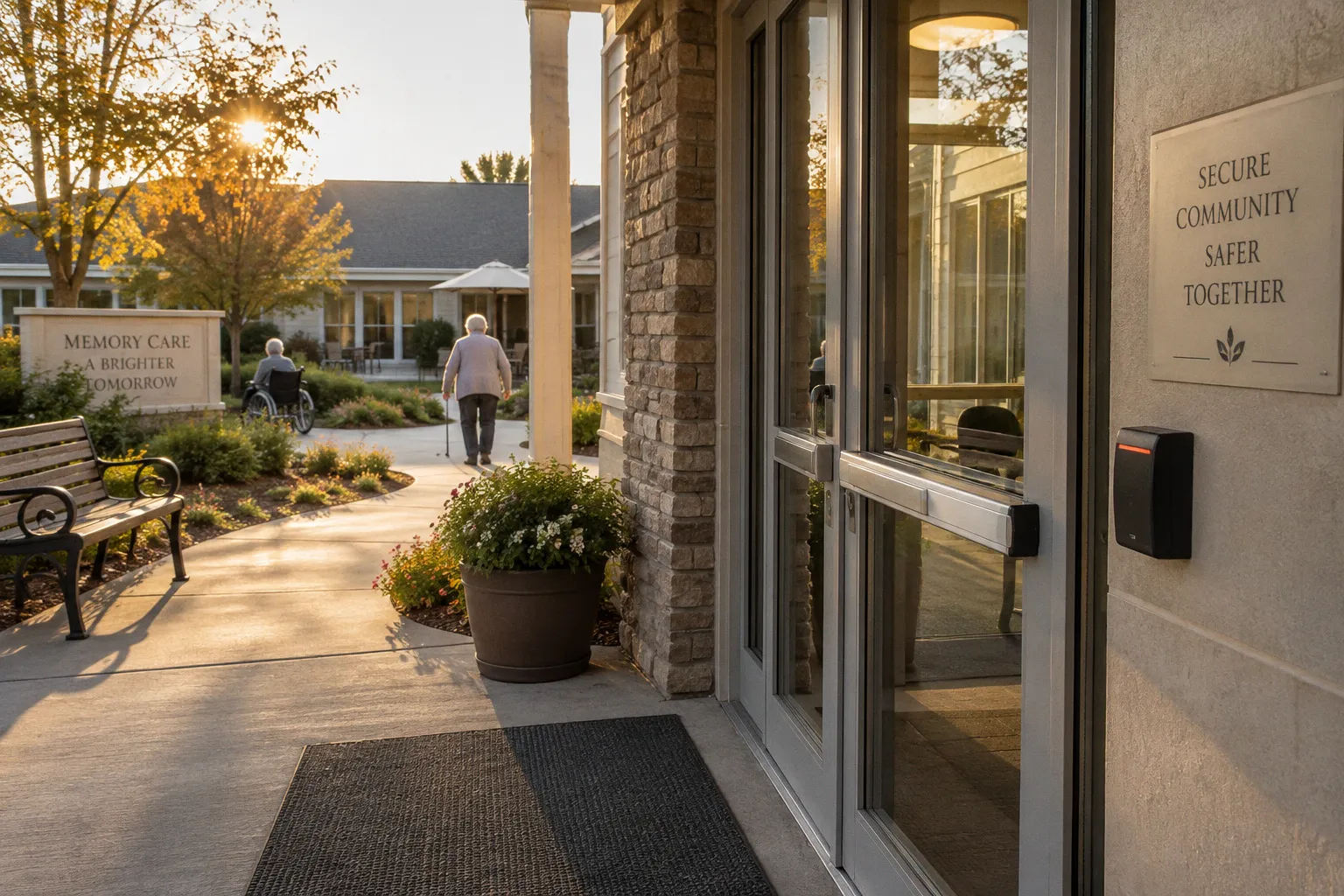
A resident who repeatedly walks the same hallway inside a secured memory care neighborhood needs a different intervention from a resident who searches for an exit, defeats door alarms, or leaves the building unnoticed.
That distinction is the starting point for choosing wandering prevention systems for dementia care. The safest approach is not to purchase the most sophisticated device available. It is to match the intervention to the resident’s behavioral expression, the environmental triggers around it, and the facility’s ability to respond when an alert occurs.
Approximately 60% of people living with Alzheimer’s disease or another form of dementia wander at least once during the illness. Yet technology alone does not prevent elopement. A wearable tag, delayed-egress door, or GPS device becomes meaningful only when staff know what the alert means, who responds, how quickly they respond, and what they do next.
The right system is not the one with the most features. It is the one that reliably connects a resident’s risk level to a staff response.
Wandering is not the same as elopement
In clinical practice, we need to separate internal wandering from elopement.
Internal wandering may involve pacing, repeated corridor walking, entering other residents’ rooms, or moving through common areas without a clear destination. These behaviors can still create falls, distress, conflict, or unmet-needs concerns, but the resident remains within a controlled environment.
Elopement means leaving a safe area entirely. A resident may exit through a door, follow another person through a secured entrance, climb over a barrier, or leave during a transition such as transportation, a fire drill, or a move between units. The risk changes immediately because the resident is exposed to traffic, weather, water, uneven ground, and delayed discovery.
The behavioral expression often has a purpose, even when the purpose is difficult to identify. A resident may be trying to:
- Return to a former home or workplace.
- Find a spouse, parent, child, or pet.
- Meet a basic need such as toileting, hunger, pain relief, or warmth.
- Escape noise, crowding, unfamiliar staff, or an overstimulating room.
- Follow a habitual routine, such as leaving for work or going to school.
- Respond to an environmental trigger that the care team has not yet recognized.
This is why a door alarm by itself can be insufficient. If the resident is repeatedly trying to leave because the dining room is overwhelming, the alarm may identify the attempt without reducing the underlying distress. We still need to address the sensory baseline, the daily rhythm, and the environmental triggers.
Start with an elopement risk assessment
A risk assessment should be more than a form completed on admission. It should be updated when the resident’s cognition, mobility, medications, routines, or living environment changes.
The first 48 hours after admission deserve particular attention. Research highlighted by ECRI indicates that approximately 45% of facility elopements occur during this early period, when the resident is adapting to unfamiliar surroundings and staff are still learning the person’s patterns. Persistent wanderers account for about 80% of elopements.
That does not mean every new resident requires the same level of restriction. It means the early assessment must be active and specific. We should observe how the resident responds to doors, transitions, staff redirection, family departures, meals, bathing, and changes in routine.
A useful assessment considers several dimensions:
- History: Has the resident wandered or eloped before? Was there a recognizable reason or time of day?
- Exit-seeking behavior: Does the resident test handles, follow staff, ask repeatedly to go home, or wait near exits?
- Mobility: Can the resident walk independently, use a wheelchair, transfer without help, or move rapidly?
- Orientation and communication: Can the resident state where they are, explain where they are going, or respond to redirection?
- Impulsivity and judgment: Does the resident act suddenly or continue toward an exit despite verbal cues?
- Time pattern: Does the behavior increase during evening hours, after family visits, or around shift changes?
- Medical contributors: Are pain, urinary urgency, medication effects, dehydration, infection, sleep disruption, or constipation affecting behavior?
- Environmental response: Is the resident calmer in a quiet room, outdoors with supervision, or near familiar objects?
We also need to distinguish an unexcused elopement from leaving against medical advice. These are not interchangeable events, and the distinction affects documentation, response planning, and regulatory review. CMS requirements under Appendix PP, including F689, expect long-term care facilities to conduct initial and ongoing elopement risk assessments and to maintain systems appropriate to identified risk.
The assessment should lead to a care plan that staff can use during a busy shift. A vague instruction such as “monitor for wandering” does not tell a nursing assistant what to do at 7 p.m. when a resident begins testing the secured door. A practical plan identifies known triggers, preferred redirection, supervision needs, alert response, and the conditions that require escalation.
Comparing the main wandering prevention systems
There is no universal best device. Each category solves a different part of the problem, and each has limitations that become important in real residential care.
| System | Best suited to | Strengths | Limitations |
|---|---|---|---|
| RFID wearable tag with door controller | Residents at recurring risk of approaching monitored exits | Links a resident-specific tag to an exit alert or door response; can cover multiple doors | Requires consistent wearing, functioning batteries, correct enrollment, and rapid staff response |
| Delayed-egress door | Units where residents may approach exits without understanding the danger | Creates time for staff intervention and can produce an audible alert | May increase distress; must be integrated into evacuation and emergency procedures |
| Door alarm or local exit sensor | Lower or emerging risk, especially when staff are nearby | Simple, visible, and relatively easy to deploy | Does not prevent passage by itself; alarm fatigue can make alerts less effective |
| Real-time location system | Higher-risk residents or larger campuses requiring location awareness | Can help staff identify a resident’s location inside or near the facility | Requires infrastructure, training, maintenance, and a defined response workflow |
| GPS tracking device | Residents who may leave the building or campus despite internal controls | May support outdoor search and location awareness away from the facility | Often depends on charging, cellular coverage, permissions, and correct device use |
| Visual barrier or door camouflage | Residents responding to the appearance of an exit | Can reduce environmental cueing without physically restricting movement | Not effective for every resident; must never obscure required exit access or emergency pathways |
| Supervised access to safe outdoor space | Residents whose movement reflects a need for activity or familiar routines | Addresses the need for movement rather than only blocking it | Requires staffing, appropriate design, weather planning, and ongoing observation |
RFID wearable systems
RFID-based wander management systems use a wearable tag, often attached to a wristband or anklet, that communicates with door controllers. When a tagged resident approaches a monitored exit, the system may alert staff, secure the door, or initiate both responses depending on the configuration.
These systems are most useful when the risk is resident-specific and exit-focused. For example, a resident may walk safely throughout the unit but repeatedly approach a particular exterior door after dinner. A wearable tag can connect that pattern to a targeted alert rather than turning every movement into a security event.
The operational details determine whether the system works:
- The tag must be worn consistently and checked during routine care.
- Staff must know what a flashing indicator, audible alert, or dashboard notification means.
- The system must distinguish between a resident who is approaching an exit and a resident who has already left.
- Door controllers, batteries, tags, and network connections need scheduled testing.
- Staff need a process for residents who remove, hide, or exchange tags.
- The facility must document missed alerts, equipment failures, and response times.
An RFID system should not be described as a guarantee against elopement. A resident may remove the tag, follow someone through an unsecured opening, leave during a maintenance event, or encounter a door that has not been properly integrated into the system.
Delayed-egress doors and door alarms
Delayed-egress doors create a time interval between a resident’s attempt to exit and the door opening. Door alarms notify staff when a monitored door is opened or approached. Both can be useful, but they serve different functions.
A delayed-egress device is a response window. It gives staff an opportunity to reach the door before the resident leaves. A door alarm is an awareness tool. It tells staff that something has happened or is happening; it does not necessarily slow the resident down.
For residents with mild or developing exit-seeking behavior, a local alarm near a staffed area may be sufficient. For residents who move quickly, do not respond to verbal redirection, or have previously crossed an exit, a delay mechanism may provide a more meaningful safety margin.
The risks are equally practical. Repeated alarms can create alert fatigue, particularly when staff hear false alarms, door-prop alerts, or alarms from residents who are not actually at high risk. When every alert sounds urgent but not every alert receives a prompt response, the system loses clinical value.
The response plan should specify:
1. Which staff member acknowledges the alarm.
2. Who visually confirms the resident’s location.
3. Who remains with the resident while the situation is assessed.
4. When the nurse is notified.
5. What happens if the resident is not found immediately.
6. How the event is documented and reviewed.
Real-time location systems
Real-time location systems, or RTLS, are designed for facilities that need more than an exit notification. Depending on the infrastructure, they may help staff locate a resident within a building, identify movement toward a restricted zone, or track a tag across a campus.
RTLS can be valuable in a large nursing facility where a resident may move through multiple units, therapy spaces, dining rooms, gardens, and transitional areas. It is less useful when the facility has not decided how location information will guide care. A map showing a resident’s position does not replace direct observation, clinical judgment, or a conversation about why the person is moving.
Before selecting RTLS, we would want clear answers to several operational questions:
- What is the expected accuracy inside the building and outdoors?
- Does the system identify a room, hallway, floor, or general zone?
- How quickly does the location update?
- What happens during network or power failure?
- Can staff receive alerts on the devices they already carry?
- Can the system distinguish a resident from equipment or another tagged person?
- Who maintains the infrastructure?
- How are access and privacy managed?
The strongest use case is a facility with a defined high-risk population, multiple potential exit points, and enough staff training to act on location data. Buying a location platform without staffing and response design usually creates an expensive notification layer rather than a complete prevention program.
GPS tracking devices
GPS tracking devices are most relevant when the concern extends beyond the building. They may support a search if a resident leaves the campus, particularly when the device is worn consistently and has an active cellular connection.
They should not be treated as a replacement for secured exits, supervision, or a missing-person protocol. GPS may be delayed or inaccurate near buildings, wooded areas, or other locations with limited signal. The device may need charging, may be removed by the resident, and may not communicate if the service plan or hardware fails.
A GPS device can be appropriate for a resident with a documented history of leaving the facility and traveling beyond the grounds, especially when the person has reliable family or staff support for wearing and charging it. It is less appropriate as the only intervention for a resident who is actively attempting to leave through several facility exits.
We should also consider consent, privacy, and the resident’s rights. Tracking technology must fit within the facility’s policies, the resident’s care plan, and applicable legal and regulatory requirements. Convenience for the organization is not enough.
Environmental strategies can reduce the demand on technology
Technology works best when the environment is not repeatedly provoking the behavior. Low-tech interventions are not secondary or unsophisticated; in many cases, they address the cause of exit-seeking more directly.
A resident who sees a large exterior door, hears activity outside, and associates the doorway with going to work may continue approaching it despite alarms. A resident who is looking for a bathroom may keep walking until someone interprets the need correctly. A resident who becomes distressed during evening noise may wander because the unit no longer feels tolerable.
Environmental adjustments may include:
- Camouflaging an exit so it is less visually prominent, while preserving required emergency access and clear staff visibility.
- Moving seating, activity stations, or familiar visual cues away from exit doors.
- Providing a quiet area when noise, crowding, or competing conversations raise arousal.
- Offering purposeful walking routes that do not terminate at a locked door.
- Placing clear, meaningful bathroom cues where residents can see them.
- Scheduling toileting, hydration, meals, and pain assessment around known patterns.
- Using soft barriers or visual boundaries only when they do not create a trip hazard or block required egress.
- Providing supervised outdoor access for residents who seek movement, fresh air, or a familiar daily routine.
- Reviewing lighting and shadows during late afternoon and evening, when visual misinterpretation may increase.
Anti-wandering visual barriers for dementia care must be used carefully. A disguised door may reduce approach behavior for one resident and increase confusion for another. If a resident is already distressed, making an exit harder to interpret can intensify searching or repeated door testing. We should observe the response rather than assume the intervention is helping.
A locked door manages access. It does not, by itself, explain why a resident is trying to leave.
Sundowning and time-of-day patterns
Many facilities see an increase in pacing, searching, or exit-seeking during the late afternoon and evening. This pattern is often called sundowning, although the behavioral expression varies widely between residents.
The practical response is not simply to install more alarms after 4 p.m. We should look for changes in the resident’s sensory baseline and daily load:
- Has the unit become louder because of shift change?
- Has the resident had enough food and fluids?
- Is the person tired, in pain, constipated, or urgently trying to toilet?
- Did family leave shortly before the behavior increased?
- Are shadows, glare, or reduced lighting affecting visual perception?
- Has the resident had too little meaningful movement during the day?
- Are evening medications causing sedation, agitation, or disorientation?
A predictable late-day routine can reduce the need for repeated correction. That might include a snack, toileting, a familiar activity, lower environmental stimulation, a short supervised walk, and a consistent caregiver approach. The exact sequence should be individualized; the principle is to reduce unnecessary demands at the time the resident is least able to process them.
When an exit attempt occurs, verbal correction should be brief and calm. Long explanations often increase cognitive demand without changing the behavior. We can acknowledge the apparent goal, offer one immediate alternative, and guide the resident toward a safer activity. If the resident says they need to go to work, arguing about the date or insisting that they are retired may escalate distress. A practical response might involve validating the concern and redirecting toward a familiar task, meal, or walking route.
This is not about deceiving the resident or dismissing what they are communicating. It is about responding to the underlying need without creating a confrontation at a locked door.
Build the response around the resident, not the device
The strongest dementia elopement prevention technology is part of a layered system. We can think of that system in three levels.
Lower or emerging risk
For a resident who wanders internally but has not shown exit-seeking behavior, begin with observation, environmental adjustment, meaningful activity, and routine-based support. A local door alarm near a staffed area may be appropriate if the behavior changes.
The goal is to avoid unnecessary restriction while identifying patterns early. A resident should not be placed into the most restrictive environment simply because they walk frequently.
Moderate risk
For a resident who approaches exits, follows staff, tests handles, or has a history of attempting to leave, combine environmental strategies with targeted technology. Options may include an RFID wearable, monitored door alarms, delayed egress, increased observation during known trigger periods, and a clearly documented response plan.
At this level, tag compliance and alarm response deserve daily attention. A device that is missing at the moment of risk is not an active intervention.
High or persistent risk
For a resident with previous elopement, rapid mobility, poor response to redirection, or repeated attempts across settings, the facility may need layered controls: wearable identification, monitored exits, delayed egress, enhanced supervision, location technology, and a documented missing-person response.
The plan should also address transitions. Transportation doors, therapy areas, courtyards, family visits, admissions, room changes, and staff handoffs can create gaps even in a well-secured unit. High risk is not confined to the resident’s room or usual hallway.
A layered plan may include:
1. A current risk assessment and individualized care plan.
2. Identification of known triggers and the resident’s preferred redirection.
3. A wearable or other resident-specific alert where clinically appropriate.
4. Monitored exits and tested door controls.
5. Staff assignment for alert response.
6. Scheduled observation during predictable high-risk periods.
7. A documented search and emergency escalation process.
8. Post-event review to identify what failed and what the resident was communicating.
What to test before choosing a system
A demonstration from a vendor rarely shows the difficult part: a resident removing a tag, a door being propped during a delivery, an alarm sounding during shift change, or staff receiving notifications while assisting another resident. Selection should include realistic workflow testing.
Ask the facility and vendor to demonstrate:
- How quickly an alert reaches the responsible staff member.
- What happens if the wearable is removed or the battery is low.
- Whether staff can identify the specific resident associated with an alert.
- How the system performs during power, network, or equipment failure.
- Whether alerts can be differentiated by urgency.
- How doors behave during fire or other emergency procedures.
- How staff silence, reset, and document an alert.
- What maintenance is required and who performs it.
- How new residents are enrolled and discharged residents removed.
- Whether the system can expand if the facility later adds another unit.
- How privacy, access, and resident consent are handled.
- What training is provided for nursing, activities, environmental services, therapy, and reception staff.
The facility should also run an unannounced but controlled drill appropriate to its policies. The purpose is not to create fear or catch staff out. It is to discover whether the actual response matches the written procedure.
Cost matters, but the least expensive system is not necessarily the most economical. A basic door alarm that no one hears is not a low-cost solution; it is an ineffective one. A sophisticated RTLS platform that staff cannot interpret may create false reassurance. Conversely, a targeted RFID system combined with good observation and environmental design may meet the needs of a smaller unit without unnecessary complexity.
What happens after an attempted elopement
Every attempt should prompt more than a note that the resident was redirected. We need to establish what happened before, during, and after the event.
Document:
- The resident’s location and activity before the attempt.
- The door, route, or transition point involved.
- Whether an alarm activated and how staff received it.
- The resident’s words, gestures, or apparent goal.
- Staff interventions and the resident’s response.
- Any injury, distress, or exposure to unsafe conditions.
- Equipment status, including tags, batteries, door controls, and network connections.
- Changes needed in the care plan or staffing pattern.
If a resident leaves the safe area, the response must be immediate and follow the facility’s missing-person protocol. The urgency is substantial: people with dementia who are not found within 24 hours face a reported fatality risk ranging from 25% to 50%, depending on environmental conditions. Search procedures should not wait for certainty about how far the resident could have traveled.
A post-event review should be factual rather than punitive. Was the resident newly admitted? Was the door held open? Did the tag fail, or was it not worn? Was the alert routed to a device no one was carrying? Did staff assume someone else had responded? Did an unmet need or environmental trigger go unrecognized?
These questions improve the system. Blame rarely does.
The practical verdict
For most memory care and nursing facilities, the best approach is a tiered combination rather than a single wandering prevention system.
- Use environmental adaptation and structured activity for residents who wander internally without exit-seeking behavior.
- Add door alarms or delayed-egress mechanisms when a resident begins approaching exits.
- Use RFID wearable systems when risk is resident-specific and recurring, particularly around monitored doors.
- Consider RTLS when the facility is large, the risk is persistent, and staff have a reliable workflow for location alerts.
- Use GPS devices as an additional outdoor search tool, not as a substitute for secure exits, supervision, or rapid response.
- Review the system whenever the resident’s behavior, mobility, medication profile, or living environment changes.
The most important selection criterion is not how advanced the technology appears during a sales demonstration. It is whether the facility can maintain the equipment, interpret the alert, reach the resident promptly, and use the information to improve care.
Wandering prevention should reduce danger without reducing the resident to a security problem. We can protect against elopement while still preserving movement, routine, choice, and dignity. That balance takes observation and clinical judgment, but it is achievable when the system is built around the person rather than imposed on them.
FAQ
What is the difference between wandering and elopement in dementia care?
Which wandering prevention system is best for a resident with dementia?
How do RFID wearable systems help prevent dementia elopement?
Are GPS tracking devices enough to prevent a person with dementia from eloping?
What should staff do after an attempted elopement?
Related articles
 Memory & Cognitive CareDementia care facility transitions: common pitfalls to avoid
 Monroe Community Hospital Launches Friendship Place for Specialized Memory Care
 Memory & Cognitive CareSensory Stimulation Tools for Dementia by Stage
 Memory & Cognitive CareCircadian Lighting for Sundowning: What Our 6-Week Test Showed