Dementia sensory mats: three tactile designs tested for agitation
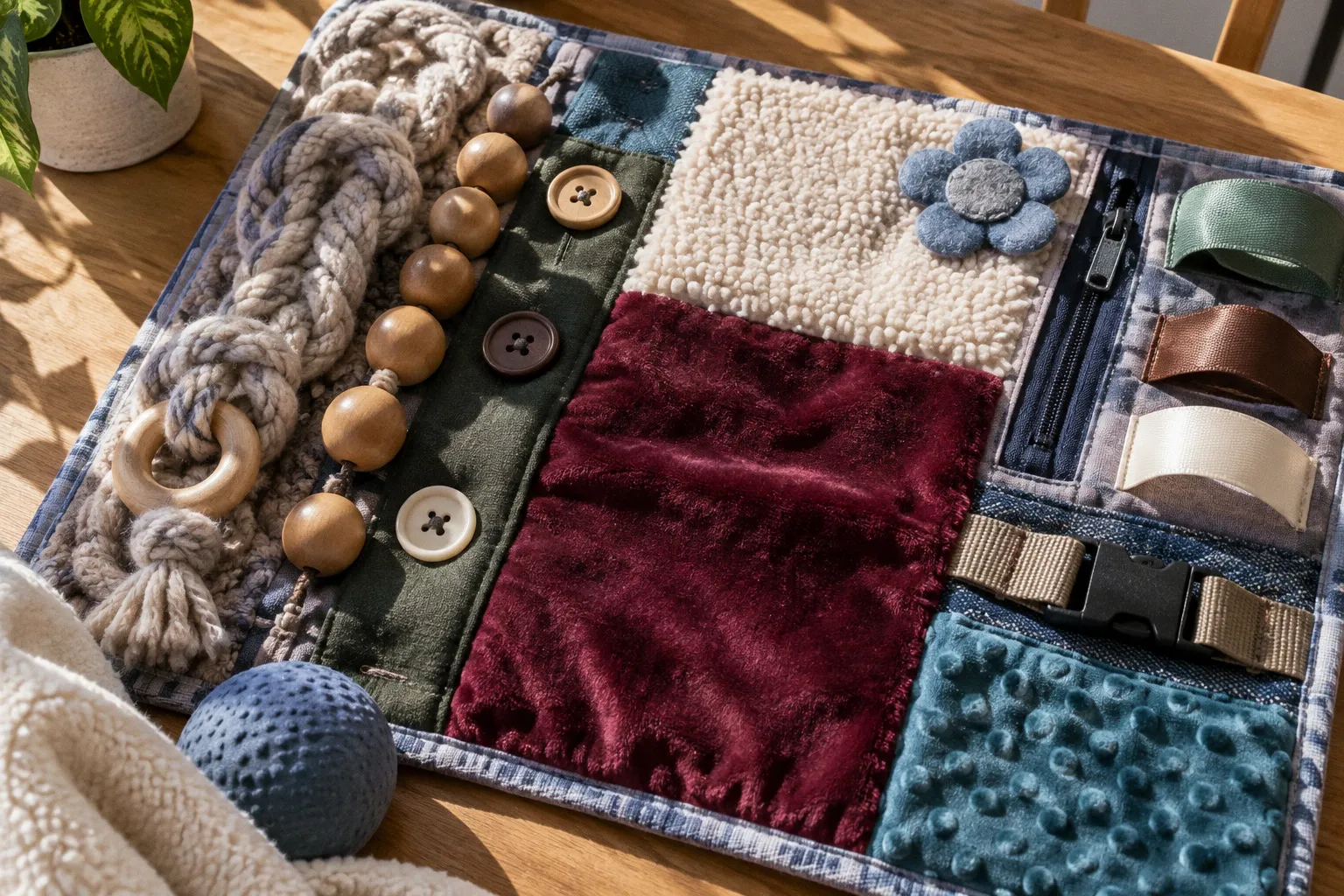
The behavior may look purposeless, but it usually has a behavioral expression. Restless hands can reflect anxiety, boredom, discomfort, poor circulation, an unmet need, or an environment that has become too demanding.
Dementia sensory mats for agitation management are useful because they give those hands something safe, familiar, and appropriately interesting to do. They are not a treatment for cognitive decline, and they will not resolve pain, delirium, constipation, medication effects, or an unsafe care routine. But when we match the tactile design to the resident’s sensory baseline and the moment of the day, these tools can support non-pharmacological agitation relief for seniors without taking away choice or dignity.
I compared three practical design types used in memory care: multi-textured lap mats, convertible mat-muff hybrids, and weighted gel pads. The best overall choice for most residents is the multi-textured lap mat, provided it is made with adult-appropriate materials and supervised during use. The mat-muff hybrid is more adaptable for cold hands and persistent fidgeting. Weighted pads can be helpful for some residents who respond well to deep pressure, but they require the most careful screening and should not be treated as a universal calming device.
What tactile stimulation can—and cannot—do
Tactile activity works by giving the resident controlled sensory input through the hands. Fabrics, fasteners, ribbons, fleece, silk, buttons, buckles, zippers, and soft textured surfaces offer different levels of resistance and movement. That variety can help redirect repetitive hand activity into a safer, more organized task.
The clinical goal is not to keep a resident continuously occupied. That standard is both unrealistic and unhelpful. Our goal is narrower: to provide a familiar sensory option that may reduce restlessness, support emotional regulation, and make a difficult part of the day more manageable.
A sensory mat is most likely to be useful when:
- the resident already seeks tactile input by rubbing, folding, pulling, or squeezing;
- the agitation is mild or moderate rather than caused by acute distress;
- the resident can still use both hands safely;
- the material is offered before the behavior reaches a crisis point;
- the activity fits the person’s abilities, preferences, and visual tolerance.
A mat is not the right first response when agitation appears suddenly or is accompanied by a meaningful change in alertness, mobility, appetite, continence, speech, or balance. Sudden behavioral change can signal pain, infection, medication effects, dehydration, constipation, or delirium. In those situations, we first assess the resident’s physical and clinical needs rather than placing a sensory tool in their lap.
The most effective sensory tool is not the most elaborate one. It is the one that matches the resident’s hands, attention span, comfort, and dignity at that particular moment.
The three designs at a glance
The designs overlap, but they do not solve the same problem. A lap mat offers the broadest range of hand activities. A mat-muff hybrid is better when warmth and continuous squeezing matter. A weighted gel pad provides a different kind of input: sustained pressure rather than manipulation.
| Design | Best suited to | Main benefit | Main limitation | Supervision level |
|---|---|---|---|---|
| Multi-textured lap mat | Residents who enjoy opening, fastening, rubbing, and sorting | Offers several tactile activities in one stable surface | Too many elements can become visually or cognitively overwhelming | Moderate |
| Convertible mat-muff hybrid | Residents with cold hands or persistent hand-to-hand fidgeting | Combines a flat activity surface with warmth and a squeezable object | Roll-up mechanism and detachable parts need regular inspection | Moderate to high |
| Weighted gel pad | Residents who respond positively to steady pressure | May support emotional regulation and reduce restlessness during seated activities | Weight can be uncomfortable or unsafe for some residents | High, especially at first |
There is no universal ranking based on agitation reduction. Comparative clinical evidence does not establish that one of these three designs consistently outperforms the others for every resident. The practical decision is therefore a fit question, not a contest between products.
1. Multi-textured lap mats: the strongest general-purpose option
A standard lap mat is usually the most versatile starting point for memory care. The resident can explore it with one hand or both, use it during seated activities, or return to it repeatedly throughout the day. A stable base also makes the activity easier to introduce than a loose collection of fidget objects.
Common components include:
- zippers that open and close with a clear beginning and end;
- large buttons and fabric loops;
- ribbons with different widths and textures;
- buckles that provide resistance without requiring fine precision;
- fleece, silk, corduroy, or other contrasting fabrics;
- pockets that can be opened, closed, or used to hold a soft object.
A practical lap activity mat is often built around dimensions of approximately 24 by 19 inches, or 56 by 47 centimeters. That size is large enough to offer several activities without becoming difficult to place on a wheelchair or chair tray. A non-slip flannel or fleece backing helps the mat remain on the resident’s lap rather than sliding to the floor every few minutes.
Why the format works
The strongest feature of the lap mat is choice. A resident may ignore the zipper but spend several minutes rubbing a fleece panel. Another person may focus on pulling ribbons through a loop or repeatedly opening a pocket. This is valuable because we do not have to predict the single activity that will be calming. The mat lets the resident locate the most comfortable form of input.
It also creates an observable behavioral sequence. We can see whether the resident reaches for a particular texture, becomes more settled after manipulating a fastener, or abandons the mat because the surface is too busy. Those observations help us adjust the care approach rather than labeling the person simply as restless.
The weakness is that variety can become overstimulation. Eight detachable or fixed manipulative activities may sound useful, but a dense arrangement of bright elements can be difficult for a resident with visual processing changes. If every surface competes for attention, the mat may increase frustration rather than reduce it.
For residents with moderate or advanced dementia, we generally get better results from a few large, distinct features than from many small ones. Oversized fasteners are easier to locate and less likely to create a fine-motor struggle. Strong contrast between materials is helpful, but excessive visual contrast is not always calming.
How to introduce a lap mat
Place the mat within reach when the resident is seated and relatively regulated. Offering it in the middle of escalating agitation can make the object feel like a demand. Instead of instructing the resident to use it, place one accessible feature near the dominant hand and allow time for exploration.
A useful sequence is:
1. Set the sensory baseline. Notice whether the resident is comfortable, warm enough, awake, and free from obvious pain. A sensory tool should not substitute for basic assessment.
2. Reduce competing stimulation. Lower the television volume, move away from a busy doorway, or remove unnecessary objects from the immediate space.
3. Offer one section first. Turn the mat so that a soft texture or large fastener is easiest to reach.
4. Model without taking over. You may slowly open a zipper or touch a fabric panel, then pause. Avoid placing the resident’s hand on the object unless consent and comfort are clear.
5. Watch for the behavioral expression. Slower hand movements, relaxed shoulders, reduced vocal distress, or longer attention may suggest that the input is helpful.
6. Stop when the resident signals enough. Pushing the activity after the resident turns away, throws it, or becomes more tense can turn a calming option into another demand.
This approach applies equally to tactile therapy boards for dementia and to fidget blankets for Alzheimer’s patients. The name matters less than the design, the resident’s response, and the way staff introduce it.
2. Convertible mat-muff hybrids: best for warmth and continuous fidgeting
A convertible mat-muff hybrid combines two uses in one design. Open flat, it functions as an activity mat with buttons, fasteners, and other tactile elements. Rolled or folded, it becomes a hand muff that can provide warmth and contain a squeezable fidget ball.
This design is particularly relevant for residents with poor circulation or persistently cold hands. Cold fingers can intensify rubbing, gripping, and pulling behaviors. A warm hand muff may address part of the discomfort while giving the resident something to squeeze or hold.
The hybrid also helps when a resident does not remain interested in a flat activity surface. Some people prefer a repetitive movement that can continue without visual attention: squeezing a soft ball, rubbing fabric between the fingers, or placing both hands inside a warm enclosure. That makes the muff format useful during television, music, group programs, or transitions through the building.
Where the hybrid has an advantage
The mat-muff design is the most adaptable of the three. Staff can begin with the flat mat when the resident is alert and interested in purposeful manipulation. If attention decreases, the same item can be converted into a warmer, simpler object without introducing something unfamiliar.
That continuity matters in memory care. Changing the object at every stage of agitation can add to the environmental load. A familiar item that changes function may be easier to accept than a new tool presented after distress has already intensified.
The limitation is mechanical complexity. A hybrid may contain folds, closures, a removable ball, or other components that need closer inspection. Any detachable part can become a choking hazard if the resident mouths objects, pulls forcefully, or has reduced safety awareness. Staff should inspect seams, fasteners, and attachments as part of routine care rather than waiting until something breaks.
The muff should also remain loose enough for comfortable hand movement. A resident who cannot easily withdraw their hands may become frightened or feel restrained. Never use the design to hold a resident’s hands in place, and do not leave it on a person who is repeatedly attempting to pull it over the face or around the neck.
When it is the better choice
Choose a mat-muff hybrid over a conventional lap mat when:
- the resident’s hands are often cold;
- the person seeks warmth as well as texture;
- squeezing is more successful than manipulating small fasteners;
- the resident becomes restless during seated periods but tolerates soft enclosures;
- staff need one familiar object that can be used in more than one way.
It is less suitable for a resident who dislikes enclosed sensations, becomes anxious when both hands are covered, or pulls apart fabric components. As always, the resident’s response carries more weight than the product description.
3. Weighted gel pads: a more specialized option
Weighted gel pads provide deep pressure touch stimulation rather than a collection of manipulative activities. Common options weigh approximately 3, 5, or 7 pounds. The pressure may feel organizing to a resident who responds well to firm, steady contact, particularly during seated activities or periods of restlessness.
This is not the same as a lap mat. A weighted pad does not offer a sequence of tasks for the hands, and it may not satisfy a resident who needs to open, pull, or sort. Its value lies in sustained pressure and physical presence.
Some residents appear calmer when a weighted pad rests across the lap. Others find it uncomfortable, restrictive, or too warm. A person with reduced sensation may not reliably communicate that the weight is causing pain or pressure. That is why we introduce weighted products gradually and observe closely.
A cautious introduction protocol
Start with the lightest appropriate option rather than assuming that more weight will produce more benefit. Place it across the lap for a brief, supervised period while the resident is awake and able to communicate discomfort in their usual way. Look at the whole behavioral expression, not only whether the hands become still.
Positive signs may include:
- a more settled posture;
- slower, less forceful movements;
- relaxed facial muscles;
- continued participation in conversation or an activity;
- the resident choosing to keep the pad in place.
Concerning signs include:
- repeated attempts to push it away;
- grimacing or guarding;
- changes in breathing;
- increased vocal distress;
- new difficulty shifting position;
- skin redness or pressure at the edges;
- drowsiness that makes the resident unable to reposition safely.
A weighted gel pad should not be placed over the chest or used in a way that limits breathing, transfers, or repositioning. It also deserves additional caution for residents with significant weakness, impaired circulation, fragile skin, respiratory concerns, or limited ability to report discomfort. Facility policy and clinical judgment should guide its use.
Deep pressure is a sensory input, not a restraint. The moment a weighted pad limits movement, communication, or the resident’s ability to refuse, it has crossed the line from support into poor care.
Matching the design to the behavioral expression
The same resident may need different sensory stimulation tools for memory care at different times of day. Sundowning, fatigue, pain, and environmental triggers can alter tolerance. A mat that works after breakfast may be irritating late in the afternoon when the resident is visually tired and less able to manage multiple steps.
The following matching approach is more useful than choosing a product by appearance:
- Pulling at clothing or linens: begin with a fabric-based lap mat that offers ribbons, fleece, or a large pocket. Avoid small loose pieces.
- Repeated rubbing of hands or arms: try contrasting soft textures or a warm muff, while checking for dry skin, pain, or cold temperatures.
- Constant squeezing: consider a soft ball within a mat-muff design before moving to a weighted product.
- Restlessness during group activities: offer a quiet lap mat with a limited number of features so the resident can use it without leaving the group.
- Agitation in a noisy or crowded area: reduce environmental triggers first. A sensory tool cannot compensate for excessive noise, glare, unfamiliar people, or a rushed care interaction.
- Mouthing or pulling apart objects: use only durable, non-detachable elements under close supervision and reassess whether a tactile mat is safe at all.
- Night-time wandering or repeated rising: a mat may occupy the hands while seated, but it does not replace a wandering-prevention plan, toileting support, lighting adjustments, or assessment for unmet needs.
The objective is not to eliminate movement. Movement is communication and part of many residents’ normal sensory regulation. We are trying to make the movement safer, more comfortable, and less likely to result in injury or conflict.
Design quality matters more than decorative appeal
Dementia sensory mats are sometimes made to look like children’s activity toys. That can be a serious mismatch for an older adult. A resident may have advanced cognitive impairment and still retain adult preferences, personal history, and a clear response to being treated in a childish way.
Evidence-based design guidance from dementia care researchers emphasizes dignity, tactile variety, and appropriate aesthetics. In practice, that means choosing materials and colors that resemble adult clothing, household textiles, tools, or hobbies rather than nursery toys. A restrained palette and purposeful layout may be more inviting than cartoon prints and excessive decoration.
When selecting or making a mat, look for:
- sturdy stitching and reinforced attachment points;
- washable, odor-free materials;
- textures that are clearly different without being abrasive;
- fasteners large enough for the resident’s motor abilities;
- a stable, non-slip backing;
- no sharp edges, exposed pins, loose threads, or fragile decorations;
- a size that fits comfortably on the lap without interfering with transfers;
- removable or cleanable components where infection-control practice requires them.
Fabric choice has a clinical consequence. Silk may offer a smooth, cool sensation, while fleece provides warmth and softness. A rough or scratchy textile may be stimulating for one person and distressing for another. We should observe the resident’s hands and skin rather than assuming that “more texture” is automatically better.
Keep a simple response record
A full behavior chart is not necessary for every use, but a short record can reveal patterns. Note:
- the time of day;
- what happened immediately before the agitation;
- which design was offered;
- how the resident interacted with it;
- whether the person became more settled, unchanged, or more distressed;
- how long the item was tolerated;
- any safety concern or maintenance issue.
This helps distinguish a genuinely useful intervention from one that merely stops a visible behavior for a few minutes. It also shows whether environmental triggers are driving the pattern. If agitation occurs every afternoon in the same noisy hallway, the most effective intervention may be changing the setting rather than adding another object.
What I would choose for a memory care program
For a facility building a small sensory activity program, I would start with several well-made multi-textured lap mats rather than purchasing only weighted pads. They are the most flexible, easiest to adapt, and most likely to serve residents with different hand skills and preferences.
I would add mat-muff hybrids for residents who need warmth, continuous squeezing, or a familiar object during transitions. Weighted gel pads would be a targeted addition, introduced individually and documented carefully rather than distributed as a standard agitation intervention.
My practical ranking is:
1. Multi-textured lap mat: best overall balance of versatility, accessibility, and resident choice.
2. Convertible mat-muff hybrid: best for cold hands, repetitive squeezing, and residents who benefit from one object with two levels of complexity.
3. Weighted gel pad: potentially useful for selected residents who respond to steady pressure, but the least forgiving design when the fit is wrong.
That ranking is about operational usefulness, not proof that one device reduces agitation more than another. The research base does not provide universal comparative percentages across these specific tactile designs, and we should not present a sensory mat as a clinically validated cure. The tools work within a broader approach that includes comfort assessment, meaningful activity, communication support, mobility, sleep routines, and attention to environmental triggers.
The final decision should follow the resident, not the product
A sensory mat earns its place in memory care when it supports agency. The resident can reach for it, ignore it, hand it back, or move on to another activity without being corrected. Staff can offer it without turning the moment into a test of cooperation. Families can recognize it as a comfort and engagement tool rather than a way to keep a person quiet.
Start with the least complicated design that matches the observed need. Introduce it when the resident is relatively calm. Watch the hands, posture, face, breathing, and willingness to continue. If the response is neutral or negative, change the texture, reduce the number of features, alter the setting, or stop using the item. Do not escalate stimulation simply because the first attempt did not work.
The best dementia sensory mats for agitation management do not erase behavioral expression. They help us listen to it more carefully. When we treat restless hands as communication rather than inconvenience, tactile care becomes more than an activity: it becomes a practical way to preserve comfort, choice, and dignity during a difficult part of the day.
FAQ
Are sensory mats a cure for dementia-related agitation?
How do I know which sensory mat design is best for a resident?
When should I avoid using a sensory mat?
Can weighted gel pads be used for all residents?
Should sensory mats look like children's toys?
Related articles
 Memory & Cognitive CareDementia care facility transitions: common pitfalls to avoid
 Monroe Community Hospital Launches Friendship Place for Specialized Memory Care
 Memory & Cognitive CareSensory Stimulation Tools for Dementia by Stage
 Memory & Cognitive CareCircadian Lighting for Sundowning: What Our 6-Week Test Showed