Therapeutic gardening programs: matching garden types to resident needs
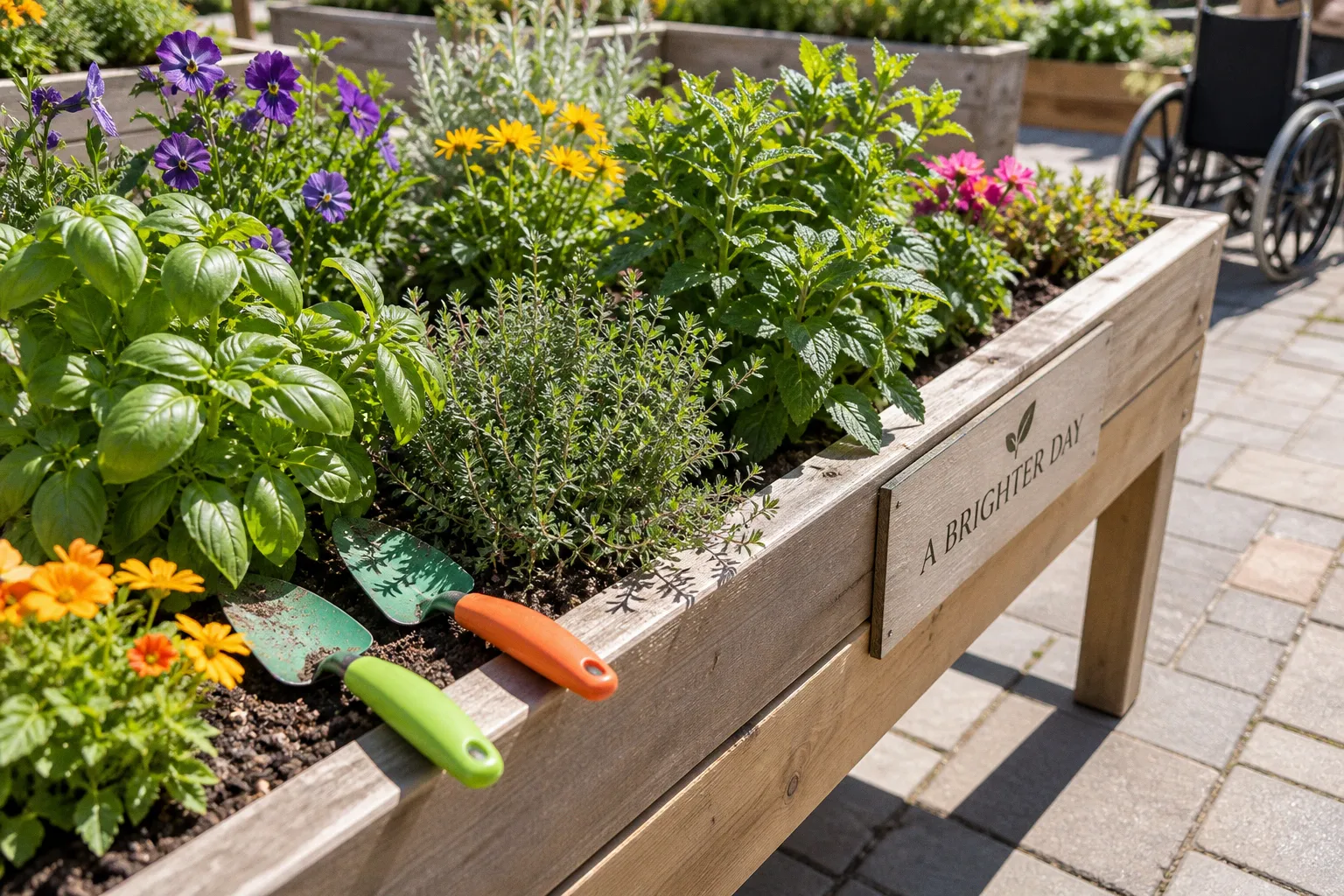
A therapeutic gardening program can fail before the first seed is planted. The raised bed may be too deep for a resident using a wheelchair, the path may be wide enough for one walker but not for a turning chair, or the planting activity may demand sustained attention from someone whose cognitive abilities fluctuate throughout the day.
In assisted living and long-term care, the garden is not simply an attractive outdoor amenity. It is part of the care environment. Its design influences whether a resident can participate independently, whether staff can provide support without taking over, and whether the activity feels meaningful rather than like another scheduled task. The strongest therapeutic gardening programs for assisted living residents begin with the person’s mobility, sensory baseline, attention span, and comfort with unfamiliar surroundings.
The practical question is not whether a community should have raised beds, a sensory garden, or indoor planters. It is which format gives a particular group of residents the safest and most dignified way to engage.
The clinical value of horticultural engagement
Gardening offers several forms of participation at once. A resident may touch soil, sort seeds, smell herbs, water a plant, observe a change in growth, or simply sit near familiar greenery. That range matters because not every resident can complete a full gardening task, and participation should not be measured only by whether a plant was successfully potted.
For residents with dementia or other cognitive changes, structured horticultural activities can support sensory engagement and reduce the number of competing demands placed on attention. A familiar smell may prompt reminiscence. Handling a large seed packet may provide an easier starting point than following several verbal instructions. Repeated activities, such as watering the same container each morning, can also create a predictable rhythm within the day.
Research cited by senior care advocates has linked daily gardening participation with a 36% reduction in risk factors associated with dementia. That figure should be interpreted carefully. It does not show that gardening prevents dementia or reverses cognitive decline, and it does not mean that every resident will experience the same outcome. It does support a more measured conclusion: regular gardening can be a useful component of an active aging and mental well-being program, particularly when it is adapted to the resident rather than treated as a generic recreation offering.
The horticultural therapy benefits for seniors also extend to physical function. Reaching for a plant, carrying a small watering container, pinching herbs, or transferring soil can involve hand strength, balance, trunk control, and upper-limb range of motion. These movements should never substitute for prescribed rehabilitation, but they can reinforce functional goals in a familiar, motivating context.
What makes the activity therapeutic
A therapeutic gardening program typically has more structure than an informal garden club. Staff identify an appropriate task, modify the environment, observe the resident’s response, and adjust the activity over time. A successful session might involve:
- choosing between two herbs rather than selecting from a crowded collection of plants;
- watering a container with a lightweight vessel that does not require excessive grip strength;
- touching and smelling herbs as a sensory activity without requiring verbal recall;
- planting large seeds or seedlings when fine-motor control is limited;
- harvesting a small amount of mint or basil for use in a meal or beverage;
- sitting beside a garden bed and observing seasonal change when active participation is not appropriate.
We should also watch for the resident’s behavioral expression. Restlessness, refusal, repeated questioning, or withdrawal may indicate that the task is too demanding, the environment is overstimulating, or the person is uncomfortable. The right response is adaptation, not pressure.
The goal is not to produce perfect plants. The goal is to create a safe, repeatable way for residents to engage with movement, memory, sensation, and choice.
Raised beds: the most flexible outdoor format
Raised garden beds for senior mobility are often the best starting point for a community garden because they can be built around different seating and transfer needs. They can support residents who stand, residents who sit on a bench, and residents who approach in a wheelchair. But a raised bed is accessible only when its dimensions match the people using it.
For seated wheelchair users, a raised bed height of approximately 24 inches, or about 615 millimeters, is commonly recommended. Table-top planters require at least 27 inches of knee clearance underneath so the wheelchair can move into the gardening position. These measurements are useful design references, not universal prescriptions. Seat height, footrests, armrests, cushion thickness, and the individual’s posture all affect access.
A bed designed for standing or bench-based gardening may be closer to 30 inches, or approximately 690 to 760 millimeters. That height can be comfortable for one group and unusable for another. Before construction, the community should observe residents in their actual mobility devices rather than relying on a catalogue diagram.
Depth is equally important. A bed accessible from both sides should generally be no more than 3 to 4 feet wide. If a resident can work from only one side, the accessible depth should be approximately 20 inches, or 500 millimeters, to prevent overreaching. When a bed is too deep, residents may lean across the soil, twist their trunk, or reach from the front of a wheelchair. Those movements can compromise balance and create unnecessary strain.
Raised bed options compared
| Garden format | Best suited to | Main advantage | Common limitation |
|---|---|---|---|
| 24-inch raised bed | Wheelchair users and residents gardening from a seated position | Allows access to the planting surface without bending to ground level | May still be difficult if the resident cannot position the chair close enough |
| Table-top planter | Residents with limited lower-limb mobility or those using a wheelchair | Provides knee clearance and a compact working area | Requires careful placement so the frame does not obstruct footrests or transfers |
| Approximately 30-inch bed | Standing gardeners and residents seated on a standard bench | Comfortable for many standing or semi-seated tasks | Can be too high for wheelchair users |
| Narrow one-sided bed | Residents who approach from a fixed path | Reduces overreaching and simplifies staff positioning | Offers less planting area and requires precise placement |
| Wide double-sided bed | Two residents or a resident and staff member working together | Supports shared activity and easier supervision | Must remain within a safe reach depth from both sides |
For communities serving residents with mixed abilities, several smaller beds are usually more useful than one large installation. Separate beds allow staff to offer different levels of physical demand and reduce crowding during group sessions. A resident who cannot reach into a deep bed may still be able to tend a narrow herb planter independently.
Pathways determine whether the garden is actually accessible
A garden can have correctly measured beds and still be functionally inaccessible. The route to the bed must accommodate walkers, wheelchairs, staff assistance, and the turning movement required when a resident needs to leave without backing up.
General ADA guidance identifies 36 inches as a minimum accessible path width. In senior living gardens, however, a more practical target is often 48 to 60 inches. That additional space accommodates walkers, wheelbarrows, side-by-side support, and wheelchair turning radiuses. It also gives staff room to assist without pressing a resident against a planter or another person.
A manual wheelchair may require a turning circle of approximately 1,575 millimeters, or 62 inches. The exact maneuvering space depends on the chair, the user’s skill, and whether staff are helping, but the design implication is straightforward: a narrow corridor between beds is not enough. Turning areas should be planned at corners, near seating, and wherever a resident may need to change direction.
Surface quality is as important as width. Loose gravel can be difficult for small front casters. Uneven pavers increase the effort required from residents using walkers. Wet surfaces may become slippery, while strong changes in texture can be confusing for a person with visual or perceptual changes. We should select a firm, stable surface and keep transitions visible and minimal.
The route should also be legible. Clear sightlines, consistent bed placement, and recognizable landmarks can help residents navigate without constant verbal prompting. Excessive decoration may create visual noise, particularly for people living with dementia. A simple layout is not a sterile one; it is often easier to understand and safer to use.
Design details that support staff and residents
An accessible garden should account for the work of care teams as well as the needs of residents. Staff may need to push a wheelchair, carry adaptive tools, manage a group activity, or respond to a sudden change in behavior. Consider:
- seating with armrests and a stable back, positioned near but not inside the main travel path;
- shade or covered areas to reduce heat exposure and fatigue;
- hose placement that does not cross walking routes;
- tool storage close enough to reduce carrying but secure enough to prevent clutter;
- edges that are visible and easy to distinguish from the path;
- drainage that prevents standing water around the beds;
- a quiet retreat area for residents who become overstimulated;
- lighting that supports safe late-afternoon use without creating glare.
These features may appear operational rather than therapeutic, but they directly affect participation. If staff must spend the entire session managing trip hazards and moving equipment, residents receive less attention. If the garden is difficult to supervise, the program will gradually become less consistent.
Sensory gardens for memory care: purposeful stimulation, not clutter
Sensory gardens are particularly useful in memory care when planting is intentional. The aim is not to fill every available space with color and fragrance. Too much stimulation can increase confusion, agitation, or withdrawal. We want a clear sensory baseline: a familiar level of sound, scent, visual contrast, and activity against which changes in behavior can be noticed.
Aromatic herbs such as basil, mint, and thyme can engage smell and touch. Their leaves are easy to recognize, and their scents may connect with cooking, household routines, or earlier gardening experience. The plant itself does not need to trigger a specific memory to be useful. A resident may simply find the scent pleasant or calming.
Plant texture can also support engagement. Large, sturdy leaves may be easier to handle than delicate stems. Plants with clear visual differences help residents identify where one activity begins and another ends. If a community uses plants that may irritate the skin, cause allergic reactions, or become unsafe when ingested, staff need a clear plan for supervision and selection. The garden should not depend on residents remembering which plants are safe.
For residents with dementia, an activity should have a visible beginning and end. A staff member might present one tray of herbs, one pair of gloves, and one simple task rather than opening a full cabinet of tools and asking the resident to choose. We can then increase or reduce complexity based on the person’s response.
Match the sensory demand to the resident
| Resident presentation | More suitable garden approach | What staff should watch |
|---|---|---|
| Enjoys familiar smells and conversation | Herb bed with guided smelling, touching, and harvesting | Signs that the scent is too strong or the conversation becomes demanding |
| Has limited attention span | One-container task with a clear start and finish | Repetition, frustration, or attempts to leave the activity |
| Becomes anxious in busy environments | Quiet sensory bed with limited visual clutter | Changes in pacing, vocal distress, or guarding behavior |
| Has reduced hand strength | Large-handled tools, sturdy plants, and lightweight containers | Grip fatigue and compensatory movements |
| Has visual impairment | High-contrast bed edges, tactile plants, and verbal orientation | Unsafe reaching or difficulty locating the work surface |
| Has a strong interest in cooking | Culinary herbs connected to meals or beverages | Overharvesting, unsafe ingestion, or disappointment when the activity is delayed |
The staff member’s communication style matters. Give one direction at a time, use the resident’s preferred form of address, and allow enough processing time before repeating the instruction. If the resident does not want to touch soil, offer a different role. Sorting labels, smelling herbs, observing watering, or choosing where a pot should sit are all legitimate forms of participation.
Indoor gardening for residents with limited mobility
Outdoor gardens are valuable, but they cannot carry the entire program. Heat, rain, winter conditions, fatigue, infection-control considerations, and transportation between care areas may make indoor gardening more practical on many days. Indoor gardening activities for elderly residents should not be treated as a lesser substitute. For some residents, a table-top activity offers better control of posture, lighting, temperature, and supervision.
Table-top planter boxes are especially useful when the resident can sit comfortably at a table but cannot safely reach a floor-level container. The planter should leave at least 27 inches of knee clearance beneath it for wheelchair access. Staff should also check the depth of the table, the position of the wheelchair footrests, and whether the resident can bring both arms forward without leaning excessively.
Indoor activities can include:
1. Planting large seeds or seedlings. These require less precision than tiny seeds and make the change in the container easier to see.
2. Maintaining herb pots. Residents can smell, touch, and trim herbs with adapted scissors when appropriate.
3. Preparing potting materials. Scooping a small amount of soil or arranging labels can provide purposeful hand activity without requiring heavy lifting.
4. Observing plant changes. A simple growth record with pictures may be more accessible than written documentation.
5. Creating a watering routine. A marked lightweight container can help staff offer a consistent task without asking the resident to judge how much water to use.
6. Propagating cuttings in clear containers. Visible roots and water levels can make the process engaging for residents who benefit from immediate visual feedback.
Indoor placement requires clinical judgment. Plants should not block corridors, create a tipping hazard, or shed soil into shared care areas. Watering schedules need to account for spills, mold, pests, and the possibility that a resident may drink from an unlabeled container. If the activity takes place in a dining or therapy space, the team should establish how materials are cleaned and stored between sessions.
Natural light can be helpful, but direct glare may make it harder for residents with visual changes to see the planting surface. A well-lit table with neutral surroundings is often more functional than a bright window ledge crowded with containers.
Choosing the right format for a care community
The best therapeutic gardening programs are not necessarily the largest or most elaborate. They are the ones staff can run consistently and residents can approach safely. Before selecting a format, we should compare the program’s actual population with the physical demands of each option.
A community with many wheelchair users may benefit from several 24-inch raised beds, table-top planters, wide paths, and sheltered seating. A community serving residents who walk independently but tire easily may place greater emphasis on approximately 30-inch beds, frequent benches, shade, and short routes between indoor and outdoor areas. A memory care neighborhood may need a smaller sensory garden with familiar herbs, strong visual boundaries, and fewer simultaneous activities.
The following questions help turn a general garden idea into an operational program:
- Can residents reach the planting surface without twisting, leaning, or standing unsupported?
- Can a wheelchair turn at the end of each path without reversing into another person?
- Can a staff member assist from the side rather than standing directly behind the resident?
- Are there quiet areas for residents who need a lower-stimulation environment?
- Can the same activity be simplified for a resident with reduced attention or increased fatigue?
- Are tools easy to identify, safe to store, and appropriate for the resident’s grip?
- Does the garden remain usable in different weather conditions?
- Can staff observe the whole area while supporting one resident closely?
- Are the plants selected for sensory interest and practical safety rather than decoration alone?
- Is there a clear way to document what helps or worsens a resident’s behavioral expression?
That final question is particularly important. Gardening can reveal environmental triggers that are less obvious indoors. A resident may become distressed when the area is crowded, when the hose is running, or when several strong scents are present. Another resident may become more settled after a brief period of repetitive watering. Recording these patterns helps the care team adapt the activity instead of labeling the resident as unwilling or difficult.
Accessibility is not a single measurement. It is the fit between the resident, the equipment, the task, the pathway, and the support available in that moment.
A practical verdict on garden types
For most assisted living and skilled nursing settings, raised beds are the strongest general-purpose option because they can be built in different heights and depths and can support both individual and group activities. They work best when communities use several compact beds rather than one oversized structure.
Table-top planters are the better choice for residents who garden from a wheelchair or who cannot safely stand at a raised bed. They offer excellent control over reach distance, but the supporting table must provide adequate knee clearance and stable wheelchair positioning.
Sensory gardens are most valuable in memory care when they are restrained, familiar, and carefully supervised. Aromatic herbs and tactile plants can encourage engagement, but the design should avoid overwhelming residents with too many scents, colors, or competing activities.
Indoor gardening is the most adaptable format for residents with fluctuating stamina, limited mobility, or sensitivity to weather. It should be designed as a complete program rather than an improvised rainy-day substitute, with suitable tables, materials, storage, and infection-control routines.
In practice, a blended model usually serves residents best: accessible outdoor beds for movement and shared activity, sensory planting for memory care, and indoor containers for days or residents who need greater environmental control. No single garden type can meet every mobility and cognitive need.
The most meaningful measure of success is not the number of planters installed or the amount harvested. It is whether residents are offered genuine choices, whether staff can adjust the activity without taking away control, and whether the environment supports participation without exposing people to unnecessary risk. When therapeutic gardening is designed around those principles, it becomes more than a recreational amenity. It becomes a practical extension of person-centered care—one that preserves dignity through small, manageable opportunities to move, notice, remember, and choose.
FAQ
What is the recommended height for a raised garden bed for wheelchair users?
How wide should garden paths be in a senior living community?
What are the benefits of using table-top planters?
How can gardening activities be adapted for residents with dementia?
Does gardening prevent or reverse dementia?
Related articles
 Senior Wellness & LivingSocial activities for introverted seniors in assisted living
 Senior Wellness & LivingAssisted Living Dining Options for Specific Dietary Needs
 Senior Wellness & LivingSeated Exercise Gear for Seniors: What Works and When
 Senior Wellness & LivingGeriatric Protein Drinks: Testing Three Formulations