Ankle foot orthosis models: three designs for stroke recovery
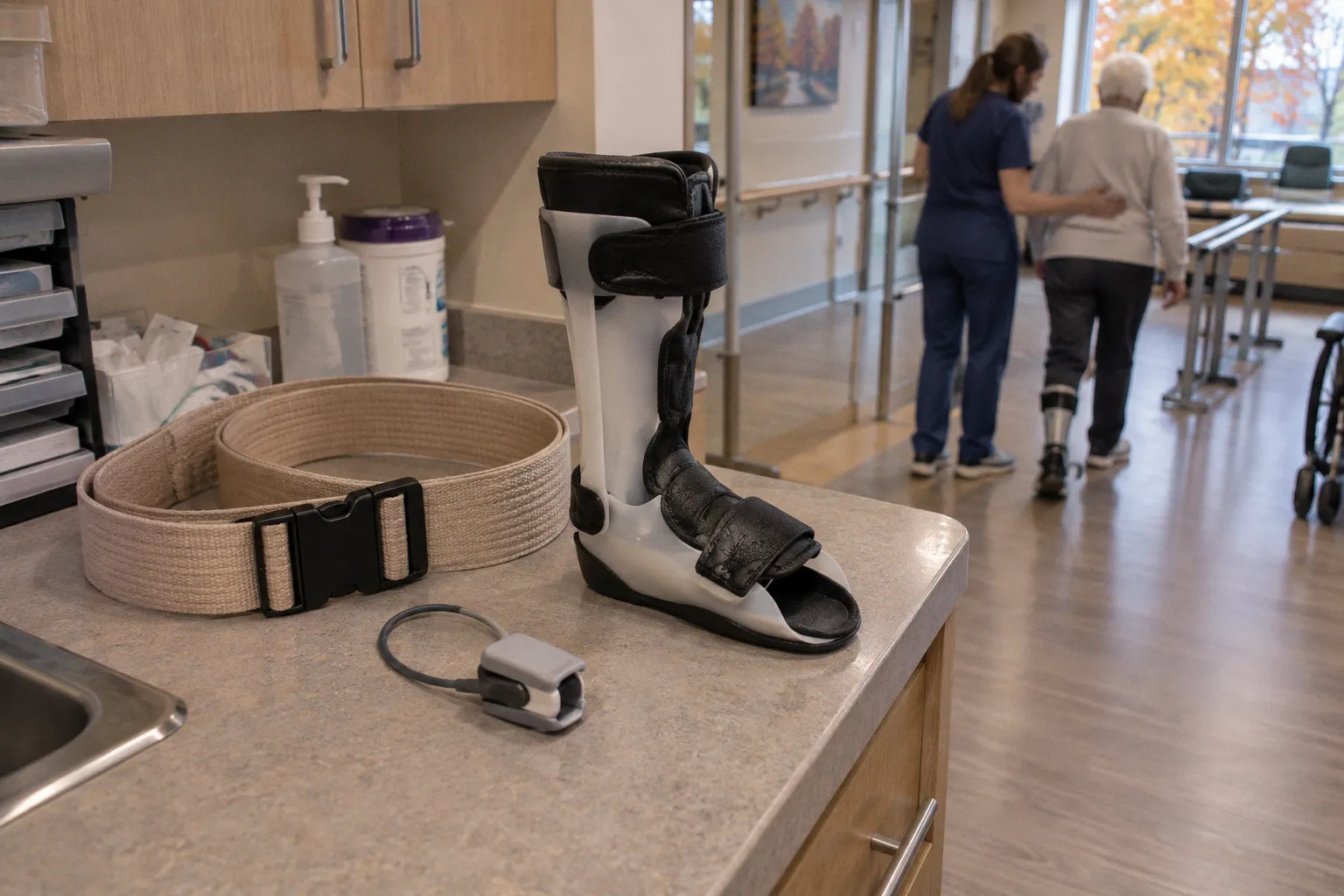
That distinction matters most when a patient is leaving inpatient rehabilitation: the brace must control foot drop and instability without creating a new barrier to transfers, stair negotiation, dressing, or safe community mobility.
The three designs most often compared are the solid ankle-foot orthosis, the articulated or hinged AFO, and the posterior leaf spring, often grouped under dynamic AFOs. They do not solve the same biomechanical problem. A solid AFO prioritizes control. A hinged AFO preserves selected ankle motion. A posterior leaf spring uses controlled flexibility to assist foot clearance and forward progression.
In a post-stroke ankle foot orthosis comparison, the right question is not which model is universally best. The useful question is narrower: how much ankle motion can this patient safely use, how much external control do they require, and which design produces the strongest gait stability with the least cost to ADL independence?
Start with the mobility barrier, not the brace category
After stroke, gait failure rarely comes from one isolated deficit. Foot drop may combine with plantar-flexor spasticity, quadriceps weakness, poor hip control, impaired proprioception, reduced selective motor control, or a tendency to load the unaffected limb for too long. The orthosis addresses only part of that chain.
During the swing phase, inadequate dorsiflexion can leave the toes close to the floor. The patient compensates with hip hiking, circumduction, vaulting on the opposite side, or a slower step pattern. During stance, the same ankle may collapse into excessive plantarflexion or inversion, reducing the base of support and shifting the center of mass outside the patient’s control.
That is why I do not treat an AFO as a passive foot-drop accessory. It is a mechanical intervention that changes:
- foot clearance during swing;
- tibial progression over the planted foot;
- mediolateral ankle stability;
- knee position during loading;
- step length and stride symmetry;
- the amount of effort required for each meter walked.
A brace that improves toe clearance but blocks controlled tibial advancement may reduce one risk while creating another. A brace that permits ankle movement but cannot contain inversion may look more natural and still fail under load. The prescription has to follow the movement problem.
The clinical sequence
I use a simple sequence when considering AFO braces for geriatric stroke recovery:
1. Define the failure point. Is the patient catching the toe in swing, collapsing at the ankle in stance, losing the knee into hyperextension, or failing because of fatigue?
2. Assess available passive range. A brace cannot create dorsiflexion when the calf is fixed in a contracture. It can only position or redirect the limb within the range available.
3. Measure motor control. Mild foot drop with useful selective movement is a different problem from severe weakness with uncontrolled inversion and spasticity.
4. Observe loading response and mid-stance. The patient must be watched while accepting body weight, not only while seated or taking a few unchallenging steps.
5. Test function beyond level walking. Transfers, turning, uneven surfaces, stairs, and toileting reveal whether the orthosis improves practical independence.
The most stable brace is not automatically the best brace. It is the best brace only when the patient’s available motor control is insufficient for a less restrictive design.
Solid AFOs: maximum control, minimum ankle freedom
A solid ankle-foot orthosis provides the highest level of rigidity among the three main designs. It limits ankle dorsiflexion and plantarflexion and can provide strong control of inversion, eversion, and unwanted plantarflexion. That makes it a rational choice for severe weakness, marked spasticity, significant mediolateral instability, or a patient who cannot reliably control the ankle during loading.
In practical terms, a solid AFO gives the therapist a stable platform from which to retrain weight transfer. It can prevent the foot from dropping into plantarflexion during swing and can stop the ankle from rolling as the patient accepts body weight. For a patient with a highly unstable ankle, that external control may be the difference between a supported gait trial and an unsafe one.
The trade-off is mechanical, not theoretical. Restricting ankle motion also restricts the normal progression of the tibia over the foot. If the patient cannot move into controlled dorsiflexion during mid-stance, the body may compensate through the knee, hip, or trunk. Some patients develop a stiffer, more abrupt gait. Others increase reliance on the unaffected limb, shorten the involved-side stance time, or slow substantially.
Comparative gait data illustrate this cost. Reported walking speeds were approximately:
| AFO design | Reported walking speed | Primary mechanical priority |
|---|---|---|
| Solid AFO | 0.555 m/sec | Maximum rigidity and ankle control |
| Articulated or hinged AFO | 0.621 m/sec | Controlled dorsiflexion with mediolateral support |
| Posterior leaf spring AFO | 0.629 m/sec | Foot clearance and dynamic assistance |
These values do not establish a universal ranking. A patient who needs a solid AFO for safe stance control should not be moved into a flexible brace simply to pursue a faster number. Walking speed is useful only when it represents a stable, repeatable gait rather than hurried compensation.
When rigidity is justified
A solid design is often defensible when the patient demonstrates:
- severe ankle instability in weight bearing;
- strong plantar-flexor spasticity that forces the foot downward;
- insufficient selective motor control to manage a hinged joint;
- persistent inversion or eversion that threatens lateral stability;
- substantial weakness across the ankle with unsafe foot placement;
- a need to protect alignment while strength and balance are rebuilt.
The prescription becomes questionable when the patient has adequate control for a less restrictive brace but remains in a solid AFO by default. Rigidity can simplify early mobility, but prolonged over-control may limit the ankle strategy needed for more efficient walking. Reassess it as motor recovery changes.
A solid AFO is not a failure of rehabilitation. It is a high-control tool. The failure is keeping the patient in maximum restriction after the movement problem has changed.
Articulated AFOs: preserve motion without surrendering control
An articulated, or hinged, AFO uses an ankle joint to permit controlled sagittal-plane movement while maintaining support in the mediolateral plane. That distinction is central. The brace does not simply make the ankle flexible; it allows selected motion within mechanical limits.
For patients with post-stroke foot drop who can tolerate some ankle movement, a hinged design may improve forward progression. Controlled dorsiflexion allows the tibia to advance over the planted foot during stance, which can reduce the need for compensatory hip and trunk movement. The patient may achieve a more symmetrical step pattern while still receiving support against inversion and uncontrolled plantarflexion.
The hinge must match the patient’s actual problem. Some articulated AFOs are configured to block plantarflexion while permitting dorsiflexion. Others use stops or resistance to limit motion in both directions. The prescription cannot be separated from knee mechanics. If plantarflexion is restricted too aggressively, the knee may be pushed toward hyperextension during loading. If dorsiflexion is permitted without adequate control, the ankle may collapse forward and destabilize the limb.
This is where a rigid vs hinged AFO for seniors comparison becomes clinical rather than commercial. The hinge is useful only when the patient has enough motor control, range of motion, and proximal stability to benefit from the movement it permits.
What to observe during gait
With an articulated brace, watch for four events:
1. Initial contact: The foot should arrive in a controlled position rather than slapping down or landing on the forefoot.
2. Loading response: The ankle should accept body weight without rapid plantarflexion, inversion, or collapse.
3. Mid-stance: The tibia should progress over the foot while the knee remains controlled.
4. Terminal stance and pre-swing: The patient should not be forced into an abrupt, rigid rollover that shortens the involved-side step.
A patient may appear faster in a hinged AFO but still lack the balance to turn safely. That is why I pair gait-speed observation with sit-to-stand performance, turning, obstacle negotiation, and the ability to manage the brace during daily routines.
The hinged model also creates a practical issue: it can be more demanding to fit correctly. Shoe selection, calf tone, ankle range, hinge alignment, and strap tension all influence performance. Misalignment can produce pressure at the malleoli or alter the intended motion. In an older adult with fragile skin, sensory loss, or diabetes, the fitting and skin-monitoring protocol is part of the treatment, not an afterthought.
Posterior leaf spring AFOs: dynamic assistance for selected foot drop
A posterior leaf spring AFO uses a flexible trim line behind the ankle. During loading and movement, the material stores and releases energy, helping the foot clear the floor during swing. It is generally most appropriate for mild to moderate foot drop when the patient needs assistance with dorsiflexion but does not require maximum ankle containment.
The mechanical appeal is straightforward: the brace supports the foot without fully immobilizing the ankle. That can preserve a more dynamic gait pattern and reduce the sensation of walking with a rigid shell. The patient still needs sufficient control to manage stance. A posterior leaf spring is not a substitute for strong mediolateral stabilization when the ankle repeatedly rolls or collapses.
Dynamic designs have also shown a potential energy-efficiency advantage. In one clinical comparison of post-stroke foot-drop interventions, the reported Physiological Cost Index was lower with a dynamic AFO than with a solid polypropylene AFO: approximately 8.476 ± 0.280 versus 11.207 ± 0.427. The practical interpretation is that some patients may walk with less physiological cost in a flexible design.
That finding should be applied carefully. A lower physiological cost does not override unsafe loading. A patient who walks farther but repeatedly loses balance has not achieved a meaningful rehabilitation gain. The brace must reduce effort while preserving gait stability and the ability to recover from perturbation.
Where the leaf spring design can fail
A posterior leaf spring may be the wrong choice when the patient has:
- severe plantar-flexor spasticity;
- marked inversion during stance;
- poor mediolateral ankle control;
- significant fixed equinus;
- inadequate knee or hip stability;
- a need for strong control of the entire ankle-foot complex.
It can also become ineffective when the patient’s footwear is unstable or poorly matched. An AFO functions inside a shoe. A flexible brace placed in a loose, unsupportive shoe will not deliver the same control as the same brace in a properly fitted, stable shoe with adequate depth.
For orthotic devices for foot drop in elderly patients, footwear compatibility is a functional requirement. The patient must be able to put on the shoe, tolerate the brace for the required duration, and walk without pressure points. If the device is too difficult to manage, ADL independence drops even when gait mechanics improve in the therapy gym.
What the gait data actually tell us
The reported walking-speed comparison favors the articulated and posterior leaf spring designs over the solid AFO: 0.555 m/sec with the solid model, 0.621 m/sec with the articulated model, and 0.629 m/sec with the posterior leaf spring model. That pattern is clinically plausible because flexible designs permit more ankle motion and may reduce compensatory effort.
But speed is a single output. It does not tell us whether the patient is safe, whether the knee is controlled, or whether the brace can be used during a full day of mobility. A meaningful post-stroke ankle foot orthosis comparison should include at least five domains:
| Domain | What a strong result looks like | What raises concern |
|---|---|---|
| Foot clearance | Toes clear the floor without excessive hip hiking or circumduction | Recurrent toe catch, scuffing, or compensatory vaulting |
| Stance stability | The patient accepts weight without ankle collapse or repeated inversion | Knee buckling, uncontrolled plantarflexion, or lateral instability |
| Gait efficiency | Walking requires less visible effort and fewer rest breaks | Breathlessness, early fatigue, or excessive reliance on the unaffected side |
| Functional mobility | Safer turns, transfers, stairs, and obstacle negotiation | Good straight-line gait but failure during direction changes |
| Device management | Patient or caregiver can apply, remove, inspect, and clean the brace | Missed wear, skin injury, or dependence on staff for every adjustment |
The brace should be judged across the patient’s real mobility demands. Level walking in a quiet corridor is only one task. A resident may need to cross a dining room, turn around a walker, stand from a low chair, step over a threshold, or reach the bathroom at night. A design that performs well only under ideal conditions is not a complete rehabilitation solution.
The best AFO is the least restrictive design that still controls the patient’s actual instability under load.
Solid versus hinged versus dynamic: a practical decision
The three designs can be understood as a progression from control toward mobility, but do not interpret that progression as a universal upgrade path.
Choose solid control when the ankle cannot yet manage load
Start with a solid design when the patient’s ankle is too weak, spastic, or unstable to maintain alignment during stance. The priority is safe weight acceptance and repeatable foot placement. If the patient cannot control the limb, permitting more motion will not create independence; it will expose the patient to more uncontrolled motion.
As recovery progresses, reassess whether the solid brace is still necessary. Look for improved selective movement, reduced tone, better knee control, and fewer losses of balance. A transition to a hinged or dynamic design should be based on those changes, not on a calendar date.
Choose a hinged design when controlled dorsiflexion can improve progression
A hinged AFO is a strong option when the patient needs mediolateral support and plantarflexion control but can use controlled dorsiflexion during stance. It may improve stride symmetry and walking speed while preserving a more functional ankle strategy.
Do not use the hinge to mask a fixed contracture or severe uncontrolled spasticity. First address range limitations, tone management, and proximal control. Otherwise, the brace may become a mechanical workaround that fails as soon as the patient encounters a step, ramp, or uneven surface.
Choose a posterior leaf spring when foot drop is the main limitation
A posterior leaf spring is most defensible when the primary barrier is swing-phase foot clearance and stance control is already adequate. It can provide dynamic assistance without the mass and restriction of a more rigid design.
The patient must still demonstrate reliable foot placement and sufficient balance. If the ankle rolls during loading or the knee cannot remain stable, the design is too permissive.
Custom versus off-the-shelf AFOs
The custom vs. off-the-shelf AFO question cannot be answered by assuming that custom always means better. Custom fabrication may be necessary when the patient has unusual alignment, significant deformity, severe tone, pressure-sensitive areas, limb-volume changes, or a complex combination of ankle and knee mechanics. It can also permit more precise control of trim lines, stiffness, and contact areas.
An off-the-shelf design may be reasonable when the impairment is relatively straightforward, the limb shape is compatible, and the patient can tolerate the standard geometry. The advantages are usually faster access, simpler replacement, and a more predictable starting point for mild to moderate foot drop.
The critical issue is fit under movement. A device that appears acceptable while seated may create pressure over the fibular head, malleoli, dorsum of the foot, or heel during walking. Older adults may not report early skin injury because of reduced sensation, communication impairment, or cognitive changes. Establish a skin-inspection routine immediately and document redness that does not resolve promptly after the brace is removed.
Also assess whether the patient can manage the device. A technically excellent AFO that cannot be donned with one hand, recognized by a caregiver, or accommodated by the patient’s shoes may reduce independence in practice.
How I judge discharge readiness
Discharge readiness is not established by the phrase “tolerates brace.” It requires measurable functional performance with the actual orthosis and footwear the patient will use.
Before discharge from post-acute rehabilitation, I want evidence that the patient can:
- maintain safe foot clearance over repeated walking trials;
- accept weight on the involved limb without recurrent ankle collapse;
- turn in both directions without catching the toe or losing balance;
- complete sit-to-stand and stand-to-sit transfers with the brace in place;
- walk the expected household or facility distance without unsafe fatigue;
- negotiate the relevant thresholds, ramps, or stairs;
- tolerate the device without persistent pressure or skin breakdown;
- follow the wear schedule and identify when the brace should be removed;
- apply, remove, or obtain assistance with the device reliably;
- use the brace with the prescribed walker, cane, or other mobility aid.
The final decision should also account for cognitive and behavioral factors. A patient may have adequate gait mechanics but forget to wear the brace, leave the straps loose, or walk without the recommended assistive device. That is not a minor compliance problem; it directly changes fall risk.
The verdict
For severe ankle instability, pronounced spasticity, or inadequate motor control, the solid AFO remains the most defensible design because it provides the highest level of external stability. Its cost is restricted ankle motion and, in some patients, slower or more effortful gait.
For patients who can control the limb but need support against plantarflexion and mediolateral movement, the articulated AFO often offers the best balance between gait stability and ankle mobility. It is the strongest middle-ground option when the patient can use controlled dorsiflexion safely.
For mild to moderate foot drop with adequate stance control, the posterior leaf spring AFO may deliver the most dynamic gait and the lowest physiological cost. It should not be used when the ankle requires rigid containment.
The evidence supports a measured preference for flexible designs when they improve walking speed, stride behavior, and energy expenditure without compromising stability. It does not support abandoning solid AFOs. The correct device is the one that produces repeatable foot clearance, controlled loading, usable gait endurance, and greater ADL independence under real conditions.
That is the discharge standard: not the most sophisticated brace, not the fastest single trial, and not the least restrictive shell. The patient should leave rehabilitation with a device that controls the dangerous motion, preserves the useful motion, and makes safe mobility repeatable.
FAQ
Which AFO design is the best for stroke recovery?
How do solid, articulated, and posterior leaf spring AFOs differ in function?
Does a more flexible AFO always result in faster walking speeds?
When is a solid AFO the appropriate choice?
Why is footwear important when using an AFO?
Related articles
 Rehabilitation & RecoveryMobility aids for seniors: top recovery tools after surgery
 Rehabilitation & RecoveryPhysical therapy frequency for stroke recovery in seniors
 Rehabilitation & RecoveryWeighted Utensils for Tremors: Testing Three Designs
 Rehabilitation & RecoveryVitalStim Dysphagia Therapy for Seniors: Is It Worth It?