Occupational therapy tools for post-stroke hand recovery
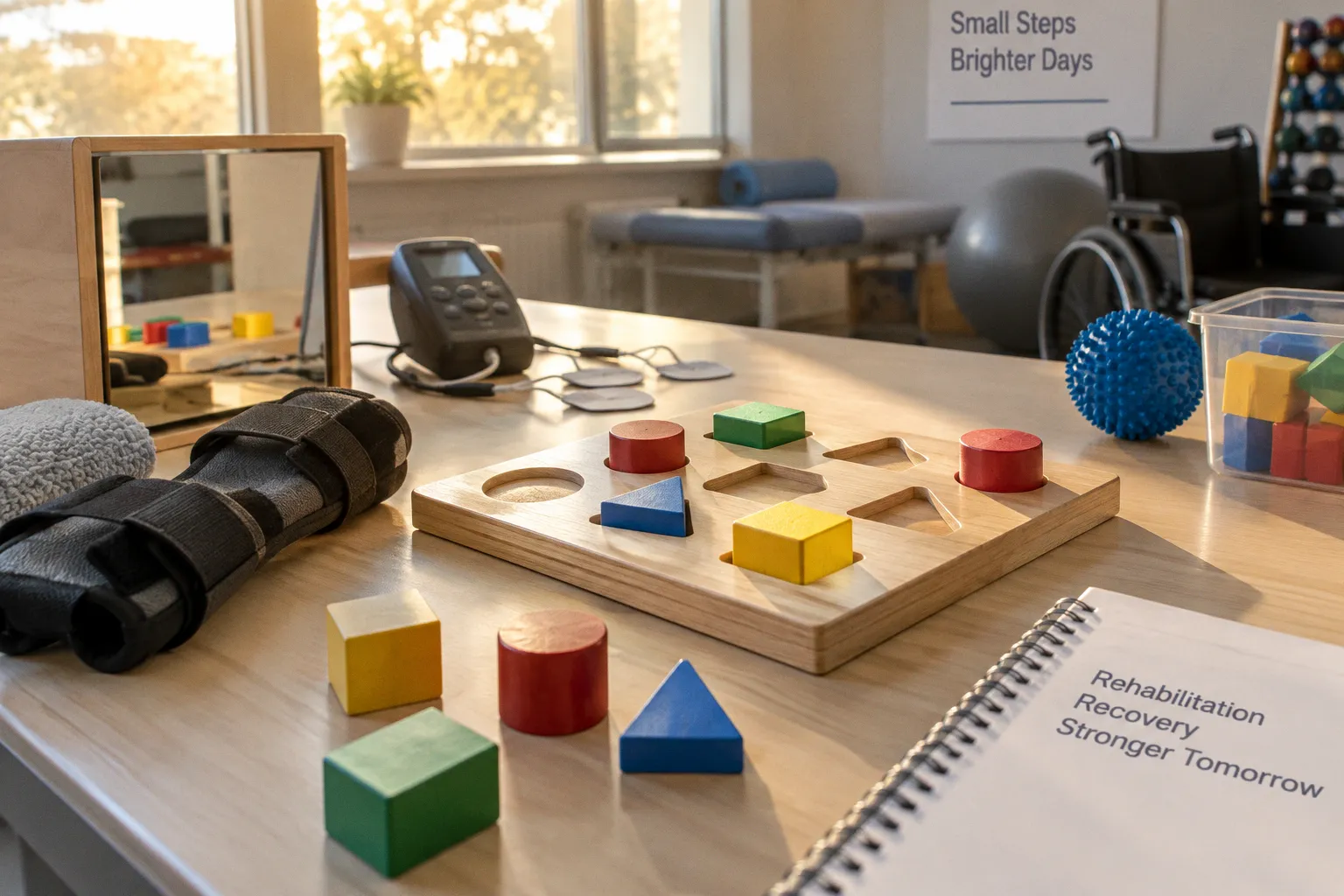
A common post-stroke complication is not complete paralysis. It is the frustrating middle ground: the patient can move the shoulder and elbow, perhaps even flex the wrist, but cannot release a cup, stabilize a shirt cuff, turn a key, or place a hand safely on a walker. The hand has movement, but not useful control.
That distinction matters. Post-stroke hand recovery is not judged by whether a device produces visible motion. I look for improved selective movement, reduced compensatory trunk motion, better grasp-and-release timing, safer weight-bearing, and greater ADL independence. The right occupational therapy tools support those gains. The wrong ones simply create activity without measurable function.
When I assess how to check occupational therapy tools for post-stroke hand recovery, I start with the outcome measure—not the product brochure. A mirror box, electrical stimulation unit, dynamic orthosis, or robotic glove may have a place in treatment, but none should be accepted as a substitute for a skilled evaluation.
Start with the hand’s actual deficit, not the equipment
A stroke can impair several separate components of upper-extremity function:
- Motor selectivity: the ability to move the wrist, thumb, or individual fingers without triggering unwanted mass flexion.
- Strength and load-bearing capacity: the ability to support the body through the affected arm or maintain a stable grip.
- Sensation: the ability to identify pressure, position, texture, and object boundaries.
- Coordination: the timing required to reach, grasp, manipulate, and release.
- Tone and spasticity: involuntary resistance that can pull the wrist and fingers into flexion.
- Attention and motor planning: the ability to initiate and sequence a purposeful task.
- Endurance: the capacity to repeat a movement without rapid loss of quality.
A tool that addresses one of these problems may do very little for another. A robotic glove can assist finger opening, but it does not automatically restore sensation. A splint can protect joint alignment, but it cannot teach the patient how to manipulate a button. Functional electrical stimulation may facilitate muscle activation, but it still requires appropriate timing, screening, and active participation.
I want the treatment plan to answer a practical question: what task will improve if this tool is used consistently?
If the answer is vague—better circulation, more stimulation, more movement—I would not consider the device adequately evaluated. The target should be observable: faster object release, improved reach-to-grasp, more stable utensil use, safer dressing, or increased participation in grooming.
The best hand-recovery tool is not the one that creates the most movement. It is the one that produces the clearest transfer into daily function.
Clinical assessment standards: measure the upper extremity before judging progress
A serious occupational therapy program establishes a baseline before intensifying treatment. In a hospital, nursing home, outpatient clinic, or home-based program, the setting may change. The measurement logic should not.
Initial occupational therapy assessment should ideally begin within 48 hours of hospital admission once the patient is medically stable. Early assessment does not mean aggressive exercise before the patient is ready. It means identifying the level of impairment, protecting the joints, documenting function, and selecting interventions while the recovery window is active.
The core measurement tools
Several standardized instruments are useful because they separate impairment from function.
| Assessment tool | What it measures | What it tells the clinician |
|---|---|---|
| Fugl-Meyer Assessment—Upper Extremity | Motor recovery, reflex activity, coordination, and movement patterns | Whether voluntary motor control is improving across the arm and hand |
| Action Research Arm Test | Grasp, grip, pinch, and gross arm movement | Whether the patient can use the arm for structured functional tasks |
| Box and Block Test | The number of blocks transferred within a timed period | How efficiently the patient performs a repetitive gross hand task |
| Nine Hole Peg Test | Fine motor dexterity and timed peg manipulation | Whether finger coordination and precision are improving |
| Task-specific ADL observation | Dressing, eating, grooming, transfers, and object handling | Whether clinical gains are becoming useful in daily life |
The Fugl-Meyer Assessment Upper Extremity, commonly called the FMA-UE, is valuable when I need a structured view of motor recovery. It can reveal progress that is not obvious during casual observation. A patient may still struggle to button a shirt but show improved isolated wrist extension or reduced abnormal synergy.
The Action Research Arm Test, or ARAT, is closer to purposeful object handling. It examines grasp, grip, pinch, and gross movement. The ARAT is particularly useful when the clinical question is not simply whether the hand moves, but whether the patient can use it to pick up, transport, and release objects.
The Box and Block Test gives a fast view of gross manual dexterity. It is simple, but it should not be overinterpreted. Moving blocks across a partition is not the same as cutting food or managing a medication container. The result is one data point, not a discharge decision.
The Nine Hole Peg Test is more demanding. It requires fine motor control, timing, visual-motor integration, and sustained attention. A patient with significant weakness, severe neglect, or poor sitting balance may be unable to complete it safely. In that situation, the inability to perform the test is clinically informative, but it is not a reason to force repeated trials.
Do not confuse a higher score with meaningful recovery
A score can improve while ADL independence remains limited. This occurs when the test environment is predictable, the object is standardized, and the patient receives cues that are not available during daily routines.
For that reason, I pair standardized measures with task observation:
1. Ask the patient to reach for a familiar object from a realistic position.
2. Observe whether the trunk leans or the shoulder hikes to compensate.
3. Check whether the patient can stabilize the object with the affected hand.
4. Test grasp-and-release timing rather than grip alone.
5. Note fatigue, pain, tone changes, and loss of movement quality.
6. Repeat the task after a short rest to identify endurance limitations.
7. Document the level of assistance and cueing required.
A hand that closes around a foam ball but cannot release it has not regained functional grasp. A wrist that extends during a therapist-led movement but collapses during dressing still requires task-specific intervention. Measure the entire action.
The repetition gap: why standard sessions may not be enough
Neuroplastic change depends on repeated, meaningful practice. The hand must receive enough opportunities to activate the relevant motor pathways, but repetitions must remain safe and technically correct.
A frequently cited rehabilitation target is approximately 400 to 600 repetitions per session for the type of practice intended to drive cortical remapping. Standard 60-minute outpatient occupational therapy sessions often produce only 100 to 200 focused hand repetitions. The difference is not a criticism of the therapist. A clinical session also includes assessment, education, positioning, rest periods, transfers, pain management, and caregiver instruction.
The practical problem is that the patient may need a structured home or nursing-home program to close the repetition gap.
That does not mean handing over a device and telling the patient to use it for an hour. Repetition without movement quality can reinforce compensation, pain, or abnormal tone. High-volume practice should be divided into short, supervised blocks with clear targets.
Build repetitions around function
I prefer a progression that moves from isolated activation to task performance:
- Activation: attempt wrist extension, finger opening, thumb opposition, or supported forearm rotation.
- Guided movement: use the unaffected hand, a therapist, or a device to complete part of the range.
- Supported task: slide a cloth, move a lightweight container, or stabilize an object on a table.
- Reduced assistance: require the affected hand to initiate and complete more of the action.
- Functional sequence: integrate the hand into grooming, dressing, eating, or mobility.
- Variable practice: change object size, weight, position, and surface so the skill is not limited to one setup.
Keep the movement goal precise. “Use the hand more” is not a treatment instruction. “Open the fingers to release a washcloth into a basket ten times with no trunk compensation” is measurable.
In a nursing home, I also look at what happens between formal therapy sessions. A patient may receive skilled occupational therapy several times per week but spend the rest of the day with the affected arm unsupported, the wrist flexed, and the hand excluded from routine activities. That arrangement undermines recovery.
Staff should know how to position the arm, encourage safe bilateral tasks, and recognize when fatigue or tone is degrading movement. Restorative nursing programs can support repetition, but they must follow the therapist’s parameters. They should not invent resistance exercises or stretch aggressively into pain.
What to record during practice
A useful treatment log does not need to become a bureaucratic exercise. Record:
- The task performed.
- The number of technically correct repetitions.
- The level of assistance.
- The amount of cueing.
- Whether pain or spasticity increased.
- Whether movement quality deteriorated with fatigue.
- The functional result at the end of the session.
The goal is not to produce impressive numbers. The goal is to identify whether the patient is building capacity that can survive outside the therapy gym.
Evaluating active rehabilitation devices: FES and robotic assistance
Active devices are attractive because they appear to solve the central problem: the patient cannot produce enough movement, so the machine supplies it. Sometimes that is clinically useful. Sometimes it bypasses the exact skill the patient needs to learn.
Functional electrical stimulation
Functional Electrical Stimulation, or FES, uses low-level electrical currents to stimulate affected muscles and support voluntary movement. Systems such as the Bioness H200 are designed to stimulate hand and arm muscles in patterns intended to assist movement.
I evaluate FES across four questions:
1. Is the target muscle clear?
The program should address a defined deficit, such as insufficient wrist or finger extension, rather than provide generalized stimulation.
2. Does stimulation occur at the correct moment?
Timing matters. Stimulation should support the intended task, not produce an isolated contraction unrelated to reaching, grasping, or releasing.
3. Can the patient participate actively?
Passive stimulation may be appropriate in selected cases, but active effort is usually more relevant to motor relearning. The patient should attempt the movement when clinically appropriate.
4. Does function improve after practice?
Remove or reduce assistance when possible and retest the task. If the hand performs only while the device is active, the treatment may still have value, but the therapist must define the next progression.
FES is not automatically appropriate for every stroke survivor. Screening should account for skin integrity, sensation, cardiac history, implanted devices, seizure history, pain, spasticity, and the patient’s ability to understand and report symptoms. The device should not be used simply because the hand is weak.
Electrical stimulation can also expose poor electrode placement or an incorrect movement target. If the stimulation produces painful co-contraction, excessive wrist flexion, or shoulder discomfort, stop and reassess. More intensity is not a substitute for better alignment.
Robotic gloves and assisted movement systems
Robotic gloves may assist finger flexion, extension, or repetitive grasp-and-release practice. They can be useful when weakness limits the patient’s ability to complete a task independently. They may also increase the number of repetitions available during a session.
But the device must be matched to the patient’s impairment.
A glove that opens all fingers together will not solve a selective pinch problem. A system that requires a certain level of cognitive attention may be unsuitable for a patient with neglect, aphasia, or reduced initiation. A rigid or poorly fitted interface can create pressure points and restrict the very sensory feedback needed for motor learning.
When reviewing a robotic glove, I look for:
- Adjustable fit for edema, contracture, and hand shape.
- A movement pattern that matches the treatment goal.
- The ability to grade assistance rather than provide maximum help continuously.
- Clear emergency release or stop controls.
- Skin and pressure monitoring.
- A documented progression from assisted to active movement.
- A method for recording repetitions and task performance.
- Training for staff and caregivers who will apply the device.
The device should not pull the hand through a large range when the joint is painful or structurally restricted. Nor should it force finger extension in a patient with severe flexor tone without a plan for tone management and tissue protection.
Assistance should decrease as control improves. If the machine does all the work indefinitely, the patient may be practicing dependence with excellent technology.
Passive and sensory tools: mirror therapy and splinting
Not every useful intervention produces a strong contraction. Some tools change visual input, protect alignment, or preserve the range needed for later active practice.
Mirror therapy boxes
A mirror therapy box reflects movement from the unaffected hand, creating the visual impression that the affected hand is moving normally. The purpose is to encourage neural pathways associated with the affected side through visual feedback and repeated attempted movement.
Mirror therapy is low-tech, portable, and relatively inexpensive compared with robotic equipment. That does not make it universally appropriate.
The patient must be able to attend to the mirror image and follow the movement sequence. Severe visual neglect, confusion, poor sitting tolerance, or inability to attempt the corresponding movement can limit the intervention. The setup also matters: the affected arm must be positioned comfortably and safely, with the shoulder protected.
I use mirror therapy as a structured practice method, not as passive entertainment. The session should include deliberate movement attempts, such as opening the hand, extending the wrist, rotating the forearm, or moving individual fingers when possible. Document whether the patient can maintain attention and whether the visual illusion improves initiation.
Dynamic and static progressive splints
Dynamic and static progressive splints provide prolonged low-load stretching and help position joints in neutral alignment. They may be used to manage limited range of motion, reduce the risk of contracture, or support a more functional wrist and hand position.
The distinction is clinically important:
- Dynamic splints apply a continuing elastic or spring-assisted force that allows some movement.
- Static progressive splints hold the joint at a selected end range and can be adjusted gradually as tolerance changes.
Neither should be treated as a generic nighttime accessory. The therapist must identify the joint restriction, determine whether the limitation is due to soft-tissue shortening, pain, spasticity, edema, or structural change, and set a wearing schedule.
Check the skin after use. Look for redness that does not resolve, pressure over bony areas, swelling beyond baseline, numbness, or increased pain. Monitor finger color and temperature. A splint that creates pressure injury is not protecting function.
Splinting also has a limitation: preserving range does not equal restoring active control. If the hand is placed in neutral every night but never trained to reach, grasp, and release during the day, the patient may maintain alignment without improving ADL performance.
Safety and screening protocols for stroke recovery equipment
A nursing home or rehabilitation facility needs more than a device inventory. It needs a process that prevents unsuitable equipment from becoming part of routine care.
Before using a hand-recovery tool, confirm the following:
- The patient has a documented occupational therapy evaluation.
- The treatment target is specific and linked to a functional task.
- Spasticity and passive range of motion have been assessed.
- Sensation is sufficient to detect pressure, pain, or skin irritation—or staff have a reliable inspection protocol.
- The patient can communicate discomfort through speech, gesture, or an established communication system.
- The device has been fitted and tested by trained personnel.
- Staff know when to stop treatment.
- The plan identifies how progress will be measured.
- The patient’s cardiovascular, neurological, orthopedic, and skin conditions have been considered.
- The device is cleaned, stored, and maintained according to its instructions.
Stop and request reassessment if the patient develops new pain, marked swelling, skin breakdown, increased spasticity, dizziness, unusual fatigue, or a sudden decline in movement. Do not interpret deterioration as evidence that the device is working harder.
Red flags in equipment marketing and care plans
I am skeptical when a product or program:
- Promises recovery without describing the patient population.
- Reports repetitions but not movement quality or functional outcomes.
- Uses before-and-after videos without standardized assessment.
- Treats all stroke patterns as interchangeable.
- Claims a device replaces licensed occupational therapy.
- Provides no screening guidance for spasticity, sensation, skin condition, or contraindications.
- Encourages high repetition without rest or monitoring.
- Focuses on muscle contraction while ignoring dressing, feeding, grooming, and transfers.
- Has no plan for reducing assistance as control improves.
A device can be well engineered and still be poorly prescribed. Clinical fit matters more than novelty.
Comparing the main tool categories
The following comparison is not a ranking of products. It is a way to match the tool to the clinical problem.
| Tool category | Best suited to | Main limitation | What I would measure |
|---|---|---|---|
| FMA-UE and other clinical scales | Establishing a baseline and tracking motor recovery | A score may not reflect real-world ADL performance | Change in motor control, coordination, and task assistance |
| FES | Supporting activation of selected weak muscles during movement | Requires screening, accurate placement, and appropriate timing | Voluntary contribution, movement quality, and task carryover |
| Robotic glove | Increasing assisted grasp-and-release repetitions | May over-assist or fail to address sensory and cognitive barriers | Repetitions completed, assistance level, and independent release |
| Mirror therapy box | Providing visual feedback for attempted movement | Requires attention and can be limited by neglect or cognition | Initiation, range of attempted movement, and carryover |
| Dynamic or static progressive splint | Preserving range and supporting neutral alignment | Does not restore active motor control by itself | Range of motion, skin tolerance, pain, and hand position |
| Task-specific ADL practice | Translating gains into daily independence | Requires careful grading and sufficient time | Assistance level in dressing, grooming, eating, and object handling |
Use the simplest tool that addresses the actual barrier. If a patient can improve wrist extension with repeated supported reaching, do not replace that practice with a device merely because the device looks more advanced.
Discharge readiness requires function, not just device tolerance
A patient is not ready for discharge from post-stroke rehabilitation because they tolerated a robotic glove or completed a mirror therapy session. Discharge readiness requires repeatable performance in the environment where the patient will live.
I look for measurable milestones such as:
- The patient can position the affected arm safely without repeated reminders.
- The patient can complete a defined grasp-and-release task with the documented level of assistance.
- The patient can use the affected hand as a stabilizer during grooming, dressing, or eating when appropriate.
- The patient can follow the home or nursing-home exercise sequence accurately.
- The caregiver or staff member can apply the splint or device without creating pressure or alignment problems.
- The patient and care team can identify symptoms that require stopping treatment.
- The patient’s performance remains stable across more than one session.
- Gains are documented with a standardized measure and a real-world ADL observation.
- The plan states how repetitions, assistance, and device support will progress.
If the hand improves only under ideal clinic conditions, the program is unfinished. Test the task with ordinary clothing, familiar utensils, a real bedside table, and the distractions the patient will actually face.
The strongest post-stroke hand-recovery programs combine measurement, repetition, appropriate assistance, and functional practice. Clinical scales tell me whether impairment is changing. Devices can increase practice capacity or protect movement. ADL observation tells me whether the recovery matters.
That is how to check occupational therapy tools for post-stroke hand recovery in a nursing home or rehabilitation setting: define the movement barrier, select a tool that addresses it, screen the patient, count quality repetitions, and verify transfer into daily activity. Demand measurable milestones. Reduce assistance as control improves. Stop using any device that produces motion without a credible path to independence.
FAQ
How can I tell if a post-stroke hand recovery tool is actually working?
Why is it important to measure hand recovery beyond just using a device?
How many repetitions are needed for effective post-stroke hand recovery?
Are robotic gloves or electrical stimulation appropriate for every stroke patient?
What is the purpose of using a mirror therapy box?
What should I look for when evaluating a splint for post-stroke recovery?
Related articles
 Rehabilitation & RecoveryMobility aids for seniors: top recovery tools after surgery
 Rehabilitation & RecoveryPhysical therapy frequency for stroke recovery in seniors
 Rehabilitation & RecoveryWeighted Utensils for Tremors: Testing Three Designs
 Rehabilitation & RecoveryVitalStim Dysphagia Therapy for Seniors: Is It Worth It?