Mobility aids for seniors: top recovery tools after surgery
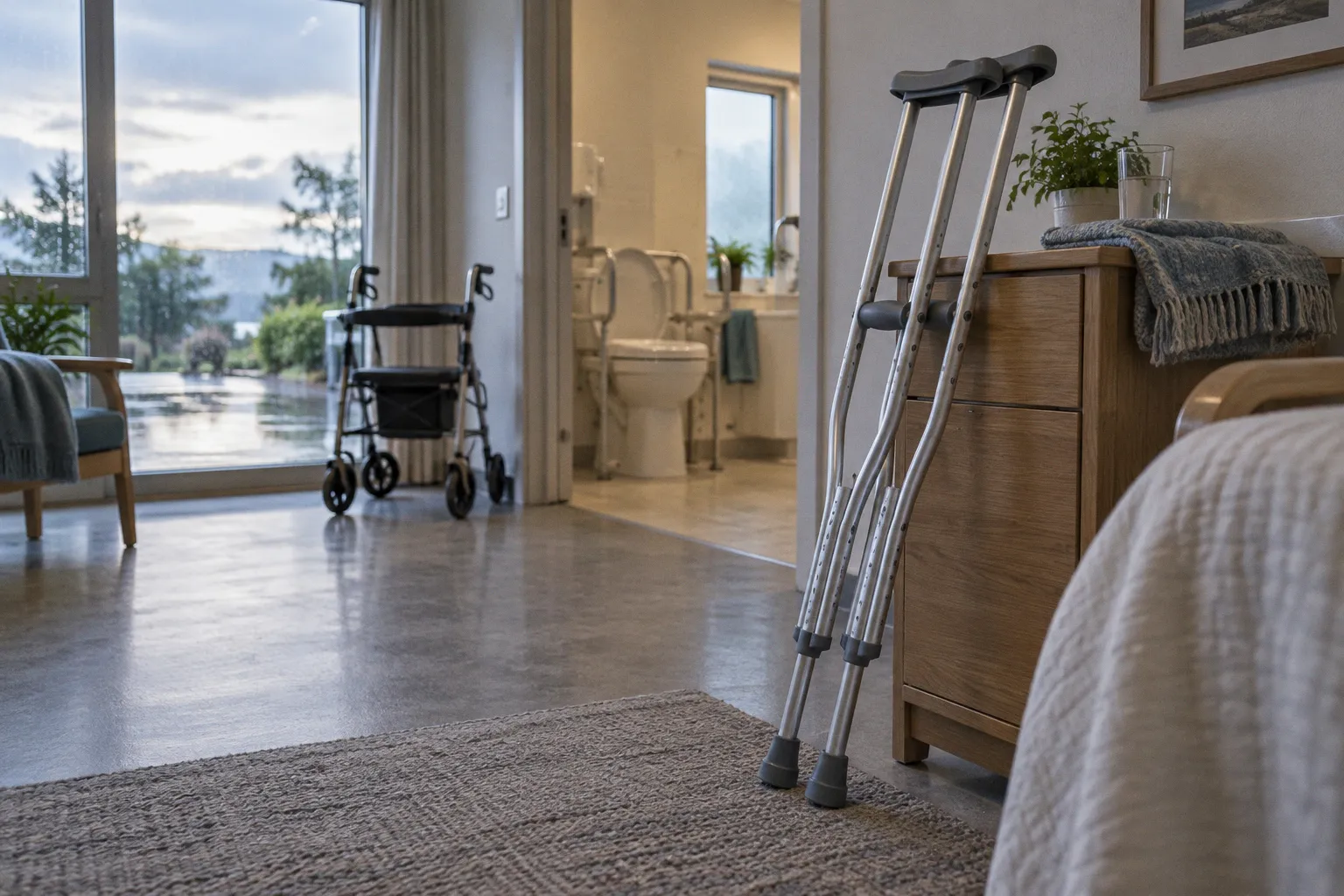
They are chosen against the patient’s current weight-bearing order, balance, grip strength, surgical approach, pain level, and home layout.
That distinction matters most in the first weeks after hip or knee surgery. A cane may look less restrictive than a walker, but it offers a much smaller base of support. A rollator may make walking feel smoother, yet its wheels and hand brakes introduce demands that a weak or unsteady patient cannot always manage. Even a simple bathroom transfer can become unsafe when the toilet is too low or the patient has not been taught which hip movements to avoid.
Mobility equipment is therefore part of the rehabilitation plan, not a separate convenience purchase. The right device limits unwanted load, gives the patient a repeatable movement pattern, and creates enough stability to practise walking without turning every step into a balance test.
Stabilizing Early Recovery with Standard Non-Wheeled Walkers
A four-legged standard walker with rubber tips remains one of the most useful devices for early recovery. It is not fast, sleek, or particularly easy to carry. Its value is more basic: it stays where the patient places it.
The user lifts the frame, sets it down, and steps into the space it creates. Because the walker does not roll forward, it gives the patient more time to organize the movement and shift weight according to the surgeon’s instructions. That is especially helpful when balance is poor, the legs are weak, or the patient is still learning how much load the operated limb can tolerate.
This does not mean every person after joint replacement should automatically receive the same walker. Device selection should be made by the surgeon, physical therapist, or occupational therapist, particularly when the patient has strict non-weight-bearing or partial-weight-bearing instructions. But for many older adults who need maximum stability at the beginning of rehabilitation, the standard walker is the logical starting point.
Its limitations are clear:
- The patient must lift and reposition it, which can be difficult with shoulder weakness, arthritis, or poor coordination.
- It encourages a stop-start gait rather than a natural walking rhythm.
- It can become awkward in narrow hallways, around furniture, or on uneven outdoor surfaces.
- The frame needs to be adjusted to the patient’s height. Handles that are too high encourage shoulder elevation; handles that are too low promote trunk flexion.
Those limitations are not necessarily defects during the first stage. Early recovery is usually about control before speed. A slower, deliberate sequence may be safer than a more fluid gait that the patient cannot stop or correct.
The walker should be positioned close enough that the patient does not have to lean far forward to reach it. When standing up, the patient should push from the bed or chair rather than pull on the walker, unless the rehabilitation team has taught a different technique. Once upright, the patient takes hold of the handles and checks balance before beginning to walk.
The same principle applies to sitting down: approach the chair until the backs of the legs touch it, reach back for the armrests if available, and lower slowly. Pulling the walker toward the body or twisting while turning to sit can create unnecessary instability.
In early recovery, the least glamorous device is often the one that gives the patient the most useful margin for error.
A standard walker is also valuable for transfers inside the home: bed to bathroom, chair to kitchen, and room to room. But it should not be treated as a substitute for supervised practice. A patient who can walk a short distance in a clinic may still struggle with the real demands of home rehabilitation: turning in a tight bathroom, carrying nothing in the hands, managing a threshold, or getting up after a period of fatigue.
Transitioning to Rollators: Balancing Mobility and Hand Strength
A rollator has wheels, hand brakes, and usually a built-in seat. Compared with a standard walker, it allows a more continuous walking pattern and can make longer distances less tiring. That makes it useful for some patients whose gait has become more consistent but who still need external support.
The key phrase is some patients. A rollator is not automatically the next step simply because the patient is tired of lifting a walker.
The device moves as soon as the patient pushes it. That is helpful when the patient can control the forward motion, but risky when the patient leans heavily onto the frame or has difficulty stopping. The hand brakes also require sufficient grip strength, finger control, attention, and reaction time. Someone with painful hands, severe arthritis, postoperative weakness, or cognitive impairment may not be able to operate them reliably.
Before changing from a standard walker to a rollator, the rehabilitation team should look at practical abilities rather than the calendar:
- Can the patient maintain an upright posture without hanging heavily on the handles?
- Can the patient start, slow, and stop the rollator without losing balance?
- Can both brakes be engaged fully and held while sitting?
- Can the patient turn without allowing the device to swing away?
- Can the patient manage the rollator’s width through doorways and around furniture?
- Does the patient understand that the seat is for a controlled rest, not an improvised moving surface?
The rollator’s seat can be useful for people with reduced endurance. A patient may walk to the end of a hallway, sit safely, recover, and continue. That can support graded activity without requiring the person to reach a distant chair. The seat is not, however, a reason to choose a rollator for someone who cannot brake or who may attempt to sit before positioning the device correctly.
Weight matters as well. A frame that is difficult to lift into a car or move over a threshold may discourage use or cause the patient to jerk the device. A lighter model is not automatically better if it feels unstable, has poorly positioned handles, or exceeds the patient’s ability to control it. The practical question is whether the person can move and stop the rollator without excessive effort.
Rollator versus standard walker for recovery
| Feature | Standard non-wheeled walker | Rollator |
|---|---|---|
| Movement | Lift, place, step | Push and walk continuously |
| Stability | High when correctly positioned | Depends on brake control and posture |
| Best suited to | Early recovery, restricted loading, poor balance | More consistent gait with ongoing need for support |
| Hand requirements | Basic grip and ability to lift the frame | Reliable grip and brake operation |
| Rest option | Requires a separate chair or planned stop | Usually has an integrated seat |
| Main risk | Lifting incorrectly or walking outside the frame | Rolling too quickly, leaning, or sitting without locking brakes |
| Home considerations | Can be easier to control in tight areas | May be wider and harder to manoeuvre indoors |
The transition should also be reversible. If a patient becomes more painful, fatigued, dizzy, or unsteady, returning temporarily to the more stable device is not a failure. Recovery is rarely a straight line, particularly after hospitalization, infection, medication changes, or a loss of appetite.
Adhering to the 90-Degree Rule During Daily Transfers
Hip precautions are often compressed into a single phrase: do not bend past 90 degrees. That phrase can be useful as a reminder, but it is not a complete safety protocol for every hip replacement.
The precautions depend on the surgical approach, the surgeon’s technique, the stability of the repair, and the patient’s individual risk factors. After a posterior-approach hip replacement, the commonly discussed combination involves excessive hip flexion together with adduction and internal rotation. In practical terms, that may mean bending deeply forward while bringing the operated leg across the body or turning the knee and foot inward. After an anterior approach, the movements of concern may be different and can include excessive hip extension or external rotation. Some patients receive modified or fewer precautions; others receive more restrictive instructions.
The patient should follow the specific precautions provided by the surgeon and rehabilitation team rather than treating a generic 90-degree rule as universal. When there is uncertainty, the operative approach and prescribed restrictions should be confirmed before discharge.
The toilet is a common problem because a low seat requires more hip and knee flexion during the transfer. An elevated toilet seat or raised toilet frame can reduce the depth of the sitting motion, but the correct height depends on the patient’s leg length, strength, balance, and the restrictions prescribed after surgery. A toilet frame or grab bar may also be needed so the patient can lower and rise without pulling on an unstable object.
The same reasoning applies to chairs and beds. A firm, higher seat with armrests is usually easier to manage than a low, soft sofa that allows the pelvis to sink backward. The patient should avoid twisting while sitting, turning, or standing. Instead, small steps should be used to bring the whole body around while the operated leg remains aligned with the trunk.
Car transfers deserve particular attention. The seat may need to be moved back, and a firm cushion can change the height and angle enough to make entry easier. The patient should sit first and then pivot the legs together, or use the transfer method taught by the therapist. The safest technique depends on the surgery and the permitted range of motion.
A raised toilet seat does not make every transfer safe by itself. The patient still needs clear space, adequate lighting, footwear with traction, and a way to call for assistance if balance fails. Loose bath mats and towels can undo the benefit of an otherwise well-chosen device.
The 90-degree rule is not a universal anatomy lesson. It is one part of an approach-specific precaution plan that should come directly from the surgical and rehabilitation team.
Leveraging Hip Recovery Kits to Minimize Joint Strain
Daily tasks often expose the limits of a healing hip more clearly than a supervised walk. Socks, shoes, trousers, bathing, laundry, and objects on the floor all invite bending, reaching, or twisting. Adaptive equipment reduces the need to improvise with a movement that has not yet been cleared.
A hip recovery kit commonly includes several long-handled tools:
1. Reacher or grabber. This helps retrieve clothing and lightweight objects without repeated bending. It should not be used to lift heavy items or to pull the patient upright.
2. Sock aid. The sock is loaded onto the device and guided over the foot while the leg remains in the position allowed by the rehabilitation plan. The patient should practise with a therapist or caregiver before relying on it independently.
3. Dressing stick. A hook or notch can help pull clothing into position without forcing the patient to reach behind the body or rotate abruptly.
4. Long-handled shoehorn. This allows the shoe to be put on without forcing the patient to bend deeply or cross the operated leg. The exact movement still needs to respect the prescribed hip precautions.
5. Long-handled bath sponge. This can reduce the need to reach toward the feet or lower legs during bathing.
6. Elastic shoelaces or slip-on footwear. These remove the need to tie laces while flexing forward and can make the morning routine more manageable.
The long shoehorn deserves a precise explanation. Crossing the leg over the opposite knee may be restricted after some hip procedures, but it is not the only movement that can be problematic, and it is not correct to describe one combination of hip motion as dangerous for every surgical approach. After a posterior approach, excessive flexion combined with adduction and internal rotation is commonly emphasized. After an anterior approach, the surgeon may place greater emphasis on avoiding excessive extension and external rotation. The patient should use the shoehorn to keep the leg in the permitted position, not assume that the tool itself makes every posture safe.
The same caution applies to a reacher. It is helpful for a dropped item, but reaching repeatedly from a standing position can still disturb balance. The patient should sit when possible, keep frequently used objects between waist and shoulder height, and ask for assistance with anything heavy, wet, sharp, or difficult to control.
Bathroom equipment may include a shower chair, handheld showerhead, grab bars, and a non-slip surface that is firmly secured. A bath bench can be useful when stepping over the side of a tub is unsafe, but the transfer should be practised before the patient attempts it alone. A chair that slides, a suction grab bar used as a permanent support, or a wet floor can create a serious hazard.
These tools do not replace strength and balance training. They make ordinary tasks possible while the patient is still rebuilding both.
Customizing Equipment Based on Weight-Bearing Restrictions
Weight-bearing instructions are not interchangeable. A patient may be told to keep all weight off the operated leg, touch the foot down only for balance, place a limited portion of body weight through it, or bear weight as tolerated. Those instructions affect the safest device and the way it should be used.
Non-weight-bearing
With non-weight-bearing restrictions, the operated limb should not support body weight. The patient may need a walker, crutches, or a combination selected by the rehabilitation team. A standard walker can provide a stable frame, but it requires enough upper-body strength and coordination to advance the body without accidentally loading the surgical leg. Crutches may be appropriate for some patients and unsafe for others, especially when there is poor balance, shoulder pain, or limited endurance.
A rollator is generally a poor choice when the patient must strictly unload one leg. Its wheels can move unexpectedly, and its frame is not designed to replace instruction in a true non-weight-bearing gait.
Toe-touch or minimal weight-bearing
Toe-touch weight-bearing usually means the foot may contact the floor for balance, but the patient should place very little load through it. The exact meaning should be confirmed with the clinical team because patients often interpret “touch down” as permission to push.
A standard walker often provides the external support needed for this stage. The patient must be taught how to distribute weight through the arms and the non-operated leg without leaning too far forward or hopping beyond the frame.
Partial weight-bearing
Partial weight-bearing places a controlled limit on the load through the operated limb. Because people are poor at estimating percentages of body weight without training, the therapist may use demonstrations, scales, or repeated practice to make the instruction practical.
The device remains important even when the patient feels capable of taking more weight. Pain can decrease before tissue capacity and balance have recovered. Advancing too quickly because walking feels easier can compromise the quality of the gait pattern and increase fatigue.
Weight-bearing as tolerated
Weight-bearing as tolerated does not mean unlimited activity. It means the patient may load the limb according to symptoms and the prescribed plan. Pain, swelling, weakness, dizziness, and compensatory movements still matter.
A rollator or cane may become appropriate at this stage, but the choice depends on control. A cane offers less support than a walker and is normally used on the side opposite the operated leg unless the clinician instructs otherwise. It should be adjusted so the elbow remains slightly bent when the hand rests on the grip. A cane is not a suitable device for someone who needs substantial support through both arms.
The surgeon’s orders establish the medical restriction. The physical therapist translates that restriction into movement, repetitions, and equipment. The occupational therapist may focus on transfers, bathing, dressing, and the home environment. All three perspectives matter because a device that works in a clinic may not work safely in a crowded bedroom or narrow bathroom.
Reading the Home Before Choosing the Device
The best mobility aid can still fail if the home is not prepared for it. Before discharge, the patient or caregiver should walk through the main route from the bed to the bathroom and identify practical barriers:
- rugs that slide or curl at the edges;
- electrical cords across walking paths;
- low coffee tables and footstools;
- narrow doorways that do not accommodate the device;
- clutter near the toilet or shower;
- poor lighting at night;
- pets that move unpredictably around the patient’s feet;
- steps or thresholds at the entrance;
- chairs that are too low, soft, or unstable.
The walker or rollator should be tested on the surfaces the patient will actually use. Turning space is as important as straight-line distance. A patient may walk well down a hallway but be unable to turn safely beside the toilet.
Carrying objects is another overlooked issue. A standard walker occupies both hands, so a small bag, walker basket, tray, or caregiver may be needed. Anything attached to the frame should not interfere with the wheels, brakes, or the patient’s line of sight. The patient should not carry a hot drink, heavy laundry basket, or unstable load while learning to walk.
Footwear should fit securely and provide traction. Bare feet, loose slippers, and socks on a smooth floor increase risk during transfers. Clothing should not drag on the floor or catch on the frame.
When to Hold the Progression
A change in equipment should be reconsidered if the patient develops more pain, a noticeable limp, repeated loss of balance, dizziness, shortness of breath, new swelling, or difficulty following the prescribed precautions. These signs do not necessarily mean the surgery has failed, but they do mean the current plan needs review.
The same applies when the patient begins to rely heavily on the device. Leaning the body onto a walker, allowing a rollator to run ahead, or using a cane as a substitute for a handrail can indicate that the device is too demanding or incorrectly adjusted.
Progression can be described in functional terms:
- The patient can stand and sit with controlled movements.
- The patient can start, stop, and turn without losing balance.
- The patient follows the weight-bearing order consistently.
- The patient maintains a reasonably upright posture instead of collapsing onto the frame.
- The patient can use the brakes or other controls every time.
- The patient can manage the device through the home environment.
- Fatigue does not cause a sudden deterioration in gait quality.
These are not rigid clearance rules for every patient. They are the kinds of observations the rehabilitation team uses to decide whether the current aid is still appropriate.
The best mobility aids for elderly post-surgery recovery are not necessarily the lightest, newest, or most advanced. A standard walker may be the right answer when stability and load control matter most. A rollator may be better when the patient can manage continuous movement and needs planned rest. A cane may suit a later stage when balance, strength, and gait control have improved enough to make a smaller support useful.
The important decision is not what the patient hopes to use next. It is what the patient can control safely today, under the restrictions that actually apply to the operation. Surgical approach, weight-bearing status, hand strength, balance, pain, and home layout should all be part of that decision. When those details guide the equipment choice, mobility aids support recovery instead of turning independence into another avoidable risk.
FAQ
Is a standard walker or a rollator better after hip or knee surgery?
When can a patient switch from a walker to a rollator?
What does the 90-degree rule mean after hip replacement?
What equipment can help with daily tasks after hip surgery?
What signs mean that mobility-aid progression should be reconsidered?
Related articles
 Rehabilitation & RecoveryPhysical therapy frequency for stroke recovery in seniors
 Rehabilitation & RecoveryWeighted Utensils for Tremors: Testing Three Designs
 Long-Term CareFall prevention protocols: three clinical approaches compared
 Long-Term CarePressure ulcer prevention tools for skilled nursing facilities