Gait training devices: four systems for senior mobility
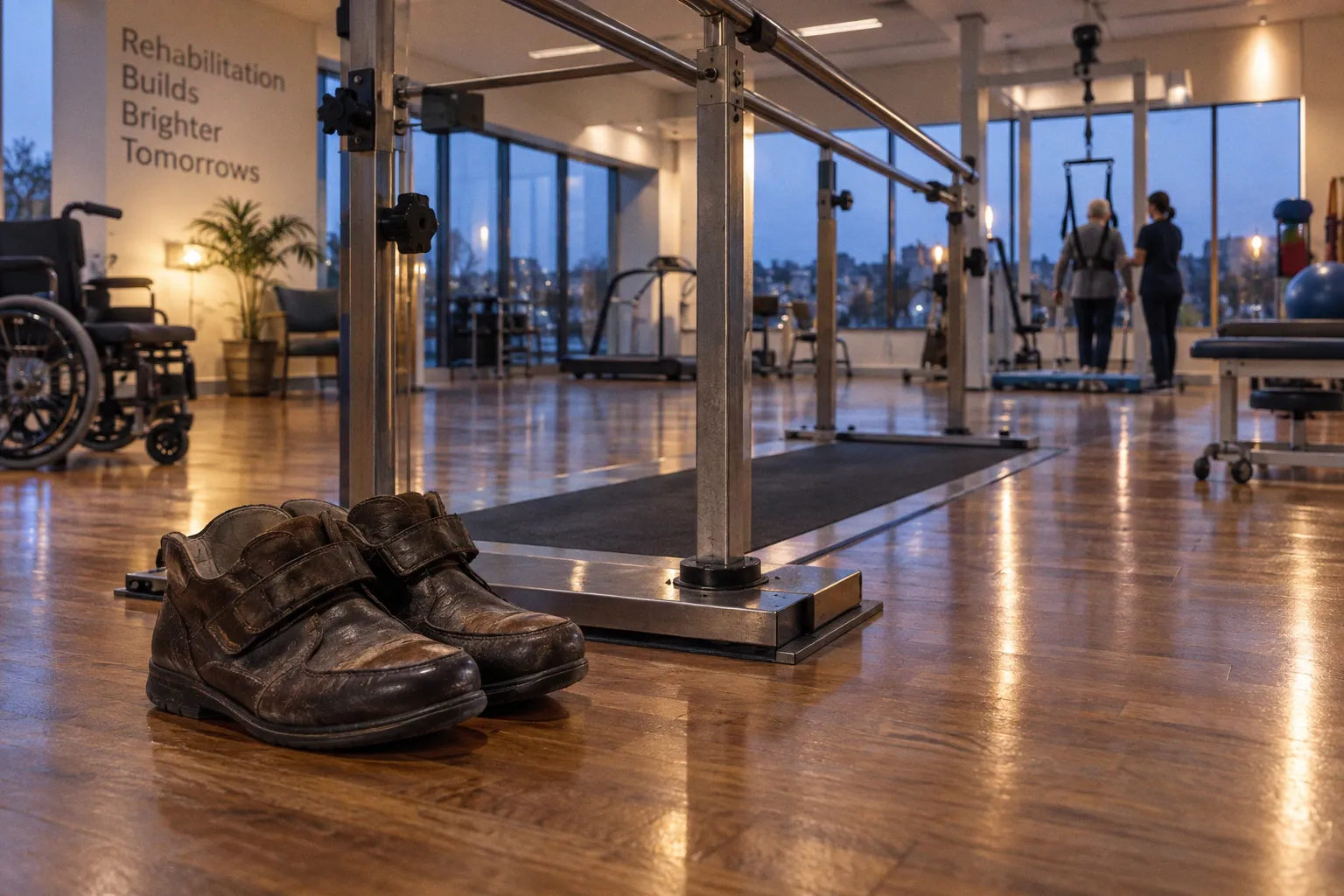
A senior may be able to move both legs in bed and still lack the load-bearing capacity, gait stability, or postural control required to walk from the bed to the bathroom.
That is where gait training devices for geriatric rehabilitation earn their place. The right system can increase stepping repetitions, unload part of the patient’s body weight, reduce the consequences of a balance error, and let therapists work on the mechanics of walking before independent gait is realistic. The wrong system can produce impressive-looking movement without improving functional mobility.
I assess these devices by one standard: do they create better movement that transfers to real tasks—standing, turning, walking to the dining room, managing a doorway, and completing activities of daily living with less assistance?
What a gait training device must solve
Walking recovery is not one problem. It is a chain of mechanical and neurological demands:
1. The patient must shift the center of mass over the stance leg.
2. The stance leg must tolerate load without buckling or collapsing into poor alignment.
3. The opposite leg must clear the floor and advance.
4. The patient must control foot placement rather than simply place the foot somewhere.
5. Balance reactions must operate during turning, stopping, and changes in speed.
6. The patient must repeat the sequence enough times for the pattern to become more efficient.
A conventional walker may help with the final stage of recovery, when the patient can already bear substantial weight and coordinate stepping. It is less useful when the patient cannot safely maintain upright posture or repeatedly loads one leg incorrectly.
Clinical gait trainers address that earlier gap. They do not replace physical therapists, occupational therapists, or nursing staff. They change the conditions under which the patient practices. That distinction matters. A harness may prevent a fall, but it cannot independently teach a patient to judge a curb, carry a plate, or turn toward a chair.
The best gait trainer is not the most sophisticated machine. It is the one that delivers the right number of safe, correctly loaded steps for the patient’s current limitation.
The four main categories are body-weight supported treadmill systems, electromechanical or robotic gait trainers, overhead dynamic track systems, and instrumented smart walkers. Each solves a different part of the mobility problem.
Body-weight supported treadmill training: controlled repetition early in recovery
Body-weight supported treadmill training, or BWSTT, uses a harness connected to an adjustable support system above a treadmill. Systems such as LiteGait can provide partial unloading while the patient practices repeated gait cycles.
The mechanical advantage is straightforward. Reduce the amount of body weight the legs must manage, and the patient may be able to practice stepping before full weight-bearing is safe. The harness also reduces the immediate threat of falling, which can prevent the stiff, guarded movement pattern that often appears after a fall or major surgery.
Why the treadmill can be effective
A treadmill provides a consistent moving surface and encourages rhythmic stepping. The therapist can focus on specific faults:
- insufficient knee extension during stance;
- delayed swing-phase initiation;
- poor foot clearance;
- asymmetrical step length;
- excessive reliance on the upper limbs;
- collapse of the trunk toward the weaker side.
For a patient after stroke, the system can help create more repetitions than overground walking allows during the earliest phase of recovery. Research on robot-assisted and supported gait training indicates that patients who are not yet independently ambulatory may achieve substantially more repetitive stepping at higher walking speeds than with manual therapy alone.
That does not mean the treadmill is automatically superior. Repetition only helps when the repetitions are mechanically useful. If the therapist allows the patient to drag one leg, hang heavily in the harness, or pull through the arms, the machine may simply reinforce compensations.
What I look for during BWSTT
I want the support level reduced as soon as the patient can maintain alignment and step safely. The harness should provide a safety margin, not become a permanent substitute for postural control.
Track these variables during treatment:
- percentage of body-weight unloading;
- duration of continuous stepping;
- treadmill speed;
- number of pauses;
- left-right symmetry;
- assistance required at the pelvis, knee, or foot;
- ability to initiate and terminate walking on command.
A standard gait-training session in clinical trials is often structured around roughly 30 minutes, but the correct dose depends on fatigue, cardiovascular tolerance, pain, cognition, and the patient’s ability to preserve movement quality. Thirty minutes of deteriorating gait is not a successful session.
Where BWSTT performs best
BWSTT is strongest when the primary barrier is insufficient load-bearing capacity combined with a need for high repetition. It is particularly useful in:
- early post-stroke rehabilitation;
- lower-extremity weakness after prolonged bed rest;
- selected orthopedic recovery cases;
- patients who can step with assistance but cannot yet walk safely overground;
- treatment plans that require gradual reduction of body-weight support.
Its limitation is ecological validity. A treadmill does not reproduce the variable demands of a hallway, bathroom, dining room, or outdoor path. The patient must eventually transition to overground gait, transfers, turning, and obstacle negotiation.
My verdict: BWSTT is one of the most useful early-stage systems, provided the team treats it as a bridge to functional walking rather than the final destination.
Robotic gait trainers: end-effectors versus exoskeletons
Robotic gait trainers are often grouped together, but the two primary designs create movement in very different ways:
- End-effector systems move the patient’s feet through motor-driven footplates or treadmill-linked platforms.
- Exoskeleton systems attach robotic orthoses directly to the patient’s legs and guide joint movement.
Both can increase stepping repetition. Neither guarantees a normal gait pattern.
End-effector systems
An end-effector device controls the distal part of the movement—the feet. The patient stands on motorized footplates or a moving platform that produces a stepping trajectory. Depending on the system and protocol, the patient may receive body-weight support and varying levels of active participation.
The advantage is controlled repetition. The therapist can create a predictable stepping pattern and gradually require the patient to contribute more force. This can be valuable when voluntary stepping is inconsistent or when the patient cannot yet coordinate the lower limbs well enough for effective treadmill practice.
The clinical risk is passivity. If the machine performs most of the movement, the patient may complete many steps without generating adequate active muscle work. I therefore look for a progression from machine-driven stepping toward patient-initiated stepping, greater load-bearing, and reduced external assistance.
Exoskeleton systems
An exoskeleton is fitted to the patient’s legs and provides powered assistance at selected joints. The device can help guide hip, knee, and sometimes ankle motion while the patient practices upright stepping.
The mechanical appeal is obvious: an exoskeleton can support a patient who lacks sufficient strength or selective motor control to move through the gait cycle independently. It can also provide consistent joint trajectories and reduce the physical burden on therapists during intensive practice.
The fitting process is less forgiving. A device must match the patient’s limb length, joint alignment, range of motion, body dimensions, and medical restrictions. Poor alignment can create discomfort or interfere with the intended movement. A patient with significant contracture, uncontrolled pain, severe spasticity, or inadequate trunk control may not be an appropriate candidate for a particular exoskeleton protocol.
Robotic assistance is not the same as independence
The strongest argument for robotic gait training is dosage. A therapist manually moving a patient’s legs cannot match the mechanical consistency and repetition of a powered system for every patient. A robotic device can help a non-ambulatory stroke patient complete repeated stepping practice earlier in recovery.
The weak argument is that robotics will replace skilled rehabilitation. It will not. A machine cannot decide whether a patient is avoiding weight on the surgical limb because of weakness, pain, fear, or a misunderstood restriction. It cannot independently judge whether the patient is ready to transfer the skill to a standard walker.
Use robotic gait training when the patient needs more repetitions than manual treatment can provide, not because the device looks advanced.
| Clinical question | End-effector trainer | Exoskeleton trainer |
|---|---|---|
| Primary movement control | Motor-driven footplates or stepping platform | Robotic orthoses attached to the legs |
| Main clinical advantage | Consistent foot placement and repetitive stepping | Direct assistance at selected leg joints |
| Best fit | Patients needing structured stepping with limited voluntary control | Patients who can tolerate fitting and need joint-specific assistance |
| Main concern | Passive participation and poor carryover to overground walking | Alignment, fitting, contracture, and tolerance |
| Progression target | Less machine assistance and more active stepping | Reduced robotic support and greater patient-generated force |
My verdict: robotic systems are valuable when the treatment plan specifies how assistance will decrease. If the protocol cannot explain what the patient must do more independently next week, the machine is being used as a spectacle rather than a rehabilitation tool.
Overhead dynamic track systems: bringing gait practice into the real environment
An overhead track system uses a ceiling-mounted rail and a dynamic harness. Unlike a fixed treadmill setup, it allows the patient to walk overground while receiving partial body-weight support and fall protection.
This is a major functional advantage. The patient can practice the tasks that determine whether discharge is realistic:
- sit-to-stand transfers;
- walking toward a chair;
- turning around;
- changing direction;
- approaching a bed or bathroom;
- stopping without losing balance;
- stepping through different spaces.
The harness can adjust with the patient’s center of gravity and provide a controlled safety margin. That allows the therapist to challenge balance without requiring a second staff member to physically catch the patient after every error.
Why overground practice changes the assessment
Treadmill walking can reveal step symmetry and endurance. Overground walking exposes the problems that machines can hide. Patients must control their speed, respond to visual information, judge distance, and manage transitions.
A patient may produce acceptable treadmill steps but still fail to:
- turn safely with a walker;
- stop before reaching a wall;
- maintain balance while reaching;
- step backward toward a chair;
- divide attention between walking and conversation;
- recover from a small perturbation.
The overhead track is well suited to graded exposure. Begin with substantial support and short distances. Then reduce unloading, increase the walking path, add turns, and incorporate transfers. The therapist should document the level of assistance rather than describing the session as simply “tolerated well.”
The harness can also distort movement
A dynamic support system is not neutral. If the harness carries too much weight, the patient may stop developing adequate ankle and hip strategies. If the therapist keeps the patient centered by excessive support, the patient may not learn to correct a lateral shift.
The goal is not to keep the patient perfectly upright at every moment. The goal is to create enough safety for the patient to experience and correct manageable balance errors.
I want to see progression in:
1. reduced body-weight support;
2. longer periods without manual correction;
3. improved stance time on the weaker limb;
4. fewer pauses during turns;
5. better control during sit-to-stand and stand-to-sit;
6. transfer of the skill to a standard walker or cane when appropriate.
My verdict: for patients who need to relearn real-world walking rather than simply produce repeated steps, an overhead dynamic track system is often the most versatile option. Its value depends on whether the team uses it to train transfers and environmental navigation, not just straight-line walking.
A safe hallway walk is a higher clinical achievement than a perfect-looking machine-assisted step if the patient cannot transfer the skill to daily life.
Instrumented smart walkers and gait analysis tools
Smart walkers combine a supportive walking frame with sensors that measure aspects of gait and device use. Depending on the system, these tools may capture walking speed, distance, step timing, pressure distribution, asymmetry, or the amount of force placed through the frame.
They occupy a different position from robotic trainers. A smart walker generally does not move the patient’s legs for them. Instead, it provides stability while generating data about how the patient walks.
That makes it useful in the later stages of rehabilitation, when the question is no longer whether the patient can take assisted steps, but whether the patient can walk repeatedly and safely with an appropriate aid.
What the data can reveal
A patient may report that walking feels better while still relying heavily on the upper limbs. Sensor data can help identify:
- excessive forward loading through the walker;
- inconsistent step timing;
- shortened steps on one side;
- declining speed with fatigue;
- poor turning performance;
- limited distance before gait quality deteriorates.
This is where gait analysis tools for nursing homes can support better clinical decisions. Instead of changing the walking aid based solely on appearance, the team can compare performance across sessions and examine whether the patient is developing more stable, efficient movement.
The data should answer a practical question. For example: can the patient maintain gait stability over a longer distance with less upper-limb loading, or does the patient become unsafe after the first few minutes?
Smart technology does not remove the need for observation
Sensor measurements can be misleading if the device is not calibrated, the patient changes footwear, or the walking pattern changes because of pain. Numbers also do not fully capture judgment, attention, impulsivity, or the ability to respond to a crowded environment.
I combine instrumented data with direct observation of:
- foot placement;
- trunk position;
- turning strategy;
- response to verbal instruction;
- ability to stop;
- fatigue-related decline;
- safety awareness.
A smart walker is most useful when it supports a progression toward a less restrictive aid. If the patient keeps increasing upper-limb pressure because the frame is doing too much of the work, the device may be improving confidence without improving lower-extremity capacity.
My verdict: smart walkers are excellent measurement and transition tools. They are less suitable as primary treatment systems for a patient who cannot yet generate consistent stepping or maintain upright control.
Choosing the system by mobility barrier
Do not select gait training equipment by diagnosis alone. Two patients with stroke may have entirely different barriers: one may have adequate strength but poor motor planning; another may have severe unilateral weakness and limited trunk control. The device must match the failed component of gait.
| Primary mobility barrier | Most relevant system | What the therapist should progress |
|---|---|---|
| Cannot safely tolerate full body weight | BWSTT or overhead track | Reduced unloading, longer stance time, improved alignment |
| Needs high-volume stepping practice | Robotic trainer or BWSTT | More active participation, less external assistance |
| Poor overground balance and transfers | Overhead dynamic track | Turns, stops, sit-to-stand, environmental navigation |
| Walks with an aid but may be unsafe or inefficient | Instrumented smart walker | Speed, symmetry, upper-limb loading, fatigue tolerance |
| Severe fitting or alignment limitations | Carefully selected non-robotic support | Comfort, joint protection, active control, safe progression |
Before using any system, the rehabilitation team should establish the patient’s medical and functional constraints. That includes weight-bearing restrictions after orthopedic surgery, cardiovascular tolerance, skin integrity, pain, joint range of motion, cognitive status, communication ability, and the capacity to follow instructions.
A device that is mechanically appropriate may still be clinically unsuitable. A patient with severe orthostatic intolerance may not tolerate prolonged upright training. A patient with advanced cognitive impairment may require a simpler, more supervised approach. A patient with poor trunk control may need stabilization before robotic leg movement is useful.
Clinical standards, supervision, and the quality of the protocol
Professional gait trainers and rehabilitation walkers manufactured for clinical care in Europe are regulated under the EU Medical Device Regulation 2017/745, with relevant devices classified as Class I medical devices. That regulatory status addresses manufacturing and device requirements. It does not prove that a particular facility is using the equipment well.
The protocol matters more than the marketing language. Ask how the facility defines progress:
- Is body-weight support reduced according to documented performance?
- Does the patient practice both machine-assisted and overground walking?
- Are therapists recording assistance levels?
- Does the plan include transfers, turning, and stopping?
- Is the patient’s standard walker or cane introduced at the appropriate stage?
- Are nursing staff using the same mobility instructions outside therapy?
- Is the patient’s dignity protected during harness fitting and repeated failed attempts?
The last point is not cosmetic. A patient who feels handled like cargo may resist treatment, stop communicating pain, or avoid participation. Good rehabilitation is demanding, but it should remain collaborative and clinically respectful.
How to judge a rehabilitation program, not just a device
A credible program can describe the starting limitation and the intended functional change. It should not rely on vague statements such as “improve mobility” without defining what that means.
Look for milestones such as:
- standing from a chair with a specified level of assistance;
- walking a defined distance with a named device;
- completing a turn without physical correction;
- maintaining safe foot clearance over repeated steps;
- transferring from bed to chair using a consistent sequence;
- completing bathroom mobility without unsafe rushing;
- sustaining gait quality without a major decline from fatigue.
These milestones are more valuable than a machine’s maximum speed or the number of programs listed in a brochure.
A therapy team should also explain the transition plan. Supported gait training is only one stage. The patient must eventually practice walking with the device used in daily life, under the supervision level expected after discharge. If a patient can walk safely only while attached to a ceiling track, the treatment has not yet answered the discharge question.
Discharge readiness is measurable
I do not consider a patient ready for discharge because they completed a session without falling. A safe discharge requires repeatable performance under realistic conditions.
The final assessment should include:
- bed and chair transfers;
- standing tolerance;
- walking distance;
- gait speed or another consistent mobility measure;
- turning in both directions;
- stopping on instruction;
- ability to manage fatigue;
- level of human assistance;
- use of the prescribed walking aid;
- ability to complete essential ADLs safely.
For patients with neurological impairment, the team must also examine attention, impulsivity, visual-spatial problems, and the ability to follow safety instructions. For orthopedic patients, pain behavior, surgical precautions, and load-bearing tolerance may determine whether the walking pattern is sustainable.
A useful discharge milestone is not “walks with robotic assistance.” It is closer to: the patient completes the required household distance with the prescribed aid, maintains adequate foot clearance, turns without loss of balance, and requires no more assistance than the home setting can reliably provide.
That is the standard the equipment must serve.
The bottom line
The best gait training devices for seniors are not interchangeable, and no category wins every clinical case.
- Choose body-weight supported treadmill training for controlled, repetitive stepping when full loading is not yet safe.
- Choose robotic end-effector or exoskeleton systems when the patient needs high-volume, mechanically consistent practice and the team has a clear plan to reduce assistance.
- Choose an overhead dynamic track when overground balance, transfers, and real-environment walking are the main barriers.
- Choose an instrumented smart walker when the patient is already walking with support and the team needs objective information about efficiency, symmetry, fatigue, and progression.
My strongest recommendation is also the least glamorous: insist on a protocol that connects every assisted step to a functional milestone. More repetitions are useful only when they build load-bearing capacity, gait stability, and ADL independence. The device should make better practice possible, not hide the fact that the patient still cannot walk safely without it.
FAQ
What is the main difference between end-effector and exoskeleton robotic gait trainers?
When is body-weight supported treadmill training (BWSTT) most effective?
Why might an overhead dynamic track system be better than a treadmill for some patients?
What do instrumented smart walkers measure?
Can robotic gait trainers replace physical therapists?
Related articles
 Rehabilitation & RecoveryMobility aids for seniors: top recovery tools after surgery
 Rehabilitation & RecoveryPhysical therapy frequency for stroke recovery in seniors
 Rehabilitation & RecoveryWeighted Utensils for Tremors: Testing Three Designs
 Rehabilitation & RecoveryVitalStim Dysphagia Therapy for Seniors: Is It Worth It?