Upright Walkers in Senior Rehab: The Clinical Verdict
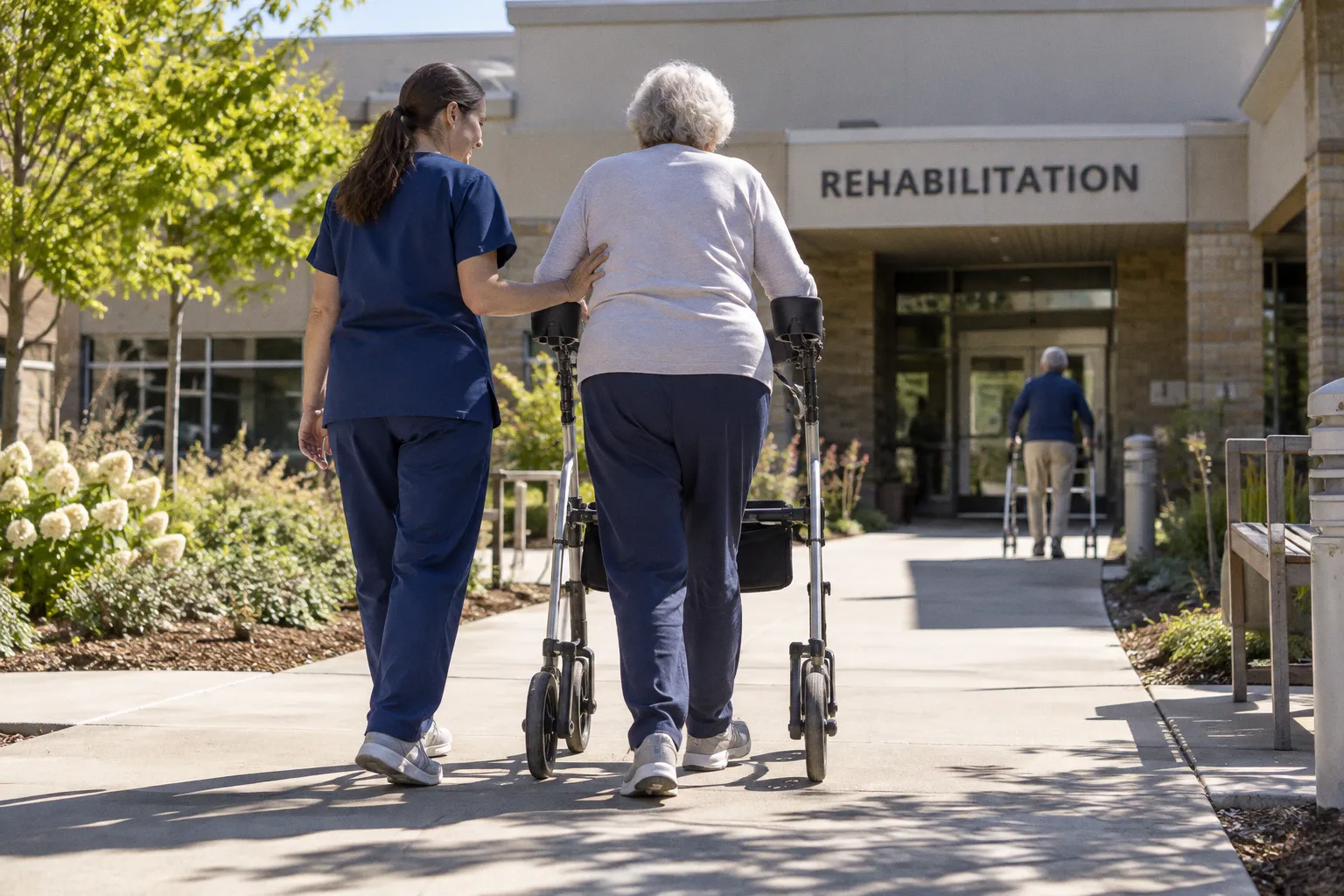
The trunk pitches forward, the shoulders elevate, the hands carry too much load, and each step becomes a negotiation with balance.
That is where an upright walker for senior rehabilitation can be useful. Its forearm platforms change the way the patient transfers body weight into the device. Instead of gripping low handles and leaning heavily through the wrists, the user supports the upper limbs on padded armrests and walks with a more erect trunk.
The clinical verdict is not that upright walkers are universally better. They are a targeted mobility device. For the right patient, a forearm rollator can improve gait stability, reduce lumbar muscle demand, and make walking more efficient. For a patient with severe balance impairment, poor brake control, or a need for maximum static support, the same four-wheeled frame can create an unacceptable risk.
I assess upright walkers by one question: do they improve functional movement without exceeding the patient’s ability to control the device?
The problem an upright walker is designed to solve
A conventional rollator usually places the hands at a relatively low position in front of the body. That setup works well for a patient who can maintain reasonable trunk control, grip the handles, regulate speed, and coordinate braking. It is less effective when the user collapses forward onto the frame or relies on the wrists to support a substantial portion of body weight.
Post-surgical weakness amplifies the problem. After lower-extremity surgery, a patient may have reduced hip extension, limited knee control, pain-related guarding, or poor confidence during weight transfer. The walker then becomes more than a balance aid: it becomes a substitute support surface. If the device is too low, the patient often compensates with trunk flexion.
That compensation affects the entire gait chain:
1. The trunk shifts forward over the base of support.
2. The hips remain flexed instead of reaching a stable extension position.
3. The patient shortens the step and increases dependence on the upper limbs.
4. The hands and wrists absorb load that should be shared by the legs and trunk.
5. The walker may advance before the patient has established adequate foot placement.
This pattern is not automatically corrected by buying a taller walker. Height is only one variable. The device must match the person’s forearm position, shoulder control, grip capacity, reaction speed, gait pattern, and braking skill.
An upright walker addresses the first part of the problem by moving the support point from the hands to the forearms. The armrests can encourage a more vertical trunk and distribute load across a larger contact area. That does not restore lower-limb strength. It can, however, change the mechanical demands of walking enough to make practice more productive.
The upright position is not the treatment. It is a mechanical advantage that still requires strength, balance, and training.
How forearm support changes gait mechanics
The principal benefit of an upright walker is the way it reorganizes load-bearing capacity. With a traditional rollator, the patient typically supports the body through the hands while controlling the device with the wrists and fingers. With a forearm support walker, the upper limbs rest on padded platforms, and the elbows remain flexed while the forearms carry part of the load.
That configuration can reduce excessive wrist loading and discourage the fully flexed posture seen in patients who lean heavily over a standard frame. It may also reduce the demand placed on the lumbar extensors when a patient otherwise walks with the trunk pitched forward.
The available clinical evidence is specific rather than sweeping. A 2019 clinical study involving 30 rollator users—80% of them women—compared a forearm support walker with standard rollators and participants’ usual devices. During a 10-meter walk test, the forearm support walker significantly reduced anterior-posterior trunk sway compared with standard rollators and usual devices. The reported statistical results were P=.001 versus standard rollators and P=.018 versus usual devices.
That matters because excessive trunk sway is not merely a posture issue. It reflects the body’s effort to maintain the center of mass over a moving base of support. Greater forward-and-backward motion can make gait less predictable, increase the need for corrective steps, and consume attention that the patient needs for foot placement and environmental scanning.
The same trial also found reduced activation of the erector spinae muscles at the L3 lumbar level and lower oxygen consumption during a 6-minute walk test. Those findings point toward improved gait efficiency: the patient may be able to walk with less lumbar muscle demand and lower overall energy expenditure.
Do not overread the result. Lower oxygen consumption in a controlled walking test does not prove that every patient will walk farther in daily life. It does show that the device can alter the biomechanics of walking in measurable ways.
What the device can and cannot change
An upright walker may help with:
- Maintaining a more erect spinal alignment during gait.
- Reducing anterior-posterior trunk sway.
- Decreasing pressure through the hands and wrists.
- Sharing upper-limb support through the forearms.
- Reducing lumbar extensor activation during walking.
- Improving walking efficiency for selected users.
- Supporting gait practice when a low-handled rollator produces excessive trunk flexion.
It does not automatically improve:
- Reaction time when the patient loses balance.
- Brake-operating reflexes.
- Lower-limb force production.
- Visual attention in a crowded environment.
- Ability to turn safely.
- Judgment about when to stop or sit.
- Dynamic balance in a patient who cannot control a rolling base.
The last group determines whether the first group is clinically useful. A device that improves posture but rolls away during a turn is not a successful rehabilitation intervention.
Upright walker benefits in senior physical therapy
In geriatric physical therapy, I care less about how a device looks and more about what it allows the patient to do repeatedly and safely. Rehabilitation depends on practice volume. If the patient can only walk a few steps before pain, lumbar fatigue, wrist pressure, or trunk collapse ends the session, the device is limiting the intervention.
An upright walker may create a better starting position for several common rehabilitation goals.
Postural control
Patients recovering from surgery, deconditioning, or neurological illness often adopt a forward-flexed strategy. The forearm platforms can give them a more stable upper-limb contact point while the therapist works on trunk control, hip extension, and step symmetry.
This is particularly relevant when the patient’s hands cannot tolerate sustained loading. Arthritis, postoperative wrist pain, reduced grip strength, or peripheral sensory loss may make a conventional rollator difficult to control. Forearm support does not eliminate the need for active hand control, but it can reduce the amount of body weight transmitted directly through the wrists.
Gait stability
The study’s reduction in anterior-posterior trunk sway is the most clinically relevant finding for gait stability. A smaller sway pattern can make the walking strategy less erratic. It may also reduce the number of large corrective movements required from the hips and ankles.
Still, the walker’s wheels introduce another variable. A four-wheeled upright rollator does not stay in place like a fixed pick-up walker. The patient must manage forward motion, steering, speed, and brakes. A more upright trunk does not compensate for poor device control.
Endurance and gait efficiency
The 6-minute walk test findings suggest that forearm support may reduce the energy cost of walking in selected users. For a patient who becomes short of breath or markedly fatigued with a conventional rollator, that difference can affect how much gait training is possible in one session.
Use the result as a reason to assess endurance, not as a promise of increased walking distance. Measure the patient’s actual response. Track walking time, rest breaks, perceived exertion, step quality, oxygen saturation when clinically indicated, and the degree of trunk collapse near the end of the task.
ADL independence
The most valuable outcome is not a better-looking gait in the therapy gym. It is improved ADL independence. Can the patient move from the bed to the bathroom? Can they approach a chair, apply the brakes, turn, and sit without pulling the device sideways? Can they transport themselves through a corridor without constant physical assistance?
An upright walker can support those goals when its improved posture translates into better task performance. If the patient still requires hands-on assistance for every turn or cannot operate the brakes consistently, the device has not yet produced meaningful independence.
Upright rollator for stroke recovery: useful, but not automatic
Stroke recovery requires more caution. Hemiparesis, impaired motor planning, visual field loss, neglect, spasticity, and delayed postural reactions can all change the risk profile of a rolling walker.
A forearm support configuration may be helpful when the patient has insufficient grip on one side or cannot maintain an effective hand position on a conventional rollator. It may also provide a more symmetrical upper-limb support position during early gait practice. But symmetry of the device does not guarantee symmetry of the patient’s movement.
Assess the following before assigning an upright rollator for stroke recovery:
- Can the patient locate and maintain both forearms on the supports?
- Can they recognize when the device has moved too far ahead?
- Can they activate both brakes with adequate force and timing?
- Can they turn without pushing the frame toward the weaker side?
- Can they respond to a verbal stop command?
- Can they identify obstacles on both sides?
- Can they maintain foot clearance while the device is moving?
A patient with unilateral neglect may fail to see a chair, doorway edge, or obstacle despite having a technically appropriate walker. A patient with impaired proprioception may misjudge the position of the legs while assuming the walker is providing complete stability. In both cases, the device must be integrated into a supervised motor-learning program.
Do not use the walker as a substitute for neurological assessment. The frame supports gait; it does not correct neglect, apraxia, or impaired postural reactions.
Upright walker versus standard rollator versus fixed walker
The right comparison is not “which walker is best?” It is “which walker gives this patient enough support while preserving controllable movement?”
| Feature | Upright forearm rollator | Standard four-wheeled rollator | Fixed pick-up walker |
|---|---|---|---|
| Primary support point | Forearms and hands | Hands | Hands and frame lift |
| Trunk position | Encourages a more erect posture | Often allows or encourages forward lean | Depends heavily on fitting and technique |
| Wheel behavior | Four rolling wheels; requires braking and steering | Four rolling wheels; requires braking and steering | No rolling base during the support phase |
| Static stability | Lower than a fixed non-wheeled walker | Lower than a fixed non-wheeled walker | Generally greater when correctly positioned |
| Wrist loading | Often reduced through forearm support | More direct through the hands and wrists | Direct through the hands |
| Best potential use | Patients needing upper-limb support with improved trunk alignment | Patients with adequate grip, balance, and brake control | Patients needing maximum support during standing and short transfers |
| Main concern | Rolling instability and incorrect fitting | Forward flexion, poor braking, or excessive speed | Slow gait, lifting errors, and limited maneuverability |
A fixed four-legged walker has an important mechanical advantage: it does not roll away when the patient applies downward pressure. That makes it appropriate for some individuals who need maximum static support. The tradeoff is that the patient must lift or advance the frame, which can be difficult with shoulder weakness, poor coordination, or limited endurance.
A standard rollator is easier to advance and often more practical for community mobility. It is not automatically safer. A patient who leans heavily over it may develop a poor gait strategy, and a patient with weak grip may be unable to control the brakes.
An upright rollator occupies the middle ground mechanically: it offers continuous rolling mobility with a more elevated support position. That combination is useful only when the patient can manage the rolling base.
Fitting is a clinical procedure, not an accessory adjustment
Poor fitting can erase the benefits of an upright walker. The forearm supports must place the patient in a position where the shoulders remain relaxed, the elbows are comfortably flexed, and the trunk does not collapse onto the armrests.
A clinician should observe the patient from the side, front, and rear. Look for:
- Excessive shoulder elevation.
- Elbows locked into extension.
- Forearms sliding forward or sideways.
- Trunk leaning over the armrests.
- Pelvis drifting behind the feet.
- Short, shuffling steps caused by the walker moving too quickly.
- Unequal loading between the right and left forearm.
- Inability to reach or release the brakes without losing balance.
The forearm platforms should not force the patient to carry the body in a rigid upper-limb brace. The patient still needs active trunk control and the ability to make small corrections through the legs.
Teach the sequence explicitly. First establish the feet. Then advance the walker a controlled distance. Place the feet into the available space rather than chasing the frame. Keep the device close enough to support the body but not so close that it blocks step progression. Before turning, reduce speed and use the brakes as instructed.
For a patient after surgery, do not assume that a more upright walker automatically satisfies weight-bearing precautions. The orthopedic surgeon’s restrictions still govern the amount and manner of loading through the involved limb. A forearm platform changes where upper-limb support is applied; it does not change the surgical plan.
The most stable-looking posture is not always the safest gait. Control of the moving frame is the deciding variable.
The main safety limitation: four wheels move
The clinical advantage of a four-wheeled upright walker is also its central weakness. The device rolls continuously. If the patient places weight into the forearm supports before the brakes are engaged, the frame can move away from the body.
This is especially dangerous during:
- Sit-to-stand transfers.
- Stand-to-sit transfers.
- Turning in a narrow space.
- Approaching a bed or toilet.
- Stopping at a doorway.
- Walking downhill or across uneven flooring.
- Divided-attention tasks such as carrying an object or speaking while moving.
A patient must demonstrate brake control under realistic conditions, not only while standing still in front of a therapist. Test the sequence at a chair, beside a bed, near a bathroom entrance, and during a controlled turn. If the patient forgets the brakes when fatigued, the device is not ready for unsupervised use.
The risk is higher for patients with severe balance deficits, delayed reactions, cognitive impairment that affects sequencing, or impaired hand function. In those cases, a fixed walker or a different level of assistance may be safer during the early phase.
Do not treat a caregiver’s presence as a substitute for device compatibility. A family member may be able to walk beside the patient, but if the walker is routinely pulled sideways, pushed too far ahead, or left unlocked during transfers, the mobility plan remains unsafe.
How I would judge whether the device is working
I would not approve an upright walker because the patient appears taller or reports that it feels comfortable. Comfort matters, but rehabilitation decisions require observable function.
Track the patient across repeated tasks and compare performance with the previous device when possible. Useful measures include:
1. Gait stability: Does the trunk remain within a controlled range, or does the patient sway forward and backward with every step?
2. Step quality: Are the feet clearing the floor? Is the patient taking purposeful steps rather than shuffling behind the frame?
3. Load-bearing capacity: Can the patient accept weight through the involved leg without collapsing into the armrests?
4. Brake control: Can the patient stop, lock the brakes, and maintain the position before sitting?
5. Turning ability: Can the patient complete a turn without crossing the feet, dragging the walker, or losing alignment?
6. Endurance: Can the patient complete a defined walking task without a major decline in posture or control?
7. ADL independence: Can the patient use the device during bed, bathroom, chair, and corridor mobility with the planned level of assistance?
8. Carryover: Does the technique remain safe when the patient is tired, distracted, or moving through a familiar daily environment?
Use standardized tests when appropriate. A 10-meter walk test can help quantify gait speed and provide a controlled setting for observing trunk sway and step consistency. A 6-minute walk test can reveal how posture and device control change with fatigue. The important point is not the test label; it is the repeated measurement of functional change.
A patient who walks faster but loses brake control has not made a meaningful gain. A patient who walks more slowly but maintains safe alignment, completes transfers, and needs less hands-on assistance may be progressing appropriately.
When an upright walker is the wrong choice
There are clear situations in which I would not make an upright rollator the first-line device.
Avoid relying on it as the primary support when the patient needs maximum static stability for standing or cannot reliably control a rolling frame. Consider a fixed walker, parallel bars, a body-weight-supported gait system, or direct therapist assistance according to the rehabilitation plan.
Use particular caution when the patient has:
- Severe uncontrolled postural sway.
- Inability to operate the brakes.
- Markedly delayed protective reactions.
- Significant cognitive impairment affecting safety sequences.
- Visual neglect or severe field loss without adequate compensation.
- Upper-limb weakness that prevents stable forearm positioning.
- Pain that worsens when the forearms bear weight.
- Inability to maintain foot clearance.
- Repeated loss of balance during turns.
- A tendency to push the device too far ahead.
These are not permanent exclusions in every case. They are reasons to reassess the device, the patient’s assistance level, and the timing of progression.
A common mistake is advancing to a rolling upright frame because the patient wants to walk more independently before they have the motor control to do so safely. Independence is not measured by whether the patient holds the device alone. It is measured by whether the patient can complete the task without an unacceptable risk of falling.
My clinical verdict
The evidence supports upright walkers as a legitimate rehabilitation option, particularly for selected older adults who struggle with forward-flexed gait, wrist loading, lumbar fatigue, or inefficient walking with a conventional rollator. The 2019 clinical study provides measurable support for reduced anterior-posterior trunk sway, lower L3 erector spinae activation, and reduced oxygen consumption during walking tasks.
That is a meaningful biomechanical advantage. It is not proof of universal superiority.
An upright walker for senior rehabilitation earns its place when it produces measurable improvements in gait stability, walking efficiency, load-bearing capacity, and ADL independence without compromising brake control. Fit the device precisely. Train the patient sequentially. Test transfers and turns under fatigue. Reassess after the patient has used the walker in real daily routines.
For discharge readiness, I want to see a patient who can:
- Stand and sit with the brakes used correctly.
- Walk a defined distance without progressive trunk collapse.
- Turn in both directions without losing foot placement.
- Maintain safe control when fatigued.
- Follow weight-bearing and surgical precautions.
- Use the walker during essential ADLs with the planned assistance level.
- Explain or demonstrate what to do when balance deteriorates.
If those milestones are present, an upright rollator may be an excellent bridge from supervised rehabilitation to greater mobility. If they are absent, changing the walker will not solve the underlying problem. Return to the fundamentals: postural control, leg strength, balance reactions, transfer mechanics, and repeated functional practice.
FAQ
What are the benefits of an upright walker for seniors?
Is an upright walker better than a standard rollator?
Can an upright walker help after hip or knee surgery?
Is an upright walker suitable for stroke recovery?
When should someone avoid using an upright rollator?
Related articles
 Rehabilitation & RecoveryMobility aids for seniors: top recovery tools after surgery
 Rehabilitation & RecoveryPhysical therapy frequency for stroke recovery in seniors
 Rehabilitation & RecoveryWeighted Utensils for Tremors: Testing Three Designs
 Rehabilitation & RecoveryVitalStim Dysphagia Therapy for Seniors: Is It Worth It?