Nursing Home vs Assisted Living: Which Level Fits Best?
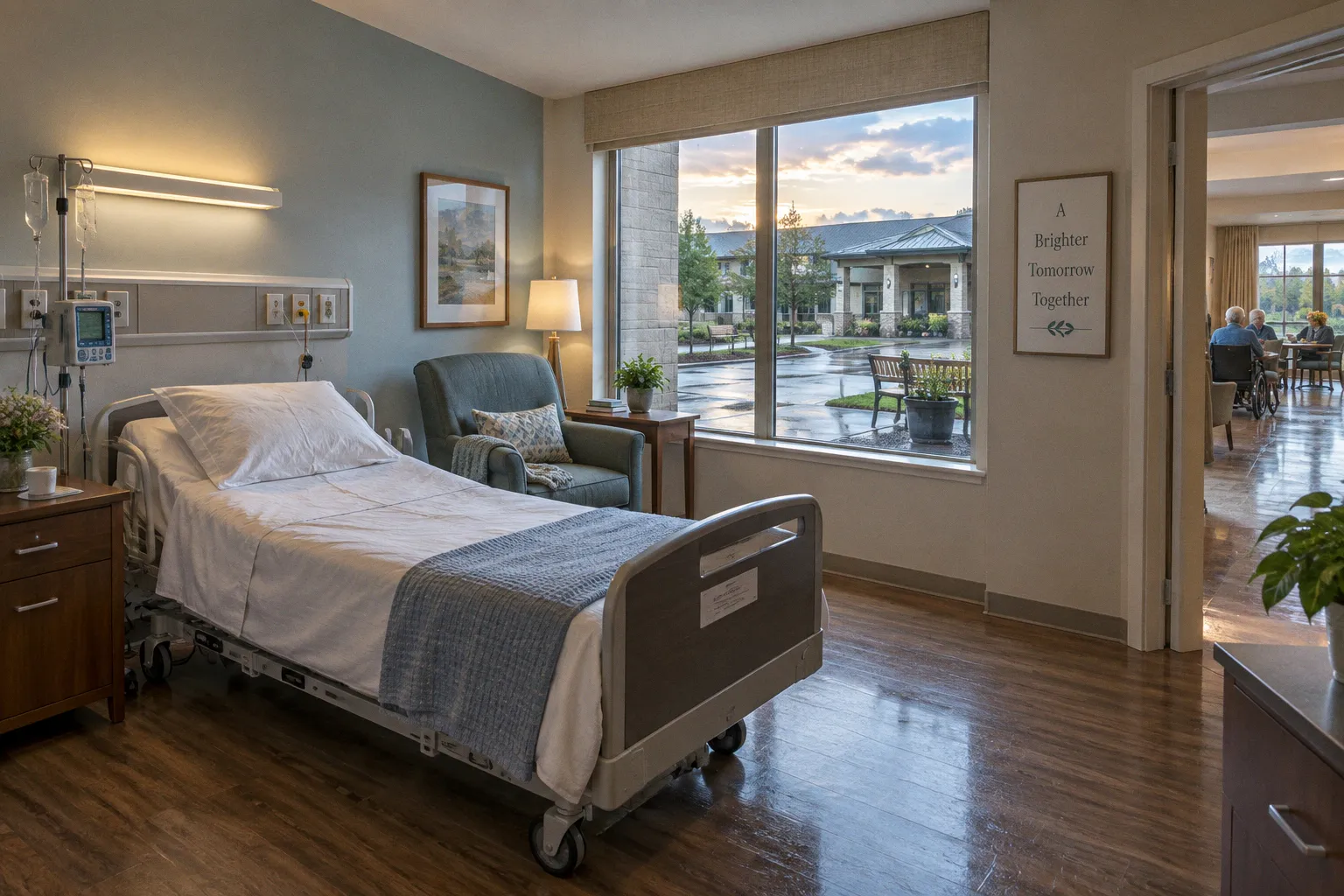
The average nursing home stay in the United States runs about 485 days, and 57% of residents are classified as long-stay occupants, remaining for more than 100 days, according to National Center for Health Statistics data referenced across the long-term care sector. Those figures reveal how quickly the boundary between “residential support” and “medical facility” can disappear in family conversations about senior care.
Choosing between assisted living and a skilled nursing facility is not simply a preference about floor plans, dining rooms, or the location of a community. It is a care-level decision shaped by acuity, supervision requirements, functional limitations, available clinical services, and the way each setting is paid for. Misreading the level of care can create unnecessary expense, disrupt continuity, and lead to emergency transfers when a community can no longer safely meet a resident’s needs.
The Department of Health and Human Services projects that 56% of Americans turning 65 in 2022 will require some form of long-term care during their lifetime. For that population, the question is not only whether care will be needed, but which of the long term care options by level of assistance matches the person’s condition now—and how likely that condition is to change.
A resident who needs help with bathing and dressing may thrive in assisted living. Someone recovering from surgery, receiving complex wound care, or requiring daily skilled nursing may need a nursing home, either temporarily or for the long term. The difference is not cosmetic. It determines who can provide the care, how often that care can be delivered, and whether the setting can respond when the resident’s condition changes.
Defining the Scope of Care: ADLs Versus Clinical Oversight
Assisted living and skilled nursing are not merely adjacent points on a price gradient. They are different operational models, generally licensed under different state regulatory frameworks, with different staffing expectations and clinical capabilities.
Assisted living communities are built around a residential model. Their core service is help with activities of daily living, or ADLs, such as:
- bathing and showering;
- dressing and grooming;
- toileting and continence-related routines;
- transferring between a bed, chair, and standing position;
- eating or arranging meals; and
- reminders or assistance related to ordinary daily routines.
The exact services vary by state and by community. Some assisted living residences provide more substantial personal care than others. One may be designed for relatively independent residents who need occasional help, while another may support people who require hands-on assistance several times a day. Memory care communities can add secured environments, behavior support, and dementia-focused programming, but they still operate within the limits of their license, staffing model, and written service agreement.
Residents typically live in apartment-style units, often with private bathrooms and, in some cases, kitchenettes. The setting is intended to preserve autonomy and normal daily life. Meals, activities, transportation, housekeeping, and social programming are part of the model because the resident is living in a community rather than receiving around-the-clock medical treatment.
Medication support requires more careful description than many comparisons allow. Depending on state rules, the facility’s license, and the training of its staff, an assisted living community may offer reminders, storage, organization, administration, or other forms of medication assistance. Some communities may provide limited help with certain injections under applicable state and facility rules. Others may prohibit that service or require a nurse or outside clinician to provide it. Families should ask exactly who handles each medication, what documentation is maintained, and which tasks require a licensed professional.
The same variation applies to health monitoring. An assisted living community may check a resident’s condition, coordinate appointments, record changes, and arrange outside services. That does not make it equivalent to a skilled nursing facility with licensed nursing coverage and a formal clinical care plan. Assisted living generally is not designed for continuous nursing oversight, complex wound treatment, IV therapy, unstable respiratory needs, or intensive post-surgical rehabilitation.
Skilled nursing facilities, often called SNFs or nursing homes, operate on a clinical model. They provide nursing care and supervision for residents who need ongoing medical oversight, rehabilitation, or assistance with complex conditions. Depending on the resident’s needs and the facility’s capabilities, services may include:
- wound assessment and treatment;
- IV therapy or other complex medication regimens;
- injectable medications;
- enteral feeding;
- tracheostomy care;
- oxygen and respiratory support;
- physical, occupational, and speech therapy;
- monitoring after surgery, injury, or acute illness; and
- assistance with multiple chronic conditions that require coordinated clinical management.
A nursing home may also provide long-term custodial care for people who no longer need a short-term rehabilitation program but cannot safely live without extensive support. In that role, it is not simply a hospital substitute. It becomes the resident’s long-term home, with nursing and personal care integrated into the daily routine.
The difference between assisted living and skilled nursing is easiest to see in the type of problem each setting is equipped to manage. A person who needs help buttoning a shirt, preparing for a shower, or remembering a scheduled medication may fit an assisted living model. A person recovering from a hip replacement, managing an active pressure injury, receiving complex treatments, or requiring frequent assessment may need skilled nursing, at least during the clinical episode.
That distinction is not absolute. A resident’s diagnosis alone does not determine placement. Two people with the same diagnosis may have very different functional abilities, risks, and treatment plans. The deciding issue is the level of hands-on assistance and clinical oversight required, along with whether the proposed setting can deliver it safely.
Assisted living is residential support with varying degrees of personal care. Skilled nursing adds a higher level of licensed clinical oversight. The mistake is assuming that one setting can absorb the responsibilities of the other without checking the details.
The Role of Medical Necessity in Facility Admission
Admission procedures reinforce the operational divide, although neither process is identical everywhere.
Entry into a skilled nursing facility for post-acute care generally involves a physician or other authorized clinician documenting the resident’s condition and the need for skilled services. The documentation may relate to a recent hospitalization, surgery, injury, qualifying diagnosis, or treatment plan that requires daily nursing or therapy. Payers may impose additional requirements before covering the stay. The facility reviews hospital records, medication orders, therapy recommendations, functional assessments, and discharge documentation before accepting the resident.
For Medicare coverage of a short-term skilled nursing stay, the beneficiary generally must meet specific eligibility and clinical requirements, including a qualifying inpatient hospital stay. Observation status is not the same as an inpatient admission for this purpose. Coverage is also time-limited and depends on continued medical necessity. A physician’s order by itself does not guarantee payment.
That process is clinical from the beginning. Hospital discharge planners coordinate with prospective facilities, medical records move with the resident, and the receiving team develops a care plan around the documented condition. The facility must also determine whether it has the staff, equipment, and available bed needed for the resident’s particular needs.
Assisted living admissions follow a different pathway, but describing them as purely administrative or financial is too simple. The prospective resident or family usually initiates the process, and the community conducts an assessment to determine whether the person’s needs fall within its licensed services and internal capacity. Depending on the state and facility, the process may include a physician’s health assessment, medication list, functional evaluation, cognitive screening, or documentation of current diagnoses and treatment needs.
States set different requirements for assisted living and residential care. Some require a health assessment before move-in or shortly afterward. Some allow communities to provide a wider range of services than others. Individual facilities may establish acuity ceilings that are more restrictive than the state licensing minimum. A community may decline an applicant who needs two-person transfers, frequent nighttime care, certain medical treatments, or continuous supervision, even if another community in the same state would accept that resident.
Admission documentation matters because it defines the practical boundary of the relationship. A family should not rely on a general statement that a community can “handle” a condition. The relevant questions are more specific:
- Who provides the service?
- How often is it provided?
- Is it included in the base fee or charged separately?
- Does the community provide it directly or coordinate an outside clinician?
- What happens if the resident’s needs increase?
- Which changes require a new assessment or revised service plan?
- At what point would the resident need to transfer?
The answers can differ even among communities with similar marketing language. One residence may assist with medication administration under its state rules, while another may only offer reminders and coordination with a home health agency. One may accept residents who use wheelchairs independently, while another may require a higher level of transfer assistance than its staffing pattern can support.
The practical risk appears after a change in condition. A resident may enter assisted living with a manageable care plan and later experience a fall, stroke, infection, hospitalization, or progression of dementia. The community may then determine that the resident’s needs exceed its license, staffing, or physical layout. If the family has not asked about that possibility in advance, the transfer will happen during a crisis rather than through a planned transition.
Before signing an assisted living contract, ask the admissions team to explain in writing:
1. Which services are outside the community’s license or internal policy?
2. Which changes in condition trigger a reassessment?
3. Under what circumstances can the community require a transfer?
4. How much notice does the family usually receive?
5. Does the community coordinate with hospitals, home health agencies, rehabilitation providers, or nursing homes?
6. Who is responsible for arranging transportation, records, medication lists, and the receiving facility?
That information is more useful than a polished tour because it shows how the community responds when the resident no longer fits the original plan.
Financial Realities: Private Pay, Insurance, and Medicare Coverage
Payment is where the difference between these settings becomes most visible—and where families often underestimate their exposure.
Assisted living is primarily private pay. Monthly costs across industry sources commonly fall in a broad range of approximately $2,800 to more than $6,000, depending on geographic market, unit size, care tier, and included services. Memory care frequently costs more because of staffing, security, programming, and supervision requirements. Additional fees may apply for medication support, incontinence care, transfer assistance, transportation, or increased care hours.
Long-term care insurance may offset part of the expense, depending on the policy’s benefit triggers, daily or monthly limits, elimination period, and definition of covered care. Many policies use an ADL threshold, such as requiring assistance with two or more activities of daily living, but policy language controls. The family should confirm whether the insurer pays the community directly, reimburses the resident, or requires a licensed provider to deliver the service.
Original Medicare generally does not pay for ordinary long-term assisted living room and board or custodial residential care. Medicaid may help with certain assisted living services in some states through waiver programs, but eligibility, covered services, provider participation, and waitlists vary. Even where assistance is available, it may not cover the full monthly cost of the residence.
Skilled nursing has a more complex payer mix. A short-term rehabilitation stay may be covered by Medicare when the resident meets the applicable hospital, clinical, and facility requirements. Coverage is not automatic, and it can end when the resident no longer qualifies for skilled care, even if the person still needs help with daily activities.
For many beneficiaries, Medicare Part A provides full coverage for a limited initial period of an eligible SNF stay, followed by a daily coinsurance period. Coverage generally does not continue indefinitely, and Medicare does not pay for a long-term custodial nursing home stay simply because the resident cannot live independently. Medicaid, private funds, long-term care insurance, and other benefits may become relevant when a skilled episode ends or when the resident enters long-term nursing care.
| Cost and coverage variable | Assisted living | Skilled nursing facility |
|---|---|---|
| Typical payment model | Primarily private pay, with possible long-term care insurance or limited Medicaid assistance | Medicare for eligible short-term skilled care; Medicaid, private pay, and long-term care insurance for longer stays |
| Medicare coverage of ordinary long-term residence | Generally not covered | Long-term custodial care is generally not covered |
| Short-term rehabilitation | Usually not the primary setting for intensive post-acute rehabilitation | Commonly provided when clinical and coverage requirements are met |
| Admission process | Facility assessment, health and functional documentation, and state-specific requirements | Clinical records, physician or authorized clinician documentation, payer requirements, and facility review |
| Main cost variables | Housing, service tier, medication support, care hours, and memory care needs | Acuity, room type, therapy, nursing intensity, location, and length of stay |
| Medicaid role | Limited or state-specific assistance, often through waivers | Major payer for eligible long-term nursing home residents |
A family considering assisted living should plan for a potentially multiyear private-pay obligation and ask how fees change as care needs increase. The initial monthly rate may not reflect the cost after a resident begins needing more hands-on assistance, incontinence care, escorting, or additional medication services.
A family entering a nursing home for rehabilitation should ask when the current coverage review will occur, what clinical milestones affect payment, and what happens if the resident is not ready to return home when the covered period ends. The financial handoff from short-term Medicare coverage to private pay or Medicaid is one of the least understood parts of the care system.
Medicaid planning also requires caution. Eligibility for long-term nursing home coverage depends on state rules, income, assets, medical need, and other factors. Families may need to document finances, address property and transfers, and complete an application process that can take time. A nursing home’s billing office can explain facility procedures, but it is not necessarily a substitute for advice from an elder law attorney or a qualified benefits specialist.
The right financial question is not simply, “Which setting costs less this month?” It is, “What level of care is likely, what services will be added over time, and which payer is responsible for each part of the plan?”
Navigating the Transition from Residential to Skilled Care
Most residents do not remain at one level of care forever. A fall, stroke, infection, surgical complication, cardiac event, or progression of dementia can push a resident beyond the service ceiling of an assisted living community. In other cases, a resident enters a nursing home for rehabilitation and later returns to assisted living, home, or another residential setting.
The transition from assisted living to skilled nursing is easier when the family recognizes the pattern early. Warning signs can include:
- repeated falls or transfers that staff can no longer complete safely;
- wounds that require treatment beyond the community’s available services;
- increasing nighttime needs that leave the resident without adequate supervision;
- frequent emergency department visits or hospitalizations;
- medication changes that require closer monitoring than the community can provide;
- worsening swallowing, nutritional, or respiratory problems;
- a need for therapy after a hospitalization; or
- cognitive or behavioral changes that create risks the current setting cannot manage.
None of these signs automatically determines placement. The next step is a clinical assessment, not an assumption that every decline requires permanent nursing home care. Some residents need a temporary skilled rehabilitation stay and can return to assisted living after regaining strength. Others need a permanent increase in nursing support. The decision should account for the resident’s baseline function, prognosis, treatment plan, safety risks, and goals.
The mechanics of a transfer are procedural but consequential. The treating clinician or discharge planner must document the reason for the move. Records from assisted living, the hospital, and outside providers need to be collected. Medication reconciliation must compare the current list with new orders, discontinued drugs, allergies, and recent changes. The receiving facility must have an appropriate bed and the capacity to manage the resident’s clinical needs.
A transfer also requires attention to details that families often discover too late:
- whether the receiving facility can provide the required therapy;
- whether it manages the resident’s specific wound, respiratory, behavioral, or nutritional needs;
- whether the room is private or shared;
- what services are included in the quoted rate;
- how transportation is arranged;
- whether the facility accepts the expected payer; and
- how discharge planning will begin if the stay is intended to be temporary.
Bed availability can delay a move, especially when the resident needs a specialized unit or the local market has limited capacity. In some cases, the resident remains in a hospital while a placement is arranged. That may be necessary, but it can also create additional cost and functional decline when the resident is medically ready for a lower level of care.
Families who maintain a current medication list, copies of major medical records, contact information for clinicians, and a short list of potential facilities are better positioned when a change occurs. They can still make difficult decisions, but they are less likely to make them for the first time from a hospital bedside.
The assisted living community can be a planning partner or a source of friction. Some communities have established relationships with nursing homes and provide organized transfer support. Others offer limited discharge planning once a resident exceeds their capacity. The difference should be investigated before admission, not during the final hours before a move.
The first placement is not necessarily the final placement. A sound plan accounts for the possibility that care needs will rise, stabilize, or occasionally decrease.
Operational Benchmarks: Staffing and Resident Longevity
Staffing structure is one of the clearest operational differences between assisted living and skilled nursing, but the headline number is rarely enough to judge quality.
Skilled nursing facilities operate under federal participation requirements that include licensed nursing coverage around the clock and a registered nurse serving as director of nursing. Beyond those baseline requirements, staffing ratios, acuity-adjusted standards, and reporting rules vary by state. A facility may meet a formal minimum and still struggle with call-outs, turnover, agency dependence, or uneven experience on a particular shift.
Assisted living communities operate primarily under state regulation. The range is wide. Some states require nurses to be present or available on a more continuous basis; others rely heavily on medication aides, personal care attendants, and periodic nurse visits. The legal title of a staff member does not by itself explain what that person is permitted or trained to do.
When evaluating a community, ask to see the actual staffing pattern rather than relying on a marketing ratio. Useful questions include:
- Who is on site overnight?
- How many staff members are assigned to the resident’s wing or floor?
- What happens when someone calls out?
- Are agency workers used regularly?
- How long have the direct-care employees worked there?
- Who performs medication-related tasks?
- How quickly are changes in a resident’s condition reported to a nurse or physician?
- Is staffing increased for residents with dementia, behavioral needs, or extensive transfer assistance?
Turnover is not a perfect measure of care, but persistent turnover can affect consistency, trust, and knowledge of individual residents. A community that cannot clearly explain its staffing pattern, vacancy coverage, and escalation process deserves closer scrutiny.
Inspection history, licensing records, complaint information, and the facility’s response to deficiencies can add useful context. They should not replace an in-person visit, but they can reveal whether a community repeatedly struggles with medication management, staffing, infection control, care planning, or resident safety.
Resident longevity also reinforces the difference between rehabilitation and long-term care. The average 485-day nursing home stay and the 57% long-stay classification cited earlier show that nursing homes serve both short-term post-acute residents and people with substantial ongoing care needs. Many residents enter for rehabilitation and later return to a lower level of care, but others remain because their medical or functional limitations persist.
Assisted living is generally designed for residents with lower clinical acuity, although the range within the sector is broad. Some residents remain for many years with relatively stable needs. Others move to a nursing home after a short period because illness, frailty, or dementia progression changes the level of support required. Length of stay is therefore a poor substitute for a care assessment. The more useful question is whether the community can manage the resident’s likely needs six months from now, not only on move-in day.
Making the Level-of-Care Decision
The comparison between skilled nursing vs assisted living care levels becomes clearer when the family separates four questions:
1. What can the resident do independently?
Look at bathing, dressing, toileting, eating, transferring, walking, and medication routines—not only the diagnosis on the medical chart.
2. What clinical services are required?
Consider wound care, injections, therapy, oxygen, feeding support, monitoring, behavioral supervision, and the frequency of professional assessment.
3. How likely is the need to change?
A resident recovering from surgery may need skilled nursing temporarily. A resident with progressive dementia or repeated falls may need a setting with a higher long-term ceiling.
4. How will the care be paid for?
Review private funds, long-term care insurance, Medicare limitations, Medicaid eligibility, and the cost of additional services before signing an agreement.
The difference between a residential care home vs skilled nursing facility is not that one is “better.” The settings solve different problems. Assisted living can offer independence, community, and personal support when a resident remains medically stable. Skilled nursing is appropriate when the resident needs licensed clinical oversight, rehabilitation, or a level of care that the residential setting cannot safely provide.
Families should also ask whether a proposed placement supports the resident’s actual goals. Some people prioritize remaining near a spouse or familiar neighborhood. Others value intensive rehabilitation, specialized dementia support, or access to nursing staff overnight. Those preferences matter, but they have to be matched with a setting that can meet the resident’s minimum safety and care requirements.
There is no single answer to when to transition from assisted living to skilled nursing care. The transition is appropriate when the resident’s needs exceed the current community’s license, staffing, equipment, or ability to respond reliably—not merely when the family becomes anxious or the resident has one difficult day. A physician, nurse, rehabilitation professional, hospital discharge planner, or geriatric care manager can help distinguish a temporary setback from a sustained change in care level.
The strongest placement decision is therefore neither the least expensive nor the most medical-looking option. It is the setting that can provide the required care today, explain what happens if the resident declines, and make the financial and clinical boundaries clear before the move occurs.
FAQ
What is the main difference between assisted living and a nursing home?
Does Medicare pay for assisted living or nursing home care?
What medical needs usually require skilled nursing?
When should someone move from assisted living to skilled nursing?
Can someone return to assisted living after a nursing home stay?
Related articles
 Long-Term CareFall prevention protocols: three clinical approaches compared
 Long-Term CarePressure ulcer prevention tools for skilled nursing facilities
 Long-Term CareInfection Control Audits: What Our 30-Day SNF Review Revealed
 MedPAC Convenes September 2026 Public Meeting Addressing Post-Acute and Skilled Nursing Payments