Sensory stimulation kits: three tools for dementia agitation
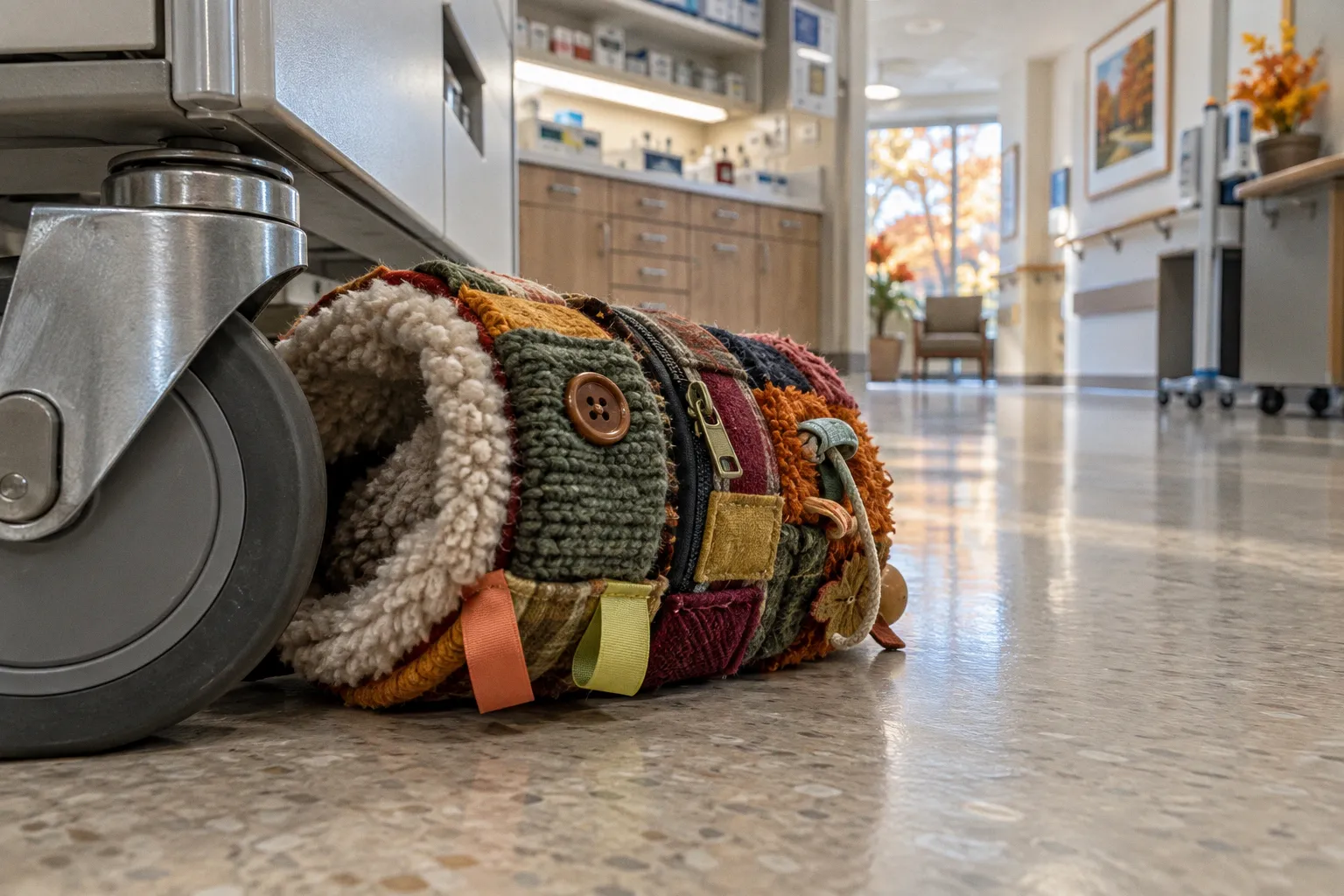
Sensory stimulation kits for dementia patients offer simple, non-drug ways to respond: something safe to handle, gentle pressure across the lap, or familiar music that helps orient attention.
These tools are not interchangeable, and none is a treatment for every cause of agitation. A fidget muff may help when restless hands need a task; a weighted lap pad may feel calming to one resident and uncomfortable to another; music can soothe or overwhelm depending on the person and the moment. Our most useful standard is not whether an item belongs in a kit, but whether it fits this resident's sensory baseline, abilities, and history.
Tactile distraction: fidget blankets and muffs
Fidget blankets and muffs give restless hands a safe, purposeful activity. They may include zippers, buttons, ribbons, and fabrics with different textures—features that invite touching and manipulation without relying on a complicated set of instructions. For a resident who repeatedly picks at clothing or searches for something to hold, a familiar-feeling object can redirect that activity.
These are tactile therapy tools, not toys. Their usefulness depends on whether the parts are comfortable and manageable for the person using them. A large blanket with many attachments may be engaging for someone who enjoys exploring textures, but confusing or overstimulating for a resident who is tired, visually impaired, or easily distracted. A smaller muff may be easier to hold and keep close, particularly for a person whose hands tire quickly or whose reach is limited by arthritis or contractures. The size of the item should match the resident's posture as well: a blanket draped across a lap is a different experience than a muff cradled in two hands, and the resident will tell us which one they prefer by what they do with it.
When choosing among fidget blankets for dementia residents, consider:
- Grip and reach: Can the resident comfortably hold the item or reach its features without strain? A button set too close together may frustrate fingers that have lost fine motor control.
- Texture and temperature: Are the materials pleasant against the skin, and do they fit the resident's usual sensory preferences? Some people welcome rough textures, and others find them irritating.
- Safe construction: Are buttons and other attachments securely fixed, with no loose parts that could be pulled off or swallowed? Staff should inspect these items regularly because wear and repeated handling loosen seams.
- Cognitive load: Does the item invite simple exploration, or does it demand more attention than the resident can comfortably give? Too many competing features can read as clutter rather than interest.
- Personal meaning: Do the colors, fabrics, or activities resemble something the resident has enjoyed before? A woman who once sewed may reach for a small fabric square; a man who worked with his hands may prefer something with buckles or clasps.
Offer one item at a time and watch what happens. If the resident touches it, settles into the activity, or shifts away from a distressing repetitive behavior, it may be a useful match. If they push it away, look increasingly tense, or start pulling at its components, remove it without treating that response as a failure. It is information about the fit, and it tells us to try a different texture, a smaller object, or perhaps a different kind of intervention altogether.
A fidget item works best when it gives restless hands something comfortable to do—not when it asks the resident to perform.
Deep pressure: when a weighted lap pad may help
A weighted lap pad provides gentle, targeted pressure across the lap. For some residents, that steady sensation can feel containing and may reduce anxiety, agitation, or restlessness, including during sundowning hours. Unlike a fidget item, it does not ask the person to manipulate anything; it offers a more passive sensory input. The resident does not have to figure anything out, hold a particular posture, or perform a task.
That difference matters. A resident who enjoys tactile activity may prefer a muff, while someone who tires easily or does not want to handle objects may find a lap pad more comfortable. But deep pressure is not automatically calming. Weight and placement can feel restrictive, especially if a person has difficulty shifting position, communicating discomfort, or removing the pad independently. A resident who cannot easily lift the pad off their lap may feel trapped by it, no matter how gentle the weight.
The available information does not establish a universal weight-to-body-mass ratio for frail older adults, and that uncertainty is itself important to acknowledge. We should therefore avoid choosing a pad by applying a simple formula or assuming that heavier means more effective. A pad that feels grounding to one person may feel like a burden to another. Begin with a product designed for this use, consult the care team about the resident's physical needs, and observe closely while the pad is in place. The resident should be able to breathe comfortably, change position, and signal or show that they want it removed.
A gradual introduction makes the response easier to read:
1. Choose a calm moment. Avoid introducing an unfamiliar sensation when the resident is already highly distressed. A new tactile experience lands very differently when someone is at ease.
2. Explain and offer. Use a simple, respectful explanation and give the resident a chance to accept or decline. A gesture, a hand extended, or a brief sentence in familiar language is often enough.
3. Place it without restraint. The pad rests on the lap; it should not pin the resident down or limit movement. If the resident cannot slide it off themselves, staff should remain nearby.
4. Stay nearby and observe. Look for relaxed posture and continued comfort, as well as signs of discomfort such as pushing the pad away, shifting repeatedly, or becoming more tense.
5. Remove it promptly if it is unwelcome. A resident's refusal is a clear reason to stop, not a cue to insist. Trying again later, with a lighter weight or a different position, is always an option.
A short trial can inform care, but it does not establish that the same approach will work for every resident or across all stages of dementia. What helps during a calm afternoon may be unwelcome during a moment of acute distress, and what feels comforting early in the disease course may feel uncomfortable later. Reassessment is part of the protocol, not a separate step to remember after the fact.
Auditory and olfactory grounding: music and scent
Familiar music can engage attention through a channel that does not depend on conversation or complex instructions. Simple-use players loaded with music a resident knows may help redirect attention and support a calmer behavioral response. Familiarity is the key: a resident's own preferred songs may be more meaningful than a generic playlist labeled for a particular generation. A woman who sang in church may settle when a hymn plays; a man who danced at family weddings may respond to the songs from those years. Family members are often the best source of this information, and a short conversation with them can reveal preferences the care team has not yet heard.
Keep the listening experience easy to control. A resident should be able to pause or stop the music, and staff should be able to lower the volume quickly. Headphones can be helpful for some residents and isolating or uncomfortable for others. If the person becomes more restless, starts searching for the source, or seems bothered by the sound, turn it off. Music that is soothing in one setting may be intrusive in another, particularly when the room is already noisy or when several televisions, call systems, and conversations are competing for attention.
Scent tools offer another form of sensory input. Lavender, sandalwood, or jasmine are among the scents used in aromatherapy approaches to dementia care. Yet scent is personal, and a pleasant smell to one resident can be unpleasant or unfamiliar to another. A fragrance that evokes a favorite garden for one person may recall a hospital corridor for someone else. Fragrance may also add to a room's sensory load when the person is already unsettled. Where scent is used, it should be introduced briefly and then removed, and staff should watch for any sign of headache, agitation, or respiratory discomfort.
We should not assume that either music or aromatherapy will reliably reduce agitation, or that they substitute for evaluating its cause. Pain, fatigue, hunger, medication effects, an unfamiliar environment, or unmet needs can all contribute to a behavioral expression. Sensory interventions may support comfort, but they should sit alongside attentive clinical assessment—not take its place.
Personalization without overstimulation
A kit is a collection of options, not a prescribed package to use all at once. The resident's cognitive capacity, physical abilities, life history, preferences, and current sensory baseline should guide what we offer. A person who once enjoyed sewing may welcome textured fabric or a simple fastening activity; another may find the same materials frustrating. Familiarity should be based on what we know about the individual, not a stereotype about age or diagnosis.
The environment matters as much as the object. A music player, scented item, fidget blanket, and weighted pad introduced together can make it impossible to tell what is helping—and may overwhelm someone who is already sensitive to sound, touch, or competing activity. Start with one intervention, in a calm space, and allow time to see whether the resident chooses to engage. If the first option does not land, return to a quiet baseline before offering another. The goal is not to fill the moment with stimulation but to find what this particular resident reaches for.
That is also the sensible way to think about sensory room equipment for memory care. A room with multiple sensory options can support individualized activities, but more equipment does not automatically mean more benefit. Noise, lighting, visitors, and the pace of care all shape the experience. Before adding an item, ask whether it addresses a particular need and whether the room gives the resident a comfortable way to approach or leave it. A sensory room that a resident can enter and exit freely offers something very different from a busy activity space where the door is closed and the lights stay on.
Therapeutic sensory activities for cognitive decline should preserve adult dignity. Offer choices in an ordinary, respectful way; do not press an item into someone's hands or praise them for using it as if they were a child. If they decline, we can try another time, another option, or simply reduce stimulation. Participation is not the measure of the person's worth or the quality of care. A resident who sits quietly with a familiar blanket across the lap is having a meaningful sensory experience, even if no observer would call it an activity.
Staff training matters as much as the equipment. A kit left in a drawer is not a sensory program. Care partners need to know how to introduce each item, how long to offer it, how to read the resident's response, and how to record what they observed. Brief, consistent routines make this possible on a busy unit. A short huddle at the start of a shift, a one-page guide beside the kit, and a shared language for describing responses can carry the program further than any single tool.
Evaluating whether an intervention helps
A calming impression is useful, but consistent observation helps a care team make better decisions. Before trying a tool, note what is happening: when the agitation occurs, what the resident is doing, what is going on around them, and whether there are signs of discomfort or an unmet need. Then offer one sensory option and observe the same details again.
A brief record can include:
- The situation: time of day, location, activity, and any likely environmental triggers.
- The behavioral expression: for example, repeated handling of clothing, pacing, calling out, or visible distress.
- The intervention: which item was offered, how it was introduced, and whether the resident accepted it.
- The response: whether the person appeared more settled, unchanged, or more distressed.
- The practical fit: whether staff could offer it safely and whether the resident could stop or move away from it.
This is not a demand to turn every interaction into a formal measurement exercise. It is a way to distinguish a helpful pattern from a hopeful guess. If the same tool appears to support comfort in a particular situation, the team can consider making it available then. If there is no consistent benefit, or the resident becomes more distressed, stop and reassess rather than escalating the sensory input.
Multi-sensory environment benefits seniors most clearly when the team revisits the match over time. A tool that worked well last month may no longer suit a resident whose vision, hearing, or preference has changed. The strongest care plans build in a regular check-in, however brief, and treat the kit as a living collection rather than a fixed inventory.
The strongest choice depends on the need in front of us:
| Tool | May be a useful fit when… | Watch for… |
|---|---|---|
| Fidget blanket or muff | The resident seeks touch or needs something safe to handle | Loose parts, frustration, or too many competing features |
| Weighted lap pad | The resident appears comfortable with gentle pressure and can shift or signal discomfort | Restriction, increased tension, or difficulty removing it |
| Familiar music | The resident responds positively to known songs and can tolerate the sound | Noise sensitivity, difficulty controlling playback, or increased searching |
| Scent tool | The resident has a known preference and welcomes the aroma | Dislike, unfamiliarity, or added sensory load |
Sensory stimulation kits for dementia patients are most valuable when they help caregivers respond with curiosity instead of treating agitation as a behavior to suppress. We can offer a safe tactile activity, try gentle pressure with close observation, or use familiar music or scent when the resident welcomes it. Then we watch, adjust, and stop when the intervention is not comfortable.
There is no single kit that suits every person, and no sensory tool removes the need to look for pain, distress, or unmet needs. A good intervention is modest: it supports comfort without taking control away from the resident. That is how practical sensory care protects both well-being and dignity.
FAQ
How do I know if a fidget item is appropriate for a dementia resident?
Is there a standard weight for a weighted lap pad for seniors?
What should I consider when choosing music for a dementia patient?
Can aromatherapy help reduce agitation in dementia patients?
Should I use all items in a sensory kit at once?
Related articles
 Memory & Cognitive CareDementia care facility transitions: common pitfalls to avoid
 Monroe Community Hospital Launches Friendship Place for Specialized Memory Care
 Memory & Cognitive CareSensory Stimulation Tools for Dementia by Stage
 Memory & Cognitive CareCircadian Lighting for Sundowning: What Our 6-Week Test Showed