Hydration tracking for seniors: three methods for daily care
Hydration Tracking for Seniors: Three Methods That Actually Work in Daily Care
Thirst perception declines with age, and by the time an older adult feels thirsty, the dehydration process has typically been underway for hours. In our nursing community, this is the daily care hurdle we return to most often: how do we know — really know — whether someone is meeting their fluid needs before the clinical signs show up?
That question is what hydration tracking methods for seniors are built to answer. There are three categories we rely on, and each plays a different role: manual documentation that anchors the day, smart technology that prompts and measures, and clinical assessment tools that catch what the other two miss. None of them works well in isolation. Let me walk you through what we use, what holds up under real care conditions, and how to bundle them so the daily target — roughly 1.6 liters for women and 2.0 liters for men per day, the ESPEN minimum for older adults — actually gets met.
Thirst is an unreliable signal in geriatric care. Systematic tracking is what closes the gap between intake and need.
The Physiological Case for Systematic Fluid Monitoring
Age changes the body's fluid regulation in ways that are easy to underestimate. Total body water decreases, renal concentrating ability drops, and the thirst response blunts. Medication load adds another layer — diuretics, laxatives, and certain blood pressure medications accelerate fluid loss in ways the resident themselves may not register. For residents living with cognitive impairment, the sensory baseline for thirst is often shifted so far that the signal never reaches conscious awareness at all.
What this means practically is that the standard "drink when you're thirsty" advice, which works reasonably well for a healthy adult, becomes a clinical liability for someone in their seventies or eighties. A review published in 2021 on fluid intake monitoring systems for the elderly confirmed what most of us see at the bedside: passive intake by older adults frequently falls below recommended thresholds without any subjective complaint of thirst.
That's why we treat hydration tracking the same way we treat medication administration — as a scheduled, documented part of the care plan, not a casual offering at meals. The ESPEN guidelines, published in 2018, set minimum daily beverage intake thresholds at approximately 1.6 liters (around 7 cups) for older women and 2.0 liters (around 8.5 cups) for older men, unless clinically restricted. Those are floors, not aspirational goals, and they're the benchmark we work back from when reviewing any tracking system. It's also worth noting that "beverage intake" is broader than plain water — soups, milk, herbal tea, and high-water-content foods like melon, cucumber, and yogurt all count toward the daily total, and we factor those into our charting rather than tracking water alone.
Manual Documentation: Bedside Charts and Visual Intake Logs
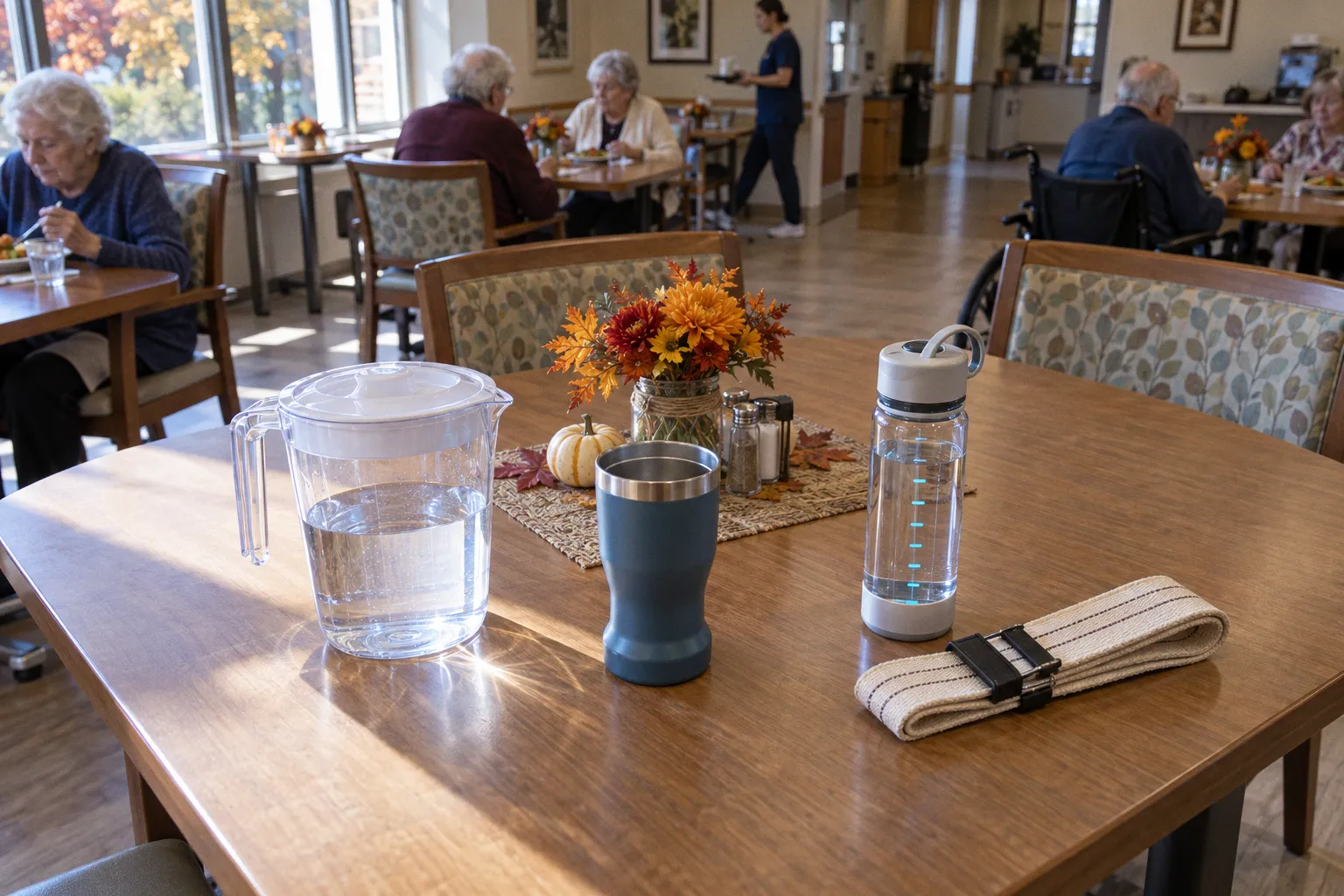
The oldest method in our toolkit is also, in many ways, the foundation. Manual tracking includes marked time-goal water bottles, bedside fluid schedule charts, and daily intake logs that record container volumes throughout the day. None of this is glamorous, and none of it requires a battery or a subscription — but in our experience, it remains the most consistent method for residents who need structured prompting.
The way we implement it: every shift documents what was offered and what was consumed, in measurable units. A standard 240 ml cup consumed twice between breakfast and lunch is a number we can trend over a week. When the numbers drift downward, we see it before any physical symptom appears. A bedside fluid schedule chart, taped at eye level in the resident's room, also gives the resident themselves a visible anchor — "by 10 a.m., I should have had two cups" — which preserves autonomy in a way that verbal prompting sometimes doesn't.
The honest limitation: manual logs are only as reliable as the staff completing them. Understaffed shifts, vague entries ("small amount"), and inconsistent container sizes all degrade the data. We coach our team to record in standardized units and to mark zero when a resident refused, not to leave blanks. A "refused" entry is clinical information. A blank is just noise.
| Method | Best for | Limitation |
|---|---|---|
| Marked time-goal bottles | Residents who self-pace and can read the goal line | Requires resident engagement; spills skew totals |
| Bedside fluid schedule charts | Visual learners and family visitors participating in care | Wall space and consistent placement needed |
| Shift-by-shift intake logs | Clinical trending and care plan review | Depends on staff documentation discipline |
Digital Integration: Smart Vessels and Hydration Reminder Apps
Smart technology for hydration tracking has matured into a genuinely useful clinical adjunct. The category breaks into three sub-tools: hydration reminder apps like WaterMinder and Elli Cares, wearable reminder devices that ping the resident on a schedule, and sensor-enabled drinking vessels such as Droplet and Smart Cups that record liquid volume as it's consumed.
What we like about this category is that it removes one of the most common failure points of manual tracking — the missed verbal cue. A gentle buzz from a wearable at 10 a.m., or a smart cup that lights up to remind a resident to take their next sip, takes the burden off the care partner who is simultaneously managing medications, transfers, and family communications. For residents in early-stage cognitive decline who can still respond to a prompt, this is often where we see the biggest single jump in daily intake, because the prompt arrives at a moment when the resident's attention is available rather than buried in a mealtime routine.
The trade-offs matter. Smart cups and sensor-enabled vessels are an investment, and their accuracy depends on consistent use — a cup left in the dining room instead of the resident's hand doesn't log anything. Apps require either a smartphone or a tablet at the bedside, which isn't realistic for every resident. Wearable reminders work well for those who tolerate wearing them and can interpret the signal. We tend to recommend starting with one device, tracking outcomes for two to four weeks, and deciding whether the additional data justifies the ongoing cost and maintenance.
| Tool Type | Strength | Consider Before Adopting |
|---|---|---|
| Hydration reminder apps | Low cost, easy to scale across residents with personal devices | Requires smartphone or tablet literacy, or a caregiver proxy |
| Wearable reminder devices | Passive prompting, no manual logging required | Comfort, skin sensitivity, daily charging routine |
| Sensor-enabled drinking vessels | Objective volume measurement at the source | Upfront cost, breakage risk, cleaning protocol |
Clinical Assessment: Why Physical Markers Require Multi-Component Oversight
Here's where caregivers get misled most often. Skin turgor, dry mouth, urine color — these are the physical signs everyone learns in basic health training, and they're the same signs that fail us in geriatric care. Age-related loss of skin elasticity means a skin pinch on the forearm or sternum returns slowly even in well-hydrated older adults. Urine color charts were largely developed for younger populations, and altered renal function changes the concentration pattern independently of fluid status.
Clinical research is clear on this point: standalone physical markers are insufficient to diagnose dehydration in older adults. They're useful as one data point in a larger picture, never as the verdict. What we treat as more reliable clinical signals are:
- A drop of 3% or more in body weight over a short period, which indicates significant fluid loss in institutionalized residents
- Sudden changes in mentation or behavioral expression — increased confusion, withdrawal, or new restlessness — that don't have another clear cause
- A documented intake trend that has fallen below threshold for more than 24 hours, regardless of how the resident looks on the surface
This is why we don't run clinical assessment as a separate "method" — it's the layer that catches what logs and apps miss, and it should always be interpreted alongside the tracking data, not in place of it. A urine dipstick or a serum lab value ordered by the physician is what confirms what the chart first suggested.
A urine color chart tells you about urine. A three-day intake log tells you about hydration. They are not the same question.
Implementing Bundled Interventions to Boost Daily Intake
The single biggest improvement we've seen — and the one most consistently supported in the literature — comes from bundling methods rather than choosing one. A quality improvement study published in 2025 on an acute geriatric ward found that a multi-component intervention combining bedside flip charts, fluid schedules, and structured hydration rounds increased the percentage of hospitalized older adults meeting a minimum 1 liter per day intake from 15% to 60%. That is a dramatic shift, and it didn't come from any single new device. It came from layering manual documentation, scheduled prompting, and clinical oversight into one routine.
What this looks like in practice on our floor: a bedside chart sets the day's goal in visible units. The shift log records each cup offered and consumed. Hydration rounds — scheduled between meals, not at meals — provide a structured prompting moment when the resident isn't already managing food intake. Any concerning physical marker triggers a chart review and a clinical conversation, not a wait-and-see. For residents with cognitive impairment, we adapt the verbal prompting to their behavioral baseline: the same offer, repeated calmly, in a calm environment, without pressure and without the kind of repeated urging that quickly becomes a behavioral trigger rather than a help.
The reason bundling works is that each method covers a different failure mode. Apps forget. Cups get left behind. Staff get busy. Charts get skipped. Physical signs lag. None of these is a reason to abandon the method — it's a reason to expect that no single method will carry the full weight of daily monitoring. The system holds because the layers overlap.
Our Verdict for Care Teams
If you're choosing where to invest your attention this month, start with the manual documentation layer. It's the cheapest, the most universal, and the one that gives you the trend data you need to decide whether smart tech or clinical escalation is actually warranted. Add structured hydration rounds between meals before you add another device. Bring in smart vessels or reminder apps for the specific residents whose intake data shows they're slipping through the cracks despite consistent prompting.
What we want caregivers and families to take away from this is not a preference for one method over another — it's the understanding that geriatric hydration tracking is a layered practice. Thirst will mislead you. Physical signs will mislead you. Single-method tracking will mislead you. The combination, documented consistently and reviewed regularly, is what protects residents from the kind of dehydration that sends someone to the hospital when it could have been prevented with a cup of water and a chart entry three days earlier.
That is the daily dignity we are protecting: the right to feel well, to stay oriented, and to have someone notice before a small gap becomes a clinical event.
FAQ
What is the recommended daily fluid intake for seniors?
Does only plain water count toward daily hydration goals?
Why are skin turgor and urine color unreliable for checking dehydration in the elderly?
What are the most reliable clinical signs of dehydration in older adults?
How can caregivers improve hydration for residents with cognitive impairment?
Related articles
 Senior Wellness & LivingSocial activities for introverted seniors in assisted living
 Senior Wellness & LivingAssisted Living Dining Options for Specific Dietary Needs
 Senior Wellness & LivingSeated Exercise Gear for Seniors: What Works and When
 Senior Wellness & LivingGeriatric Protein Drinks: Testing Three Formulations