Hydration Tracking Cups for Seniors: Our 4-Week Trial
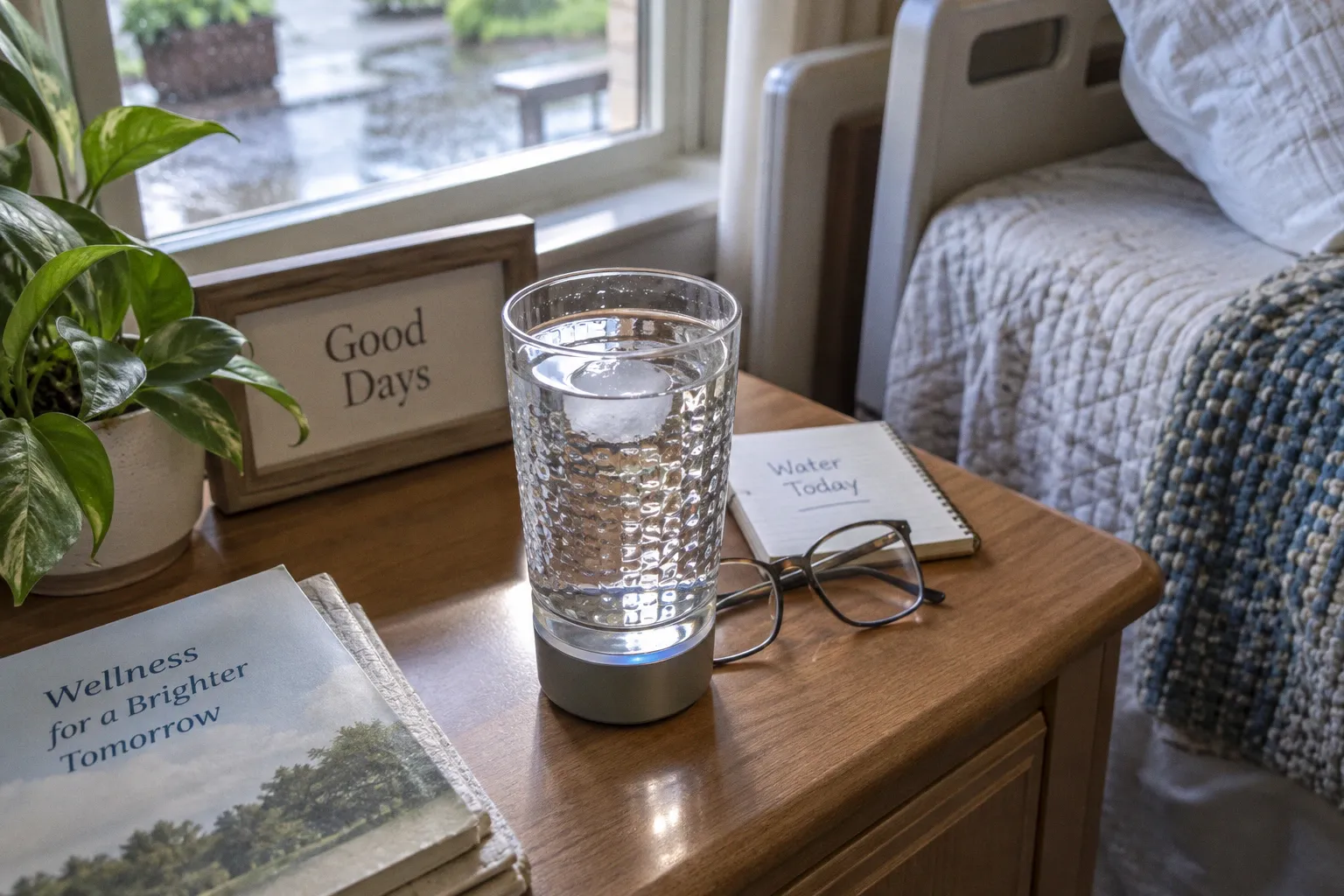
What it cannot do on its own is determine whether that person should drink more, whether the liquid is safe to swallow, or whether a missed drink reflects forgetfulness, fatigue, nausea, pain, or a clinical fluid restriction.
That distinction matters in assisted living and long-term care. Hydration is not simply a matter of placing a larger bottle on a bedside table. Residents may have dysphagia, dementia, tremor, arthritis, kidney disease, heart failure, or an individualized care-plan target that differs substantially from a general recommendation. Smart hydration cups for seniors can support observation, but they do not replace observation by a caregiver or nurse.
There is also a limitation with the title of this review: the available research does not provide verified participant numbers, protocol details, or measured outcomes from a completed four-week trial of one particular smart cup in assisted living. We therefore cannot responsibly present a product experiment as clinical evidence. Instead, we examine what a four-week use period can realistically show, where the technology fits into senior care, and where it creates more work than value.
The reality of fluid intake monitoring in senior care
Fluid intake is often harder to assess than families expect. A resident may drink from a cup at breakfast, take a few sips during medication administration, eat soup at lunch, accept a popsicle in the afternoon, and drink from a different glass during an activity. If those fluids are not recorded consistently, the daily total becomes an estimate.
A smart cup addresses only one part of that problem: fluid consumed from that specific vessel.
That makes it different from a complete geriatric fluid-intake tracking system. The cup may capture volume, time, and sometimes the resident’s pattern across the day. It may not capture:
- Drinks taken from another cup, a carton, or a communal beverage station.
- Fluid contained in soup, gelatin, ice cream, or other foods.
- Thickened liquids, depending on the cup’s design and how the sensor measures volume.
- Spills, partial pours, or drinks that are discarded.
- Intake recorded while the device is offline or not synchronized with the phone.
- Situations in which the cup is shared, moved to another resident, or picked up by staff while being cleared.
In practice, the cup is best understood as one observation tool within a broader care process. If the resident’s fluid intake falls, the technology may help identify a pattern. It will not explain the pattern.
The clinical question is not simply whether a device can count milliliters. It is whether the count changes what the care team does next. If a resident’s intake appears low, staff still need to assess swallowing safety, oral discomfort, constipation, infection symptoms, medication effects, mobility, mood, access to beverages, and the resident’s preferences.
A hydration tracker can make intake more visible. It cannot make an individualized hydration decision for you.
The Centers for Medicare & Medicaid Services expects nursing facilities to offer sufficient fluids to support hydration and health, while matching drinks to the resident’s needs and preferences. That can include keeping beverages within reach, offering assistance, reviewing medications that may increase dehydration risk, and providing alternatives such as ice cream, gelatin, or popsicles when appropriate. A smart cup may support those efforts, but it does not fulfill them by itself.
How smart hydration technology functions in practice
The most useful hydration tracking cups for seniors generally combine three elements:
1. A volume sensor that estimates how much liquid has been consumed.
2. Wireless synchronization, commonly through Bluetooth, with a mobile application.
3. A reminder system, such as a light, sound, or notification.
The HidrateSpark PRO smart tumbler is a clear example of this category. Its sensor sits at the base, the cup connects to a mobile app through Bluetooth, and customizable light reminders prompt the user to drink. The app also calculates a personalized hydration goal rather than displaying one fixed target for everyone.
The 20-ounce model was listed at $79.99 when the product page was crawled, with a stated sensor battery life of 10 to 14 days. Those details can change, and they should be treated as a dated product snapshot rather than a permanent price or specification. The sensor puck must be removed before cleaning and must not be submerged or placed in a dishwasher. That maintenance requirement is not a minor detail in senior care: a device that is damaged during routine cleaning quickly becomes an expensive ordinary cup.
The manufacturer reports accuracy of 97% compared with manual recordings. That is a manufacturer claim, not independent clinical validation. It may describe performance under the company’s testing conditions, but it does not establish that the cup will capture every type of drink, every drinking pattern, or every real-world care situation.
A four-week observational use period could still answer practical questions:
- Does the resident accept the cup without repeated prompting?
- Can the resident grip and lift it safely?
- Does the reminder light attract attention or become background noise?
- Does the cup remain with the correct resident throughout the day?
- Can staff keep the sensor charged and the app synchronized?
- Does the recorded information lead to a useful change in care?
- Are the readings complete enough to discuss with the nurse or dietitian?
Those are meaningful questions, but they are usability and workflow questions. They are not proof that the device prevents dehydration, urinary tract infections, falls, hospitalization, or confusion.
What a realistic four-week review should measure
If a community or family chooses to test a smart cup, the review should focus on a small set of observable outcomes rather than on the app’s appearance.
| Review area | What to observe | Why it matters |
|---|---|---|
| Resident acceptance | Whether the resident chooses the cup, refuses it, or forgets its purpose | A technically accurate device has little value if it is not used |
| Physical handling | Grip, weight, lid operation, lifting, and spill control | Frailty, arthritis, tremor, and reduced vision can change usability |
| Data completeness | Whether drinks from other vessels and food-based fluids are recorded separately | A partial record can look more precise than it really is |
| Reminder response | Whether visual or audible prompts lead to drinking | A reminder is not the same as successful intake |
| Staff workload | Charging, cleaning, assigning, syncing, and reviewing the cup | Added workflow can undermine adoption |
| Clinical usefulness | Whether the record helps staff adjust assistance or escalate concerns | Monitoring should support a care decision, not merely produce a graph |
A four-week period is long enough to reveal whether the cup fits a resident’s daily routine. It is too short, by itself, to establish durable clinical benefit. Research on hydration interventions in older adults has used periods ranging from three days to 12 months, and the approaches have included standardized cups, fluid charts, staff encouragement, larger cups, flavored drinks, and structured drink rounds. The range of methods is a reminder that hydration outcomes usually depend on a care package rather than on one device.
Hydration goals are individual, not built into the cup
General public guidance can provide context, but it cannot replace a resident’s care plan.
The National Academies lists adequate intake for total water—including water from beverages and food—at 3.7 liters per day for men aged 51 and older and 2.7 liters per day for women aged 51 and older. These figures are not universal prescriptions for every older adult. They include water from food, and they do not account for conditions in which fluid intake must be limited or carefully adjusted.
The British Dietetic Association describes approximately six to eight glasses of fluid per day, or at least 1.5 liters, as a general public-facing target for older adults. Again, that is a broad reference point, not an automatic order for a resident in assisted living or skilled nursing.
A person with congestive heart failure, edema, kidney disease, or another condition may have a fluid restriction. Another resident may need additional support because of fever, vomiting, diarrhea, medication effects, heat exposure, or reduced thirst. Someone with dysphagia may require thickened liquids or a swallowing plan that changes which vessels and consistencies are safe.
Before setting a goal in an app, we should confirm:
- The resident’s current care-plan target.
- Whether the target refers to beverages only or total fluid from food and drinks.
- Any fluid restriction or medical exception.
- The prescribed liquid consistency.
- Whether the resident needs physical assistance, cueing, or adaptive equipment.
- Which signs should prompt a nurse, physician, speech-language pathologist, or dietitian review.
The app’s personalized goal is not necessarily the resident’s clinical goal. It is a software calculation. The care plan remains the clinical reference.
Barriers to adoption: weight, swallowing, and environmental triggers
The most persuasive feature of a smart cup may be its tracking function. The feature most likely to determine success is whether the resident can comfortably use it.
Commercial smart-bottle reviews have identified sensor placement and device bulk as important usability considerations. A heavy bottle may be manageable for one resident and unsafe for another. A person with arthritis may be able to hold a lightweight handled cup but struggle with a wide tumbler. A resident with tremor may need a lid that reduces spills without requiring precise finger movements. A person with low vision may not notice a small indicator light, while a resident with dementia may interpret a blinking light as confusing or irritating.
This is where a sensory baseline becomes useful. We should know how the resident normally recognizes and accepts a drink:
- Do they prefer a particular color, temperature, flavor, or cup shape?
- Do they drink more reliably in a quiet room or during social drink rounds?
- Do they become distressed by lights, sounds, or repeated prompts?
- Do they need the cup placed in a specific position?
- Do they recognize the device as a drinking vessel?
- Does staff assistance improve intake more than the reminder itself?
Environmental triggers can suppress drinking even when fluid is available. A crowded dining room, an unfamiliar cup, a cold drink, poor lighting, or a rushed medication pass may all change behavior. What appears in the app as low intake may actually be a behavioral expression of discomfort or difficulty.
Dysphagia requires particular caution. A recent nursing-home comparison of systematic hydration rounds and a socially assistive robot found that the technology-supported intervention was not associated with higher fluid intake over one month. Dysphagia was independently associated with lower intake. The practical conclusion is straightforward: if swallowing is difficult, a reminder cannot solve the barrier. The resident may need assessment, modified consistency, pacing, positioning, direct assistance, or a different drinking vessel.
When intake is low, the first question is not “How do we make the app send more reminders?” It is “What is making drinking difficult for this resident?”
A cup should also be evaluated during ordinary care, not only in a demonstration. Can staff clean it correctly? Is the sensor removed before washing? Does the cup remain charged? Can the resident distinguish it from another person’s cup? Is the device still useful when Bluetooth is unavailable? Does the care team have time to review the data?
If the answer to those questions is no, a simpler measured cup and consistent documentation may be more effective.
Beyond the app: the interventions that still do the most work
The evidence reviewed here does not show that hydration-tracking cups alone improve hydration outcomes in older adults. It does show that several low-technology practices remain central: regular drink rounds, staff encouragement, accessible beverages, suitable cup size, preferred flavors, and individualized assistance.
That does not make smart cups irrelevant. It places them in the right role.
A device may be especially helpful when a resident drinks independently but inconsistently, when a family wants a clearer picture between visits, or when staff need additional information about timing and patterns. It may be less useful when the resident requires direct assistance with every drink, has a strict fluid restriction, drinks from several vessels, or cannot safely use the cup without staff support.
For a four-week review, we would begin with a baseline rather than immediately trusting the device. Record the resident’s usual vessels, assistance level, preferred fluids, and known barriers. Then introduce the cup while keeping the rest of the hydration routine as consistent as possible. Review the device record alongside staff observations, meal intake, swallowing guidance, and the resident’s behavior.
At the end of the period, ask whether the cup produced a better care decision. Did staff identify a predictable time when the resident drank less? Did a change in cup shape or placement help? Did reminders work, or did personal cueing work better? Were there missing drinks that made the app’s total misleading? Did the device reduce uncertainty, or did it create another task without changing care?
Our practical verdict is cautious: hydration tracking cups for seniors can be useful supplemental tools for residents who can use them comfortably and whose care teams have a clear plan for responding to the information. They are not senior dehydration prevention tools in isolation, and they should not be treated as clinical monitoring devices without independent validation.
The strongest approach remains human and specific. Keep the drink within reach. Match the vessel and liquid to the resident’s abilities. Respect preferences. Follow swallowing and fluid-restriction instructions. Watch for changes in behavior and intake. Use technology when it makes that work clearer—not when it gives the appearance of precision without improving the resident’s daily experience.
That is the standard we should apply after four weeks: not whether the cup produced a persuasive chart, but whether it helped the person drink safely, comfortably, and with dignity.
FAQ
What can a hydration tracking cup measure?
Can a smart hydration cup determine how much an older adult should drink?
Is a hydration tracking cup a substitute for caregiver or nurse observation?
What should be evaluated during a four-week smart-cup trial?
Are smart hydration cups proven to prevent dehydration or related health problems?
Related articles
 Senior Wellness & LivingSocial activities for introverted seniors in assisted living
 Senior Wellness & LivingAssisted Living Dining Options for Specific Dietary Needs
 Senior Wellness & LivingSeated Exercise Gear for Seniors: What Works and When
 Senior Wellness & LivingGeriatric Protein Drinks: Testing Three Formulations