Air quality monitors in senior facilities: our 30-day test
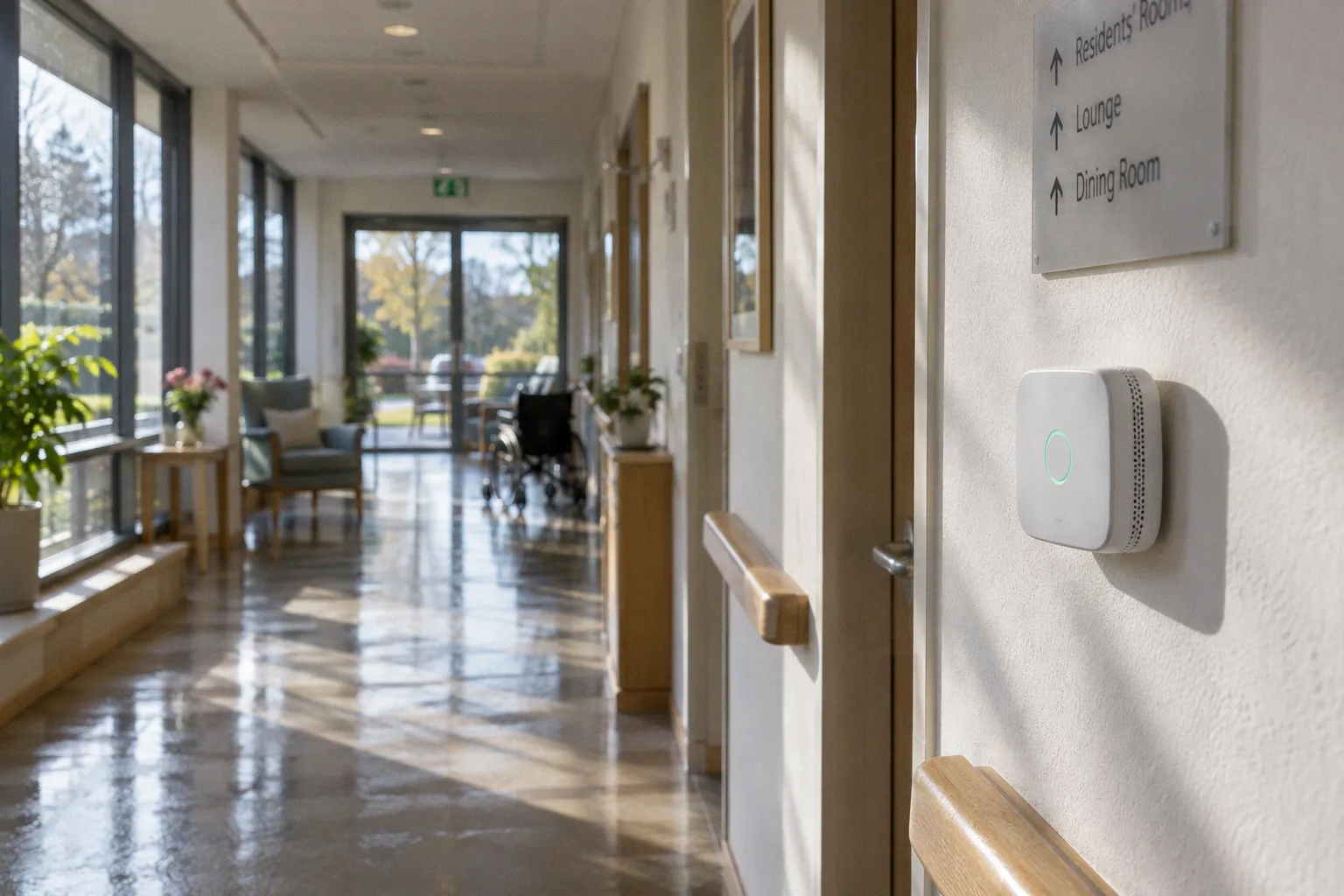
Lighting, noise, room temperature, and the sensory inputs residents may not be able to name all deserve attention. Air quality belongs on that list.
Older adults spend much of their time indoors, and senior living environments can contain higher concentrations of indoor pollutants than outdoor air. For residents who cannot tell us that a room feels stale or that their chest feels tight, the only signal may be a change in behavior: more restlessness, more withdrawal, less participation in programming. Air quality is silent until it is not.
That is the practical lens for a 30-day evaluation of consumer-grade indoor air quality monitors in memory care common areas and selected resident rooms. The purpose is not to crown a winning device or suggest that a sensor can diagnose a resident. The useful question is narrower: can an accessible monitor give caregivers and facilities teams enough reliable information to make better day-to-day decisions about the air residents actually breathe?
The answer is yes, with meaningful limits. Understanding those limits is half the work.
The perception gap between leadership and the actual air
Ask a senior living operator how indoor air quality is performing and the answer will often be that it is fine. Industry survey data has suggested that roughly 78% of long-term care administrators rate their indoor air quality as good or excellent. Other published research on nursing home environments has indicated that approximately 81% of long-term care facilities operate with inadequate ventilation or air circulation.
Those findings are not necessarily contradictory. They describe two different things: how a building feels and how effectively it exchanges and filters air.
Without real-time instrumentation, comfort is the only proxy many teams have. Comfort is a poor proxy for respiratory health, however. A room can smell neutral and feel pleasantly cool while carrying elevated carbon dioxide, fine particles from outside, or volatile organic compounds released by flooring, disinfectants, fragrances, hand sanitizer, and personal care products. Administrators are not ignoring problems they can see. They may simply lack the feedback loop that would allow them to see the problems in the first place.
A building that smells clean is not the same as a building that is ventilated adequately. Residents deserve better evidence than our assumptions about what feels fine.
This is where an inexpensive monitor can change the conversation. Even an imperfect sensor, placed correctly and interpreted against a sensible benchmark, can replace a vague impression with a pattern. That does not make the number a verdict. It makes the number a prompt for a better question: what is happening in this room, and what can the building team change?
Placement matters from the beginning. A monitor positioned in a back hallway or beside a supply closet may produce a technically valid reading that says very little about residents’ exposure. In a memory care setting, the relevant locations are usually the dining room, activity room, lounge, corridors with heavy traffic, and rooms where residents spend extended periods. The device should not sit directly beside a window, supply vent, kitchen exhaust, cleaning cart, or humidifier unless the goal is specifically to investigate that source.
A useful 30-day test should also record context. Occupancy, meal periods, housekeeping, weather, wildfire smoke, window opening, maintenance work, and product changes can all affect readings. Without that context, a graph becomes decoration. With it, the graph can reveal a recurring ventilation problem or a source that staff had previously missed.
Decoding the data: CO2 and TVOC thresholds in geriatric care
A practical monitor often tracks three families of pollutants: carbon dioxide, particulate matter, and total volatile organic compounds. The numbers do not all mean the same thing, and they should not be treated as interchangeable measures of safety.
| Metric | Practical benchmark | What it primarily signals | Reasonable response when elevated |
|---|---|---|---|
| CO2 | Around 1,000 ppm as a ventilation reference point | Fresh-air exchange and occupancy effects, not direct toxicity | Check HVAC operation, increase outdoor-air exchange where appropriate, and reduce crowding |
| PM2.5 | WHO annual guideline: 5 µg/m³ | Fine particles that can penetrate deep into the lungs | Check filtration, identify indoor or outdoor sources, and limit exposure during peaks |
| PM10 | Nursing home studies have reported indoor values from about 2 to 188.4 µg/m³ | Coarser dust, tracked-in soil, and other airway irritants | Address entry dust, housekeeping practices, and air-handler filtration |
| TVOC | Umweltbundesamt framework: up to 0.3 mg/m³ considered hygienically safe; 3.0–10.0 mg/m³ concerning | A combined signal from volatile chemicals | Review products, increase ventilation, and keep residents away from active applications |
These values are translation aids, not a prescription. A reading only becomes useful when it points toward a building behavior that can be changed.
CO2 is a ventilation proxy, not a toxicity line
Carbon dioxide is often the easiest metric for staff to interpret because it has a clear relationship to occupancy and ventilation. Under ASHRAE Standard 62.1, adequate ventilation is commonly discussed as indoor CO2 remaining no more than roughly 700 parts per million above the outdoor baseline. With outdoor CO2 around 420 to 430 ppm on average, that produces a practical reference point near 1,000 ppm indoors.
The distinction matters. ASHRAE’s figure is a ventilation benchmark, not a line separating safe residents from unsafe residents. A reading near 1,000 ppm does not mean that the room has become toxic. It suggests that the room may not be receiving enough fresh air to dilute the pollutants generated by people, products, furnishings, and daily operations.
That makes CO2 valuable in senior care. It helps a team see how a room behaves over time:
- Does the dining room climb rapidly during meals?
- Does the activity room remain elevated after a group leaves?
- Does the lounge recover when the HVAC system changes modes?
- Are readings consistently higher on weekends or during family events?
- Does one room perform differently from a similar room on the same floor?
A recurring peak after a crowded event is not automatically a crisis. It is a maintenance and scheduling signal. Staff may need to check whether the HVAC schedule matches actual occupancy, whether outdoor-air dampers are functioning, or whether a room is being used beyond its practical capacity. In some buildings, reducing crowding or moving part of a program to another space may be more effective than simply opening a window.
CO2 monitors can also expose the limits of intuition. People acclimate to a room gradually, and staff may not notice a slow decline in ventilation during a long shift. A sensor does not become tired, distracted, or accustomed to stale air. It will not explain the cause, but it can identify when the room deserves attention.
TVOC is a trend signal, not a toxicity verdict
Total volatile organic compounds are more difficult to interpret. TVOC combines readings associated with many different chemicals, including compounds released by paints, flooring, fragrances, cleaning products, and solvents. Each substance has its own properties and potential health effects. A single TVOC number cannot identify which chemical is present or establish that a room is safe.
The German Federal Environment Agency’s framework is useful as a broad interpretive guide: up to 0.3 mg/m³ is considered hygienically safe; 0.3 to 1.0 mg/m³ is generally acceptable; 1.0 to 3.0 mg/m³ is noticeable; 3.0 to 10.0 mg/m³ is concerning; and levels above 10 mg/m³ are considered unacceptable within that framework.
Those categories should not be presented as a medical diagnosis. Consumer sensors may estimate TVOC through a broad response to changing gases, and the estimate can be affected by humidity, temperature, and the specific mixture of compounds in the room. The more useful question is whether the number changes in a repeatable way after a particular activity.
A rise after floor stripping may support a decision to schedule the work when residents are elsewhere and to extend the ventilation period. A rise after painting may support keeping an activity room closed longer than the product label’s minimum drying time. A persistent increase near a storage area may justify reviewing how disinfectants, solvents, fragrances, or aerosol products are stored and used.
The monitor does not tell staff which product caused the change. It helps narrow the investigation.
The reality of particulate matter: PM2.5 and PM10 risks in nursing environments
Particulate matter is often the most consequential category for older adults with respiratory or cardiovascular vulnerability. PM2.5 refers to particles 2.5 micrometers or smaller. Because these particles are so fine, they can penetrate deeply into the lungs. PM10 includes larger particles that can irritate the upper airways and contribute to coughing, discomfort, and poor perceived air quality.
A 2024 nursing home study reported indoor PM2.5 concentrations ranging from 0.2 to 124 µg/m³ and indoor PM10 concentrations ranging from 2 to 188.4 µg/m³. In some rooms, indoor PM2.5 reached approximately 12.7 times the outdoor concentration. The precise readings will vary by building, location, season, weather, and operating practices, but the broader lesson is consistent: indoor air is not automatically cleaner than outdoor air.
The World Health Organization’s annual average PM2.5 guideline is 5 µg/m³, a level that many senior living interiors can exceed during routine activities or short-term events. A brief peak does not carry the same meaning as a persistent elevated baseline, but both deserve context. A high reading during a nearby wildfire smoke event points toward a different response than a high reading that appears every morning when aerosol cleaning products are used.
Common sources include:
- Outdoor smoke entering through outdoor-air intakes, windows, or poorly sealed doors.
- Cooking and meal preparation, particularly when exhaust systems are weak or poorly balanced.
- Aerosolized cleaning and disinfecting products.
- Dust disturbed by housekeeping, renovation, or floor-care work.
- Soil and debris tracked in through entrances.
- Poorly maintained filters, gaps around filters, or air-cleaning equipment operating below its intended setting.
- Candles, incense, smoking, or other combustion sources where they are present.
The most useful interpretation is not, What is the exact count at this moment? It is, What is the pattern, and what can we change?
A monitor that establishes a relatively stable baseline helps staff recognize when a room suddenly departs from its usual behavior. The next step is investigation. Was a window open during a dusty task? Did a delivery bring in cardboard and soil? Was the kitchen exhaust running? Did a filter reach the end of its service life? Was an air purifier moved, blocked, or switched to a lower setting?
HEPA filtration is only effective when the system works as a system
The phrase “HEPA-grade” can create false confidence. A high-efficiency filter cannot clean air it never receives, and it cannot compensate for a poorly sealed filter rack, an undersized unit, or a fan schedule that leaves the equipment off when the room is occupied.
For air purification systems in nursing homes, the relevant questions include:
- Is the unit appropriately sized for the room’s volume?
- What clean-air delivery rate does it provide?
- Does the device continue operating during the hours residents occupy the space?
- Are air intakes and exhaust paths unobstructed?
- Is the filter seated correctly, without visible bypass gaps?
- Is the filter changed according to loading and operating conditions rather than an arbitrary calendar alone?
- Does the device create noise or drafts that could disturb residents?
- Can staff maintain it consistently?
A portable purifier rated for a smaller room may have limited effect in a large commons, particularly if doors remain open and people move in and out. Conversely, a properly selected unit may be useful as a supplemental measure when the central HVAC system cannot deliver enough filtration or outdoor-air exchange.
Monitoring can help verify that an intervention changes the room’s pattern, but it cannot by itself prove that a filter meets a regulatory standard. Facilities teams should rely on manufacturer documentation, preventive maintenance records, and qualified HVAC professionals when the question concerns system performance or compliance.
Limitations of consumer-grade sensors versus regulatory compliance
Consumer monitors are attractive because they are accessible, portable, and easy to deploy. They are also easy to overinterpret.
The U.S. Environmental Protection Agency distinguishes low-cost indoor air monitors from Federal Reference Method and Federal Equivalent Method instruments used for regulatory outdoor-air monitoring. Consumer devices do not carry those designations simply because they display a precise-looking number. Their sensors can drift, respond differently to humidity and temperature, and behave unevenly across different pollutant mixtures.
That creates two common errors.
The first is treating a consumer reading as proof of compliance. A monitor showing green does not certify that a building meets every applicable indoor air quality, ventilation, occupational, or health requirement. It cannot replace professional testing, HVAC commissioning, laboratory analysis, or documentation required by a regulator, accreditor, or local authority.
The second is dismissing the reading because it is not laboratory-grade. That is equally unhelpful. A device that consistently shows higher CO2 in one room than another may reveal a ventilation imbalance even if the absolute readings are not exact. A particle sensor that repeatedly rises during one housekeeping task can still support a useful operational change.
A bathroom scale gives a number with some error. Used consistently, the trend matters more than any single reading. A consumer air monitor is closer to that than it is to a lab instrument.
Good practice means treating the monitor as a directional tool. Look for repeated patterns, compare similar rooms, and document the conditions around each reading. Avoid drawing major conclusions from one spike or one device in one location.
Calibration and placement also deserve attention. Some sensors require a period of acclimation after installation. Others need periodic adjustment or replacement. A device placed beside a supply vent may read air that has just passed through a filter rather than the mixed air in the room. A device near a window may overrepresent outdoor conditions. A monitor mounted too high or too low may not reflect the breathing zone of seated residents.
For higher-stakes questions, a facilities team can use consumer monitors to identify where professional assessment is warranted. That is a sensible division of labor: low-cost sensors find the questions, while qualified testing answers the questions that carry regulatory or clinical consequences.
Practical strategies for improving ventilation beyond monitoring
Monitoring matters only when it leads to action. The response does not always require a capital project. In many buildings, the first improvements involve scheduling, maintenance, placement, and clearer communication between nursing, housekeeping, dietary, and facilities staff.
1. Match the HVAC schedule to actual occupancy
A building schedule designed around office hours may not match the rhythm of a senior living community. Dining rooms, activity spaces, and lounges may be occupied early in the morning, late in the evening, or intermittently throughout the day. Review CO2 patterns alongside the actual resident schedule rather than assuming that the programmed settings reflect use.
If readings rise predictably before the HVAC system changes modes, facilities staff may be able to adjust the schedule or investigate outdoor-air dampers. The solution should be evaluated for comfort, humidity, energy use, and resident safety. Opening windows may help in some weather conditions and worsen particulate exposure in others.
2. Verify filters instead of assuming they are working
A filter can be present without performing as intended. Staff should document the filter type, installation date, replacement schedule, fit, and condition. The stated MERV rating is only one part of the picture. A clogged filter, damaged frame, or bypass gap can undermine the system.
For persistent PM2.5 elevations, the investigation should include both the filter and the equipment around it. A higher-efficiency filter may not be appropriate for every air handler if the fan cannot maintain the required airflow. Facilities professionals should confirm compatibility before making a change.
3. Separate resident activities from chemical-intensive work
Floor stripping, painting, disinfecting, and aerosol application should be scheduled around resident presence whenever possible. Closing off the area, increasing ventilation during and after the work, and documenting the product used can reduce unnecessary exposure.
This is particularly important in memory care, where odors and sensory changes may cause distress even when the measured concentration is not a regulatory concern. A room that is technically available may not be practically suitable if the smell, noise, or altered layout is disruptive.
4. Control particles at the entrance
PM10 often has an obvious pathway into a building: shoes, wheels, deliveries, and foot traffic. Layered entry mats, regular cleaning of the mats themselves, and attention to high-traffic surfaces can reduce tracked-in soil. A no-outdoor-shoes policy may be appropriate in some areas, but it should be designed around fall prevention, mobility devices, infection-control requirements, and resident dignity.
The goal is not to make the building sterile. It is to reduce avoidable particle loads without creating a new hazard.
5. Size air purifiers for the room, not the brochure
A portable unit advertised for a small bedroom may contribute little in a large common area. Compare the purifier’s clean-air delivery rate with the room volume, and consider ceiling height, doors, occupancy, and the amount of air exchanged by the central system.
Noise also matters. A purifier that is technically effective but too loud for conversation or programming may be switched off. For residents with dementia, a sudden hum or draft can be disorienting. The most effective device is the one that is correctly sized, appropriately located, maintained, and left running when it is needed.
6. Create a shared response protocol
A monitor should not become the responsibility of one enthusiastic staff member. Decide in advance who reviews the readings, what counts as a repeated pattern, when facilities staff are contacted, and how the response is documented.
A simple log can include:
- Date and time.
- Room and monitor location.
- Occupancy.
- HVAC mode or notable maintenance activity.
- Housekeeping, cooking, painting, or floor-care activity.
- Outdoor conditions, including smoke or unusual weather.
- CO2, PM2.5, PM10, and TVOC readings.
- Action taken and whether the reading later returned toward baseline.
That record turns a gadget into part of a continuous quality improvement process. It also prevents staff from treating every fluctuation as an emergency or ignoring a problem because no one person owns it.
7. Connect air readings with resident care without overclaiming
Air quality can affect comfort and respiratory burden, but a monitor cannot establish that a specific behavior was caused by a specific pollutant. Agitation, fatigue, withdrawal, coughing, and reduced participation have many possible causes, including pain, infection, medication effects, dehydration, sleep disruption, noise, and changes in routine.
The responsible approach is to treat environmental readings as one piece of the assessment. If a room repeatedly shows poor ventilation at the same time residents become uncomfortable, that pattern deserves attention. It does not justify claiming that improved air caused fewer behavioral symptoms unless the relationship has been properly documented and evaluated.
The same caution applies to family communication. Families may reasonably ask whether a facility measures indoor air quality. They should receive a clear explanation of what the facility monitors, how often, what the readings mean, and what the facility does when patterns are concerning. They should not be given a green dashboard as proof that every aspect of indoor air is safe.
What we tell families and new administrators
Consumer-grade sensors can help a senior living community see what comfort alone cannot reveal. They may identify when CO2 rises with occupancy, when particulate levels change during housekeeping or cooking, or when a product or maintenance task alters the air in a room. They can help facilities teams prioritize inspections and start better conversations about ventilation.
They cannot certify regulatory compliance, diagnose a resident, identify every chemical in the air, or prove that a single intervention improved a clinical outcome. Their value is more practical and more modest: they make recurring patterns visible.
A sound 30-day test should therefore end with questions rather than a celebratory score. Which rooms showed the most consistent ventilation problems? Were the readings associated with occupancy, maintenance, weather, or products? Did the team respond in a way that could be repeated? Did the equipment remain maintained and correctly placed? Which concerns require professional testing rather than another consumer device?
For residents who cannot always speak for themselves, that discipline matters. Indoor air quality monitoring is not a substitute for attentive care, good HVAC maintenance, or clinical judgment. It is a way to make an invisible part of the care environment less dependent on assumption.
The strongest case for monitoring is not that a small device can tell a facility everything. It is that the device can show staff where their assumptions need testing. Effective senior indoor air quality monitoring is less about buying the most impressive gadget and more about building the habit of noticing what the building is doing, documenting it, and responding before poor air becomes the only explanation left.
FAQ
Can a consumer-grade air monitor prove that a facility meets safety regulations?
Why is carbon dioxide (CO2) used as a metric in senior care facilities?
What should staff do if a monitor shows high levels of total volatile organic compounds (TVOC)?
Where is the best place to position an air quality monitor in a memory care unit?
Does a high PM2.5 reading always indicate a dangerous air quality issue?
Related articles
 Senior Wellness & LivingSocial activities for introverted seniors in assisted living
 Senior Wellness & LivingAssisted Living Dining Options for Specific Dietary Needs
 Senior Wellness & LivingSeated Exercise Gear for Seniors: What Works and When
 Senior Wellness & LivingGeriatric Protein Drinks: Testing Three Formulations