Robotic gait trainers: do they accelerate stroke recovery?
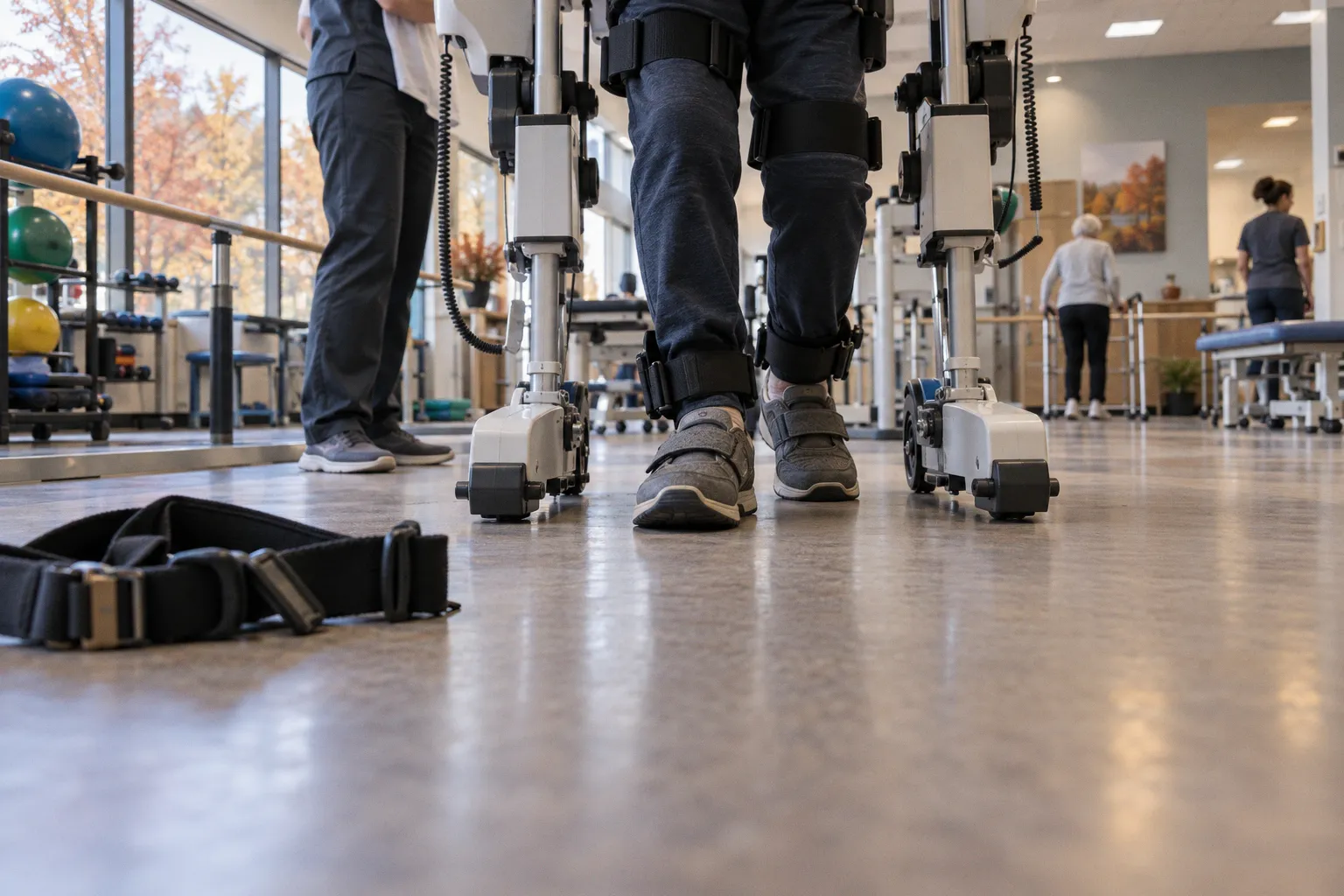
A patient may understand the task, have partial activation in the affected leg, and still fail to walk because the limb cannot tolerate load, advance during swing, or maintain balance long enough to complete a step.
That is the problem robotic-assisted gait training is designed to address. A robotic gait trainer can provide repeated, mechanically guided stepping while the therapist adjusts body-weight support, speed, resistance, and the amount of active work required from the patient. The machine does not replace rehabilitation. It changes the number and quality of steps a patient can safely practice.
The relevant question is not whether a robot looks more advanced than manual therapy. It is whether the added capital cost and operational complexity produce measurable gains in walking independence, gait velocity, dynamic balance, and ADL independence.
Current evidence supports a qualified yes—particularly for older adults in the subacute phase of stroke recovery, and especially for patients who are not yet walking independently. But the device must be selected correctly, integrated into conventional physical therapy, and used against functional milestones rather than as a technology demonstration.
The clinical evidence: more stepping, better walking potential
Robotic-assisted gait training, or RAGT, combines a robotic device with conventional rehabilitation. Depending on the system, the patient may walk on a treadmill while a harness and robotic limbs guide the legs, or take steps on a footplate-based platform that reproduces the phases of gait.
The central biomechanical advantage is repetition under controlled conditions. A therapist working manually can facilitate hip and knee movement, block the knee, shift the pelvis, and help with foot placement. That hands-on work is essential, but it is physically demanding and difficult to sustain for a high number of technically consistent steps. A robotic system can support the patient through the gait cycle repeatedly while the therapist concentrates on alignment, weight transfer, trunk control, and the patient’s active contribution.
That distinction matters after stroke. Motor relearning depends partly on task-specific practice. If every attempt collapses because the patient cannot bear weight on the affected side, the nervous system receives limited exposure to the actual demands of walking. Robotic assistance can reduce the mechanical bottleneck enough to make stepping practice possible.
A systematic review and meta-analysis of 23 randomized controlled trials involving 907 patients found that RAGT combined with conventional rehabilitation improved several clinically relevant outcomes compared with conventional rehabilitation alone:
- Gait function improved with a standardized mean difference of 0.51.
- Gait speed improved with a standardized mean difference of 0.47.
- Balance improved by a mean difference of 4.58 on the outcome measure used across the included studies.
- Activities of daily living performance improved with a standardized mean difference of 0.35.
These are not arguments for abandoning manual physical therapy. They are evidence that adding robotic practice can improve outcomes that matter outside the therapy gym.
The robot’s value is not its ability to move a patient’s legs. Its value is creating enough safe, repeatable, task-specific stepping for the patient to contribute and improve.
The largest practical mistake is to describe RAGT as passive movement. A poorly configured system can indeed allow the patient to be carried through the gait cycle. A properly prescribed session does the opposite: it uses assistance strategically, then reduces that assistance as the patient develops load-bearing capacity, motor control, and timing.
The therapist should continuously ask:
- Is the patient initiating stance and swing, or merely being moved?
- Is the affected limb accepting meaningful load?
- Is the pelvis aligned, or is the harness compensating for poor trunk control?
- Can assistance be reduced without a collapse in gait quality?
- Does the patient’s performance on the device transfer to overground walking and daily tasks?
If the answers never change, the program is not producing measurable progression, regardless of how sophisticated the hardware appears.
When timing matters most: subacute versus chronic stroke
The timing of intervention is one of the strongest variables in the evidence. Cochrane evidence synthesis indicates that electromechanical and robotic gait-training devices used alongside physiotherapy increase the likelihood of independent walking after stroke. The effect is strongest when treatment begins within the first three months after the stroke.
A separate review of 28 randomized controlled trials found that RAGT delivered for 30 to 60 minutes per day over four weeks produced a moderate effect on lower-limb functional recovery. The benefit was particularly relevant in early-stage stroke patients and those who were not independently ambulatory.
This does not mean that robotic gait training becomes useless after three months. It means the expected return changes. In the subacute phase, the patient may still have substantial neurological recovery potential, limited walking exposure, and a large gap between bed mobility and functional ambulation. A robotic system can help close that gap by allowing structured practice before independent walking is safe.
For a chronic stroke survivor, the treatment target is often narrower. The patient may need improvements in gait symmetry, endurance, turning, obstacle negotiation, or fall risk rather than the first emergence of walking. RAGT may still be useful, but the clinical question must be more specific. A facility should not promise the same magnitude of improvement seen in early post-stroke populations.
The patient who benefits most
In my clinical assessment, the strongest candidate is not automatically the patient with the most severe weakness or the most impressive referral diagnosis. The better candidate is the patient whose current limitation can be addressed by supported, repetitive stepping.
That often includes a person who:
- Cannot walk independently but can tolerate upright positioning.
- Has enough passive range of motion to achieve a functional step.
- Can follow commands and engage with the task.
- Has medical stability for repeated cardiovascular and neuromuscular loading.
- Demonstrates some capacity for active trunk, hip, knee, or ankle control.
- Needs high-volume stepping practice that cannot be delivered safely overground.
A patient with severe contracture, uncontrolled orthostatic symptoms, significant pain, poor attention, or inability to participate may require preparatory treatment before robotic gait training becomes productive. The machine does not erase those barriers. It may expose them quickly.
The first three months after stroke also tend to be the period when rehabilitation teams can make the most decisive gains in basic mobility. That is where treatment intensity and access become operational issues. A center that owns a robotic system but cannot schedule consistent sessions has an expensive piece of equipment with a weak clinical program attached to it.
End-effector systems versus exoskeletons
Not all robotic gait trainers provide the same mechanical experience. The two broad categories are end-effector systems and exoskeletons.
End-effector devices guide the patient’s feet through a stepping pattern, commonly using moving footplates. The patient’s legs are not necessarily enclosed in a rigid robotic frame from hip to ankle. Exoskeleton systems, by contrast, align robotic joints with the patient’s anatomical joints and assist movement through a wearable structure.
The distinction is not cosmetic. It affects how much control the device provides, how the patient loads the limb, how easily the therapist can adjust the task, and how closely the training resembles overground walking.
Evidence from subgroup analyses indicates that end-effector robotic systems may produce superior gait and balance outcomes compared with robotic exoskeletons, particularly during the subacute phase of stroke recovery. That finding should not be turned into a universal ranking. Device performance depends on patient selection, protocol design, therapist skill, and the outcome being measured. Still, it is a meaningful warning against assuming that a wearable exoskeleton is automatically the most advanced or effective option.
| Parameter | End-effector gait trainer | Robotic exoskeleton |
|---|---|---|
| Mechanical assistance | Guides foot placement through moving platforms or footplates | Assists joint movement through a wearable robotic frame |
| Best clinical use | Repetitive stepping for patients needing substantial support and controlled gait practice | Patients who can tolerate the device and may benefit from more upright, wearable gait training |
| Therapist priorities | Adjust stepping pattern, weight shift, speed, and unloading | Align joints carefully, monitor device fit, and manage assistance through the gait cycle |
| Operational burden | Usually requires dedicated setup and harness positioning | Often involves more fitting, alignment, donning, and doffing |
| Evidence signal | Favorable gait and balance results in some subacute comparisons | Useful in selected patients, but not universally superior |
| Main risk of misuse | Patient follows a preset pattern without active contribution | Device fit or excessive assistance limits natural motor engagement |
The hardware should follow the functional barrier, not the marketing category.
For a non-ambulatory patient, the initial goal may be to achieve repeated, symmetrical weight acceptance with enough assistance to prevent knee collapse. For another patient, the limiting factor may be poor swing clearance or inadequate hip flexion. For a third, the problem may be dynamic balance during turning. A system that excels at one of these tasks may be poorly suited to another.
What the session should look like
A robotic session should have a progression plan. The therapist should document the variables that can change:
1. Reduce body-weight support when tolerated. Unloading is useful early, but excessive unloading prevents the affected limb from developing load-bearing capacity.
2. Increase active participation. Assistance should be adjusted so the patient must initiate movement rather than simply follow the machine.
3. Progress stepping volume and duration. The available evidence identifies 30 to 60 minutes per day over four weeks as a dosage associated with meaningful lower-limb recovery in studied populations, but tolerance and medical status still determine the safe prescription.
4. Challenge gait quality. Speed, symmetry, foot clearance, stance control, and trunk position should be monitored instead of treating total step count as the only outcome.
5. Transfer gains off the device. Practice must move toward overground walking, transfers, toileting, dressing, and other ADLs.
The last step is where weak programs fail. A patient can look better on a robotic treadmill while remaining unable to stand from a chair, turn safely, or walk from the bedroom to the bathroom. The discharge decision must be based on function in the real environment.
Robotic rehabilitation versus manual physical therapy
The comparison is often framed incorrectly. Robotic gait training is not a competitor that replaces manual therapy. It is an adjunct that can increase the amount of structured walking practice.
Manual therapy remains necessary for problems that a robotic system cannot solve on its own:
- Selecting and fitting an ankle-foot orthosis.
- Managing spasticity-related positioning.
- Improving trunk control and pelvic alignment.
- Training sit-to-stand transfers.
- Practicing turning, reaching, and obstacle negotiation.
- Addressing pain, joint restrictions, and compensatory movement.
- Rehearsing ADLs with occupational therapy.
- Teaching caregivers how to assist safely.
Robotics is strongest when the problem is insufficient stepping exposure under safe conditions. Manual therapy is strongest when the patient needs individualized facilitation, environmental adaptation, or problem-solving across different tasks.
The clinical advantage comes from combining the two. A therapist may use the robotic device to produce a controlled volume of gait practice, then immediately test whether the patient can apply the improved motor strategy during overground walking. If the gains disappear as soon as the harness is removed, the protocol needs adjustment.
A traditional session may include repeated sit-to-stand work, transfer practice, gait with an assistive device, and balance activities. RAGT can add a more concentrated dose of stepping, particularly for someone who cannot yet walk safely for long enough to accumulate comparable practice manually.
That additional dose is not automatically beneficial. Fatigue can degrade gait quality, increase compensatory trunk movement, and create a false impression of endurance. The therapist must stop treating duration as a badge of intensity. Functional repetition is the goal; exhausted repetition is not.
Cost-effectiveness: when does the investment make sense?
The economics are complicated because the device is only one part of the cost. A facility also pays for staff training, installation, maintenance, room allocation, harnesses or consumables, patient transport within the building, and the therapist time required for setup and supervision.
The clinical return is also difficult to measure with a single number. A patient who progresses from wheelchair dependence to supervised household ambulation may reduce caregiver burden and improve participation in ADLs. Those gains can be substantial even if the patient does not achieve fully independent community walking.
A cost-effectiveness analysis conducted across hospital settings in Singapore found robotic exoskeleton therapy cost-effective compared with conventional physiotherapy for stroke rehabilitation in the analyzed setting. For non-ambulatory patients with a Functional Ambulation Category score of 0, the incremental cost-effectiveness ratio was US$28,259.62 per quality-adjusted life year over a six-month horizon.
That result is useful, but it is not a universal price tag or guarantee of financial value. Economic outcomes vary with:
- Initial hardware investment.
- Patient severity and baseline walking ability.
- Treatment intensity and session frequency.
- Staff utilization and therapist-to-patient ratios.
- Reimbursement rules.
- Length of stay.
- Whether improved mobility changes discharge destination or care needs.
- Whether the device remains in active use rather than serving a small number of patients.
A skilled nursing facility should therefore avoid asking only, “How much does the robot cost?” The more relevant question is, “Which measurable functional outcomes will this program improve, for which patients, and at what utilization level?”
A robotic gait trainer earns its place through functional throughput: more appropriate patients progressing toward safer transfers and walking, not through the novelty of the equipment.
For a facility considering purchase, the financial case is strongest when the program has a defined referral population, adequate therapist training, reliable scheduling, and a method for tracking outcomes. A center that cannot deliver consistent sessions may not achieve the treatment intensity associated with the research evidence.
The long-term cost-effectiveness of robotic gait training beyond six to twelve months remains less certain across different healthcare systems and reimbursement models. Direct financial comparisons between branded devices in US skilled nursing facilities are also not established by the available evidence. That uncertainty should be stated plainly in any procurement decision.
How to measure whether robotic gait training is working
A robot should not be evaluated by whether the patient completes a session. The patient must demonstrate a change in functional capacity.
Useful measures include:
- Gait velocity: Is the patient walking faster without sacrificing stability or requiring more physical assistance?
- Walking independence: Has the patient progressed from non-ambulatory status to assisted, supervised, or independent walking?
- Dynamic balance: Can the patient shift weight, turn, and respond to perturbations more safely?
- Load-bearing capacity: Can the affected limb accept more body weight during stance?
- Assistance level: Has the patient moved from two-person assistance to one-person assistance, contact guard, or supervision?
- Transfer performance: Can the patient complete sit-to-stand and bed-to-chair transfers with less help?
- ADL independence: Can the patient manage toileting, dressing, and household mobility with fewer cues or less caregiver support?
- Carryover: Do improvements remain when the patient is walking overground with the appropriate assistive device?
The exact assessment battery will vary by setting. The principle does not. Record a baseline, set a time-limited target, and reassess with the same method.
For example, a weak goal would be to complete more robotic sessions. A stronger goal would be to reduce the physical assistance required for a ten-meter walk, improve gait velocity while maintaining safe foot clearance, or complete a bathroom transfer with supervision rather than hands-on assistance.
Discharge readiness is not a technology score
The patient is ready for discharge from a post-acute rehabilitation program when the functional plan is safe and sustainable, not when the patient has reached a particular robotic setting.
I look for measurable milestones such as:
- Stable transfers using the prescribed technique.
- Safe gait with the appropriate walker, cane, or orthosis.
- Adequate gait stability for the patient’s home environment.
- Consistent foot clearance and controlled knee position during walking.
- Ability to negotiate essential turns and thresholds.
- Sufficient endurance for necessary household distances.
- Reliable use of the call system or emergency strategy when fatigue or imbalance occurs.
- Caregiver competence when assistance remains necessary.
- A home exercise and mobility plan that can continue after discharge.
If the robotic device improves gait speed but the patient still cannot safely rise from a low chair, the treatment plan is incomplete. If balance improves on the machine but the patient cannot manage the bathroom doorway, the program has not yet reached the environment that matters.
The implementation problem: equipment is easier to buy than expertise
Robotic gait training requires more than an equipment purchase. The team needs a protocol for screening, contraindication review, fitting, session progression, emergency response, documentation, and outcome reporting.
Staff should understand how to manage:
- Harness fit and pressure points.
- Joint alignment and range-of-motion limitations.
- Orthostatic symptoms during upright training.
- Fatigue and cardiovascular response.
- Spasticity and abnormal tone.
- Knee control during stance.
- Foot placement and swing clearance.
- Patient fear, cognition, and ability to follow commands.
- Safe transition from robotic practice to overground mobility.
The patient’s dignity also matters. Donning a harness, positioning the legs, and attaching a wearable frame can be physically intrusive. Explain each step, preserve privacy, and avoid treating the patient as an attachment to the machine. Clinical precision and respectful care are not competing priorities.
The therapist must also be willing to reject a robotic session when the patient is medically unstable, excessively fatigued, in pain, or unable to participate. More technology does not justify lower clinical judgment.
My verdict: worthwhile for the right patient, not a universal upgrade
The evidence supports robotic gait trainers as a useful addition to stroke rehabilitation. Combined with conventional physical therapy, RAGT can improve gait function, gait speed, balance, and ADL performance. The strongest clinical signal appears in subacute stroke recovery, particularly during the first three months and among patients who are not yet independently ambulatory.
The financial case can also be reasonable in selected inpatient settings. The reported incremental cost-effectiveness ratio of US$28,259.62 per QALY for non-ambulatory subacute stroke patients provides a reference point, not a guarantee. Local staffing, utilization, reimbursement, and patient mix will determine whether a facility sees comparable value.
My recommendation is direct:
- Choose RAGT when the primary barrier is insufficient safe stepping practice.
- Use it early when clinically appropriate, especially in subacute recovery.
- Favor the system whose mechanics match the patient’s impairment, rather than the device with the most marketable design.
- Keep conventional physical and occupational therapy in the protocol.
- Reduce robotic assistance as active motor control improves.
- Measure walking independence, gait velocity, balance, transfers, and ADL performance.
- Do not claim success until gains transfer to overground mobility and discharge tasks.
Robotic gait therapy is worth the investment when it increases meaningful practice and moves patients toward measurable independence. It is not worth the investment when it becomes an expensive substitute for assessment, hands-on therapy, or a properly designed discharge plan.
FAQ
Does robotic gait training replace manual physical therapy?
Which stroke patients benefit most from robotic gait training?
What is the difference between end-effector systems and robotic exoskeletons?
How long should a typical robotic gait training session last?
Is robotic gait training cost-effective?
Related articles
 Rehabilitation & RecoveryMobility aids for seniors: top recovery tools after surgery
 Rehabilitation & RecoveryPhysical therapy frequency for stroke recovery in seniors
 Rehabilitation & RecoveryWeighted Utensils for Tremors: Testing Three Designs
 Rehabilitation & RecoveryVitalStim Dysphagia Therapy for Seniors: Is It Worth It?