Robotic Companion Pets for Seniors: Are They Worth It?
Another refuses to leave the activity room. Someone else starts rubbing the same spot on the sofa cushion, over and over. We call this late-day cluster sundowning, and the behavioral expressions can run from simple restlessness to full-throated agitation that puts both the resident and the care team at risk.
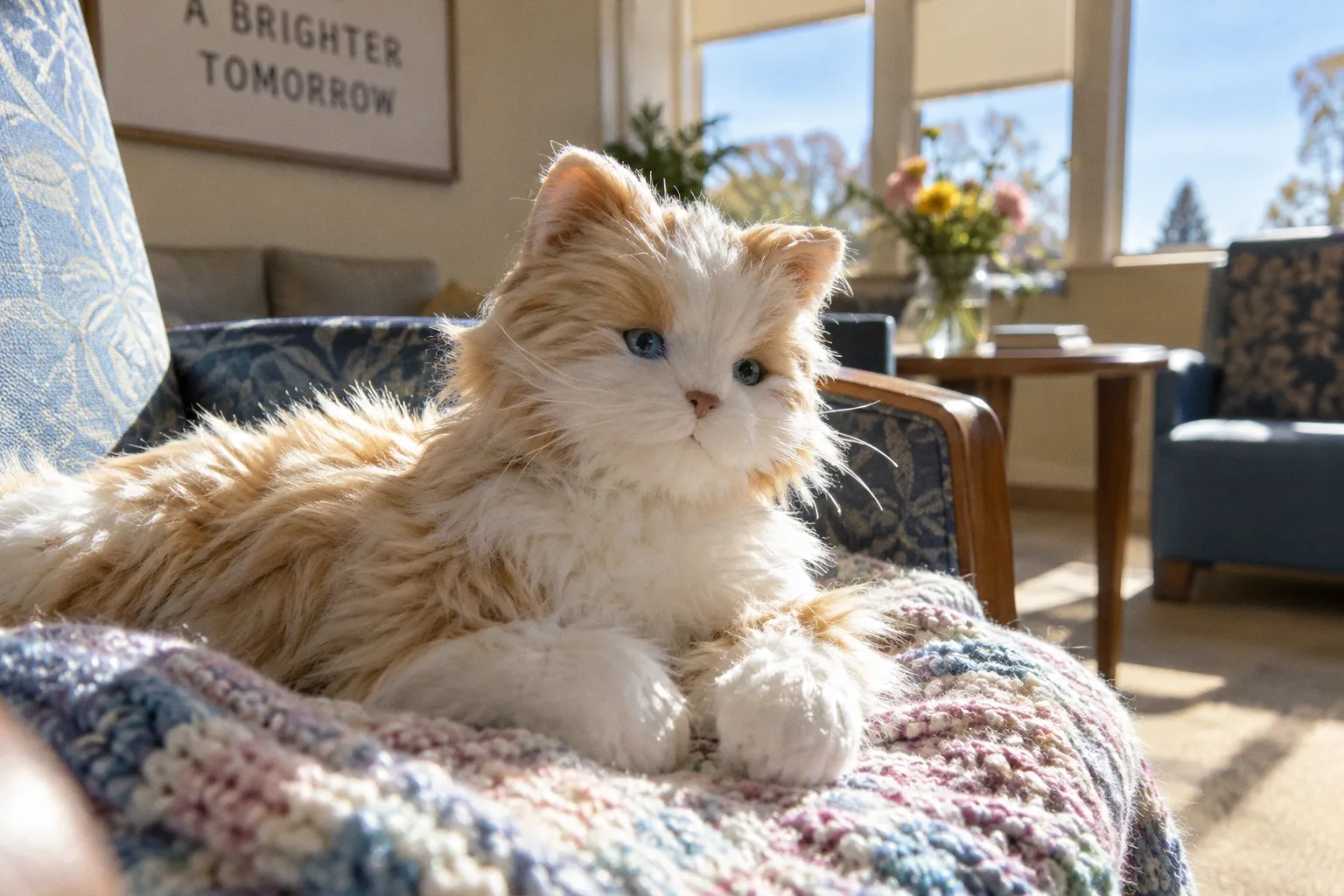
Non-pharmacological interventions are our first line of response, because antipsychotic medications carry their own well-documented hazards in older adults with dementia. Music, hand massage, orientation cues, a familiar blanket — these tools work for some residents, some of the time. What we have been adding to that toolbox over the last decade is a category that still surprises families when we suggest it: robotic companion pets for seniors.
So the question families and care planners actually ask us is not "do they exist?" It is "are they worth it?" Let's work through it together, with the candidness this category deserves.
What we mean by "robotic companion pet," and where the technology sits today
The market now stretches from a $30 sleeping plush kitten to a $6,000 therapeutic seal developed in Japan. That range is wide enough to confuse anyone, so we find it useful to sort the options into four tiers based on what the device actually does.
A robotic companion pet is not a substitute for human contact. It is a sensory anchor — something warm, soft, and responsive that an agitated resident can hold, talk to, and settle beside.
| Tier | Price range | Typical product | What it does | Best fit |
|---|---|---|---|---|
| Passive plush | $25–$40 | Precious Petzzz, Perfect Petzzz | A breathing plush that "sleeps" with a subtle chest rise. No interaction. | Residents who want a soft presence but get overstimulated by motion or sound. |
| Interactive animatronic | $100–$180 | Joy for All by Ageless Innovation | Responds to touch and sound with purring, barking, head turns, and a heartbeat. | Most memory care residents who enjoy engagement but do not need conversation. |
| AI-driven companion | ~$189 and up | MetaCat and similar | Adds conversational responses and adaptive behavior patterns. | Higher-functioning residents who enjoy dialogue and novelty. |
| Therapeutic robot | ~£5,000 (roughly $6,000+) | PARO (the seal) | A regulated medical device with extensive sensor arrays, used in clinical research. | Specialized clinical settings with trained staff. |
The first three tiers are consumer products. PARO is something else entirely — a Class II medical device, certified in the U.S. and the U.K., designed specifically for therapeutic use. Most communities, including ours, operate in the middle two tiers.
The clinical evidence — what we know, and what we don't
Two studies anchor our confidence in this category, and we think families should know what they say and where they stop.
A 2022 study published in the Journal of Holistic Nursing followed 18 residents with dementia in a residential care setting over six weeks of daily interaction with robotic companion pets. The researchers measured statistically significant reductions in loneliness and significant improvements in depression scores. That is a small sample over a short window, but it aligns with what we observe at the bedside.
A 2021 Florida Atlantic University study looked specifically at robotic cats and dementia patients. More than half of the participants showed slight to moderate improvements in mood and in cognitive areas like attention and language. Again, a six-to-eight-week observation window.
What the evidence does not yet establish is whether these benefits hold over months and years, whether they delay cognitive decline, or whether they reduce the need for psychotropic medication in measurable ways. We tell families this directly. We also tell them that the absence of long-term data is not the same as the absence of benefit — it simply means we evaluate robotic companion pets the way we evaluate any other comfort intervention: by watching what each individual resident does with it.
Why they work: behavior, not magic
We do not describe these devices as calming. We describe them as giving a resident something to do.
For someone with moderate dementia, an agitated state often has nowhere to land. Hands wander. Voices rise. The environment stops making sense, and the resident's nervous system is essentially asking for input — any input — that feels familiar. A robotic cat that purrs when held, that turns toward the resident's voice, that has a heartbeat you can feel through the fur, offers a sensory baseline. The resident's hands have something to stroke. The room has a sound that is not a staff member asking them to "come sit down." Attention has a place to rest.
More features are not better features. The right answer is the one that matches the resident's sensory threshold.
In clinical language, we are talking about redirecting behavioral expression toward a tolerable stimulus. In plain language, we are talking about giving someone a job that feels like companionship. This is also where the device tier matters. We have watched residents who were deeply agitated become calm within minutes with a Joy for All cat — and we have watched the same resident ignore a more expensive AI-driven model that talked too much. The "best" device is the one the resident actually engages with, not the one with the longest spec sheet.
What we tell families to watch for
Before we recommend a robotic companion pet to a family, we walk them through four things we have learned to ask.
1. How does your loved one respond to new objects? A resident who tears at unfamiliar things, or who is frightened by mechanical sounds, will not be served by an interactive animatronic. A passive plush may be a better starting point.
2. Does the device match their reality orientation? For a resident in early-stage dementia who knows the cat is not real, a high-end conversational AI pet can feel condescending. For a resident in the later stages who responds emotionally before cognitively, the same device can be a genuine comfort.
3. What is the infection control plan? Soft synthetic fur in a shared living environment requires laundering protocols. We have had to retire devices that could not be cleaned to the standards our state requires. Ask the manufacturer whether the fur is removable and washable, and at what temperature.
4. Who owns the attachment? This is the ethical question we take most seriously. If a resident becomes strongly bonded to the device and the device fails, breaks, or is lost during a transition, the grief response can be significant. Build that possibility into your thinking from day one. A backup device, or a rotation between two similar pets, is not paranoia — it is good care planning.
The honest comparison: where your money actually goes
Families often ask us whether the cheaper models are "good enough." The answer depends on the resident, but here is the framework we use.
- Under $50 — Best for residents who want texture and presence without interaction. Limited clinical applicability in mid-to-late dementia, where engagement is the goal.
- $100–$180 — The sweet spot for most memory care settings. Joy for All has the longest track record in U.S. facilities and the broadest base of caregiver experience to draw on.
- $189–$400 — AI-driven models are improving quickly, but the conversational quality still varies and the long-term durability of the software is an open question.
- $5,000+ — PARO belongs in research and specialized therapeutic programs. If a community is recommending it for a single resident, ask what training the staff has and what outcomes they are tracking.
We do not recommend buying the most expensive option by default, and we do not recommend buying the cheapest one for a resident who clearly wants engagement. The middle tier is where most of our residents land.
How to introduce one without making it a production
The introduction matters as much as the device. A robotic pet handed to a confused resident with the words "here is a toy" will often be rejected or set aside. We have refined our introduction protocol to a few steps.
- Place, do not present. Set the pet on a chair or sofa where the resident naturally sits, already turned on and purring. Let it be discovered.
- Do not over-explain it. A resident with dementia does not need to be told it is a robot. Most will pick it up and begin interacting on their own. If they ask, a simple "she likes company" is enough.
- Watch for sensory overload. If the resident startles at the first purr, the volume may be too high. Most devices have a sound adjustment, and we would rather lose the realism than the resident's trust.
- Let the name come from them, if it comes at all. Some residents name the pet immediately. Others never do. Both responses are fine.
- Document the response. Note what happened, what time of day, what the resident did. This is the data that tells you whether to keep going.
If after a week the resident ignores the device, we do not force it. Not every intervention works for every person, and that is information too.
Where we land
Robotic companion pets for seniors are not a cure, not a replacement for staffing, and not a guaranteed comfort. They are, in our experience, a low-risk, well-tolerated, and frequently effective non-pharmacological tool for residents whose behavioral expressions include loneliness, restlessness, and the late-day agitation that wears down caregivers as much as it wears down the residents themselves.
For a family considering one for a loved one at home, we would suggest a middle-tier interactive model from a manufacturer with a clear sanitization protocol, an introduction that does not make the device the center of attention, and a willingness to let your loved one tell you — in their behavior, not their words — whether it helped.
For a community evaluating a program, the calculus is similar but the responsibility is broader: training for staff, infection control procedures, a plan for when devices fail, and a clear-eyed understanding that this category complements care rather than substitutes for it.
The dignity question is the one we keep at the center. A robotic pet that respects the resident — that meets them where they are, that asks nothing of them, that does not require them to perform for it — is a tool worth having. A robotic pet deployed as a behavior-management shortcut, without attention to who the resident actually is, is not. The device does not change that calculus. We do.
FAQ
What are robotic companion pets for seniors used for?
Do robotic pets help people with dementia?
How much do robotic companion pets for seniors cost?
Which type of robotic pet is best for a senior with dementia?
How should a robotic pet be introduced to someone with dementia?
Related articles
 Senior Wellness & LivingSocial activities for introverted seniors in assisted living
 Senior Wellness & LivingAssisted Living Dining Options for Specific Dietary Needs
 Senior Wellness & LivingSeated Exercise Gear for Seniors: What Works and When
 Senior Wellness & LivingGeriatric Protein Drinks: Testing Three Formulations