Patient Transfer Lifts in Nursing Homes: Three Models Tested
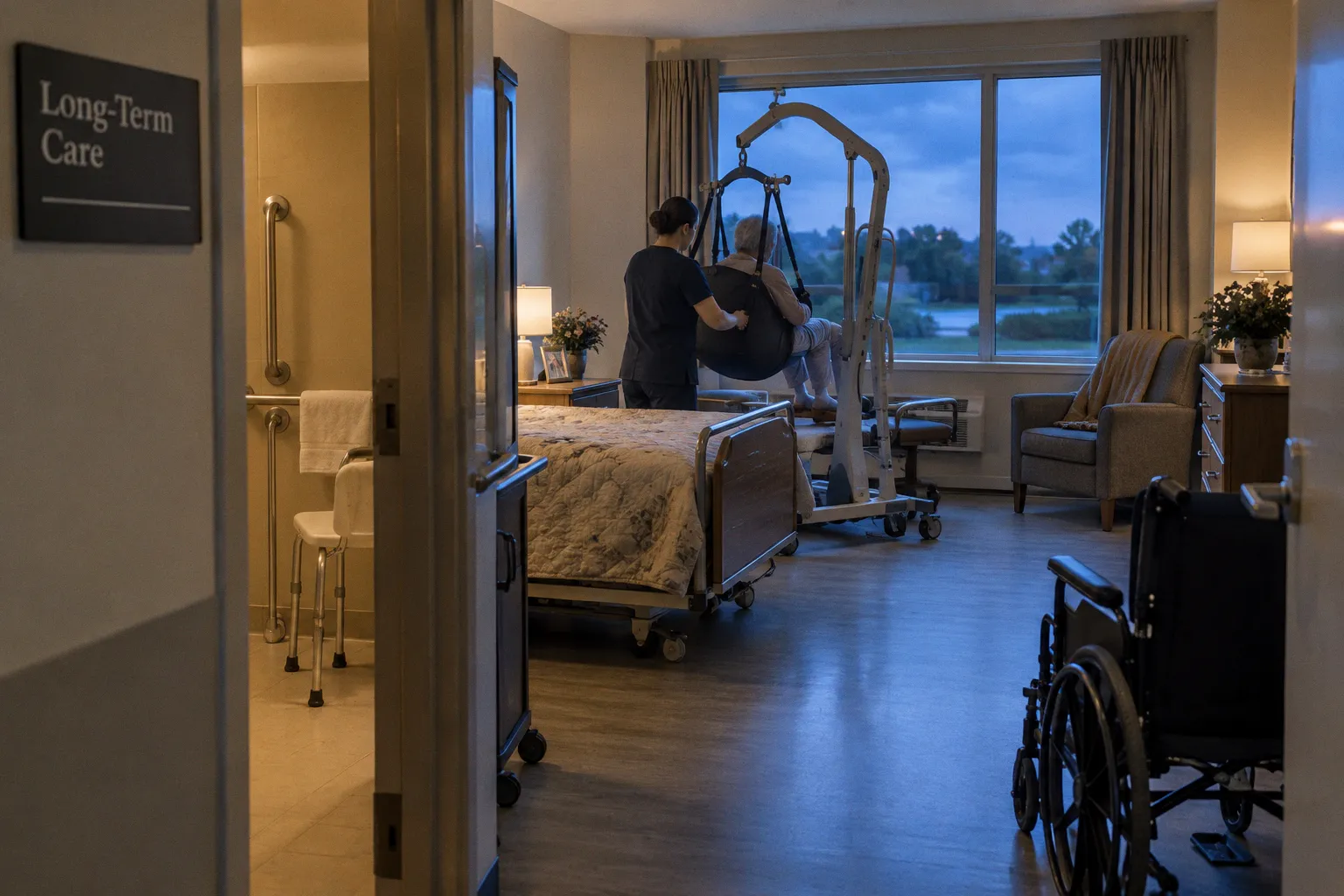
Nursing assistants face an especially severe exposure profile: the rate cited in OSHA materials reaches 225.8 cases per 10,000 workers, compared with 37.8 across the national workforce.
That is not a minor ergonomic issue. It is an equipment and operating-model failure. In skilled nursing facilities, a resident transfer that exceeds safe manual handling capacity creates a predictable chain of consequences: staff injury, overtime, restricted duty, workers’ compensation costs, missed care tasks, and potential deficiency citations.
NIOSH uses 35 pounds as the upper limit for manual patient transfers. Any transfer requiring more than that level of manual lifting should be performed with mechanical assistance. OSHA materials indicate that a comprehensive safe patient handling program using mechanical lifts can reduce healthcare worker exposure to manual lifting injuries by up to 95%.
For nursing homes, the practical comparison comes down to three lift categories:
1. Mobile floor sling lifts, commonly called Hoyer lifts.
2. Sit-to-stand lifts for residents who retain reliable partial weight-bearing ability.
3. Ceiling-mounted track lifts for facilities prioritizing fixed transfer routes, floor-space efficiency, and repeatable handling procedures.
The correct selection is not determined by purchase price alone. It depends on resident acuity levels, room geometry, staffing patterns, transfer frequency, sling management, maintenance capacity, and the facility’s tolerance for operational variation.
The three lift models serve different resident profiles
A mechanical patient lift comparison in long-term care becomes unreliable when all equipment is treated as interchangeable. These devices solve different transfer problems.
A full-body lift supports a resident who cannot safely bear weight. A sit-to-stand device assumes that the resident can participate in the transfer. A ceiling lift removes the wheeled base from the equation but requires an installed overhead track and a transfer route that matches the building.
The first decision is therefore clinical, not financial: what level of assistance can the resident reliably provide?
| Lift model | Appropriate resident profile | Main operating advantage | Primary limitation |
|---|---|---|---|
| Mobile floor sling lift | Totally dependent or non-weight-bearing residents | Flexible use across rooms and transfer locations | Requires floor maneuvering and clear paths |
| Sit-to-stand lift | Residents who can bear partial lower-extremity weight and follow basic cues | Faster transfers with some resident participation | Unsafe for residents with no weight-bearing ability |
| Ceiling-mounted track lift | Residents requiring full or substantial mechanical assistance on established routes | Saves floor space and avoids many threshold and carpet problems | Higher installation commitment and less portability between rooms |
The distinction between weight-bearing and non-weight-bearing residents cannot be softened for convenience. Sit-to-stand lifts are appropriate only when the resident can reliably bear partial weight through the lower extremities and follow basic instructions. A resident who cannot support any leg weight requires a full-body floor lift or a ceiling lift.
Using a sit-to-stand device outside that clinical envelope is not an efficiency measure. It is an unsafe substitution of equipment.
The lift model must follow the resident’s functional capacity. Staffing convenience is not a clinical indication.
Mobile floor sling lifts: the default workhorse, with a large footprint
Mobile floor sling lifts remain the most adaptable option for skilled nursing facilities. The basic design uses a wheeled base, mast, boom, and full-body sling. The resident is suspended in the sling and moved without requiring meaningful exertion.
That makes the mobile floor lift suitable for residents who are totally dependent, non-weight-bearing, or unable to follow transfer cues consistently. It can support transfers between bed, wheelchair, shower chair, and other surfaces, provided the sling, lift capacity, and transfer procedure are appropriate for the resident.
Where mobile floor lifts perform well
The principal advantage is deployment flexibility. One lift can serve multiple rooms or units. This matters in facilities where the resident population changes frequently or where capital budgets do not support dedicated equipment in every room.
Mobile lifts also avoid permanent construction work. A facility can add units incrementally, assign them to high-acuity halls, or reposition them as resident needs change. For smaller facilities, that flexibility can be decisive.
They are particularly useful when:
- Residents have highly variable acuity levels.
- Transfers occur in multiple rooms and locations.
- The facility cannot install overhead tracks throughout the building.
- Management needs to scale equipment gradually.
- Renovation restrictions limit ceiling-mounted infrastructure.
Where the operating burden appears
The wheeled base creates the central limitation. Staff must maneuver the lift across the floor, around furniture, through doorways, and over threshold transitions. Carpets, uneven flooring, tight bathrooms, and cluttered rooms all increase the physical and procedural demands of the transfer.
The device may reduce manual lifting while still creating pushing, pulling, turning, and positioning tasks. That distinction matters. A mechanical lift is not automatically a low-risk lift if the room layout forces staff to wrestle with the equipment.
Floor lifts also compete for storage space. If the device is kept in a remote equipment room, staff may delay retrieval or improvise when a resident needs an unscheduled transfer. If it is parked in the resident room, it consumes usable floor area and may interfere with wheelchair positioning, bedside care, or emergency access.
The facility therefore needs more than a purchase order. It needs a storage and availability policy. A lift that is technically owned but operationally distant is not reliable safe patient handling equipment.
Sling control is part of the lift system
The sling is not an accessory in the casual sense. It is a load-bearing component of the transfer system. Staff must match sling type and size to the resident, inspect it for damage, and follow the manufacturer’s application instructions.
A mobile lift program becomes unstable when slings are shared without clear identification, stored wet, mixed across sizes, or left without documented inspection. These are operational defects, not housekeeping details. They can create incorrect positioning, discomfort, skin risk, and transfer instability.
The equipment purchase should therefore include:
- A defined sling inventory by size and function.
- A storage method that keeps slings clean, dry, and identifiable.
- A process for removing damaged equipment from service.
- Staff competency validation for sling application.
- Documentation of lift capacity and resident compatibility.
The mobile floor lift is usually the broadest starting point for a nursing home. It is not automatically the lowest-total-cost option once storage, transport time, staff training, and room maneuverability are included.
Sit-to-stand lifts: efficient only within a narrow clinical envelope
Sit-to-stand lifts are often presented as a middle option between manual transfer and full-body suspension. That description is directionally correct but operationally incomplete.
The resident must retain partial weight-bearing ability in the lower extremities. The resident must also be able to follow basic cues and participate consistently. The device supports the transition from sitting to standing; it does not replace the resident’s ability to generate and maintain enough lower-body support.
This makes sit-to-stand lifts useful for residents with limited but meaningful functional capacity. They can support transfers from bed to wheelchair, repositioning for toileting, and selected rehabilitation-related activities when the resident’s status is stable and the care plan permits that approach.
They are not appropriate for a resident who cannot bear weight through the legs. They are also a poor fit when cognition, fatigue, pain, weakness, or fluctuating medical status makes participation unreliable.
The efficiency case
When correctly matched to the resident, a sit-to-stand lift can reduce the time and physical effort required for routine transfers. The resident participates. Staff guide and stabilize rather than fully suspend and transport the person.
That can make the device valuable in rehabilitation units and post-acute settings where the resident’s functional status is expected to change. It may also support a more graduated transfer plan as residents move between assistance levels.
However, the operating benefit depends on accurate assessment. If staff classify a resident as partially weight-bearing based on a single successful transfer, the facility may be using an optimistic data point rather than a safe functional profile.
The classification risk
A resident’s transfer status can change with infection, dehydration, medication changes, pain, delirium, falls, or general decline. A device that was appropriate last week may not be appropriate today.
The care team must therefore connect equipment selection to current clinical information, not merely to a standing room assignment. A resident listed as one-person assist in an old care plan may require a full-body lift after a significant change in condition.
This is where documentation and staff communication affect equipment safety. If the resident’s functional status is not visible at the point of care, staff may select the fastest available device rather than the correct one.
The operational controls should include:
1. A documented weight-bearing assessment.
2. Clear transfer instructions in the care plan.
3. A process for reassessment after falls, acute illness, or functional decline.
4. Staff training that distinguishes partial weight-bearing from no weight-bearing.
5. A prohibition on using sit-to-stand equipment for residents who cannot support leg weight.
The sit-to-stand lift can be an efficient tool. It can also become a high-risk shortcut when the facility treats participation as optional.
Ceiling-mounted track lifts: infrastructure in exchange for control
Ceiling-mounted lifts operate along an overhead track. Depending on the track configuration, the equipment can move a resident through defined routes between the bed, bathroom, wheelchair, and other transfer points.
The major physical advantage is the removal of the wheeled base. Staff do not need to steer a large mobile frame across carpets, over thresholds, or through narrow room layouts. The overhead system also preserves floor space, which is material in shared rooms, compact bathrooms, and high-acuity units.
For facilities with predictable transfer routes and frequent full-body transfers, that can change the risk profile of the entire unit.
Why ceiling lifts solve a building problem
A mobile lift is affected by the floor. A ceiling lift is affected primarily by the track. That distinction shifts the engineering problem from daily maneuverability to installation design.
The facility must determine:
- Which rooms require dedicated tracks.
- Whether tracks should connect bed and bathroom areas.
- How shared rooms will be configured.
- Whether the ceiling structure can support the installation.
- How the system will function during maintenance or power interruption.
- Whether the track route matches actual staff workflows.
A poorly planned track can create a permanent obstacle rather than a reliable transfer route. A track that stops short of the bathroom, for example, may still require staff to perform an awkward lateral movement or use a second device.
The design has to follow the transfer process. Installing equipment in the most convenient construction locations is not the same as installing it where residents actually need to move.
The capital and maintenance trade-off
Ceiling-mounted systems require a larger upfront commitment than a mobile lift. Installation may involve structural review, electrical work, room downtime, and coordination with renovation schedules. The financial calculation therefore extends beyond the equipment itself.
The return comes through repeatability and reduced daily maneuvering. In a high-acuity setting, a ceiling system can reduce the number of floor obstacles, simplify transfers, and make equipment availability more predictable. It may also reduce the time spent locating and positioning mobile lifts.
That benefit is not universal. A facility with low transfer frequency, frequently changing room use, or major building limitations may not justify a fixed system across all rooms. Selective installation in high-acuity rooms or dedicated rehabilitation areas may be more rational than a building-wide rollout.
Available evidence does not establish a universal brand-by-brand winner on maintenance cost. The relevant comparison is site-specific: installation requirements, service response, battery and motor maintenance, track configuration, staff adoption, and the number of transfers performed each day.
Ceiling lifts trade portability for control. In high-acuity rooms, that is often a favorable trade. Across an unsuitable building, it becomes expensive infrastructure with limited reach.
Ceiling versus floor lifts in nursing homes
The ceiling-versus-floor decision is often framed as a simple equipment preference. It is more accurately a comparison between two operating systems.
A mobile floor lift provides flexibility. A ceiling lift provides a fixed, repeatable path. The better option depends on how often transfers occur, how predictable the room layout is, and whether the facility can support the infrastructure.
Mobile floor lifts are the stronger choice when:
- The resident population changes frequently.
- Transfers occur in varied locations.
- The facility needs equipment that can move between units.
- Construction or ceiling reinforcement is impractical.
- The building has enough clear floor space for safe maneuvering.
- Management needs a scalable solution rather than a capital project.
Ceiling lifts are the stronger choice when:
- Residents require frequent full-body transfers.
- Room layouts and transfer destinations are stable.
- Floors are difficult to navigate because of carpets or thresholds.
- Storage space is limited.
- The facility wants equipment available in the room rather than transported from a central location.
- The unit has a high concentration of residents with advanced mobility limitations.
The hidden variable: workflow reliability
A device’s clinical capability is only one part of its performance. Availability determines whether staff use it.
A mobile lift may be clinically appropriate but unavailable on the unit. A ceiling lift may be installed but unusable because the sling is missing, the battery is discharged, or staff have not been trained on the track route. Both scenarios create the same operational result: manual handling pressure.
Facility leaders should evaluate the full sequence:
1. Can staff identify the required lift quickly?
2. Is the equipment stored where the transfer occurs?
3. Is the correct sling available in the correct size?
4. Can one caregiver retrieve and prepare the system without delaying care?
5. Is the transfer route free of furniture, thresholds, and other obstructions?
6. Does the equipment remain functional under routine maintenance conditions?
7. Is there a documented alternative when the primary device is out of service?
The answers reveal more than a vendor specification sheet. They show whether the facility has a functioning safe handling program or simply owns mechanical equipment.
Selection criteria that survive an audit
A facility choosing patient transfer lifts for skilled nursing facilities should treat the purchase as a compliance and operations decision. The device must fit resident needs, staff capability, building conditions, and documentation systems.
1. Match the lift to acuity levels
A low-acuity rehabilitation unit and a long-term care memory support unit may require different equipment profiles. The decision should account for the percentage of residents who are non-weight-bearing, the frequency of two-person transfers, and the likelihood of rapid functional change.
A sit-to-stand lift cannot fill the role of a full-body lift. A mobile floor lift cannot eliminate every maneuvering problem. A ceiling lift cannot compensate for a poorly designed track route.
2. Map the actual transfer routes
The evaluation should include beds, wheelchairs, toilets, showers, therapy areas, and emergency access paths. Measurements should be taken in the rooms where transfers occur, not only in a showroom or floor plan.
For mobile lifts, the relevant constraints include:
- Door widths.
- Bed height and clearance.
- Turning radius.
- Floor transitions.
- Carpet resistance.
- Bathroom dimensions.
- Furniture placement.
- Storage distance.
For ceiling lifts, the relevant constraints include track coverage, structural support, transfer destinations, and the need for room-to-room movement.
3. Assess staff handling demands beyond lifting
The risk does not end when the resident leaves the bed. Staff may still push a mobile device, reposition the sling, rotate the lift, or stabilize the resident during movement.
A strong selection reduces total physical exposure. It does not merely replace one manual step with another awkward task.
4. Build maintenance into the reimbursement environment
Long-term care operators function within reimbursement thresholds and narrow labor budgets. Equipment downtime can increase overtime, delay care, and force staff to use backup methods that were not planned for the resident.
Maintenance planning should cover battery charging, inspection intervals, sling replacement, motor and control checks, track servicing, and vendor response times. The facility should know who removes equipment from service and how quickly a replacement becomes available.
A device with a favorable purchase price but weak service support can become a recurring operational liability.
5. Tie equipment to deficiency prevention
Improper transfer practices can appear in several forms: staff lifting beyond safe capacity, missing care-plan instructions, unavailable equipment, damaged slings, or inconsistent documentation. These conditions can contribute to deficiency citations when they create or expose residents and staff to avoidable risk.
The facility should be able to demonstrate:
- Which residents require mechanical assistance.
- Which lift type is authorized for each resident.
- Which staff members are trained and validated.
- How equipment is inspected.
- How damaged equipment is removed from service.
- How changes in resident status trigger reassessment.
- What happens when the assigned lift is unavailable.
This is not paperwork detached from clinical care. It is the evidence that the operating system exists.
Training determines whether the equipment reduces risk
Mechanical lifting equipment cannot compensate for inconsistent technique. Staff need practical competency, not a one-time product demonstration.
Training should cover resident assessment, sling selection, positioning, lift controls, emergency lowering, battery status, route clearance, and communication among staff. It should also address the boundary conditions for each model.
The most important distinction is often the simplest: a sit-to-stand lift is not a full-body lift. Staff must recognize when a resident no longer meets the weight-bearing requirement and escalate to the appropriate device.
Competency validation should be tied to actual facility equipment. Generic training on a different model does not establish reliable performance. Controls, sling attachment points, emergency features, and safe operating limits vary.
A practical program includes observation of:
- Correct resident and sling identification.
- Pre-transfer equipment inspection.
- Proper attachment and positioning.
- Safe movement through the planned route.
- Recognition of instability or resident distress.
- Controlled lowering and transfer completion.
- Post-use storage and charging.
The facility should also monitor near misses. A resident sliding in a sling, a mobile lift catching on a threshold, or a staff member reporting difficulty maneuvering equipment is early operational data. Waiting for an injury or deficiency citation discards the most useful warning period.
The financial comparison is broader than acquisition cost
A commercial investigation of nursing home lift equipment should include the cost of failure. That means looking beyond the invoice.
The financial exposure includes:
- Staff injuries and workers’ compensation claims.
- Overtime and agency coverage for restricted or absent employees.
- Lost productivity during complex transfers.
- Equipment downtime and emergency replacement.
- Training hours and competency reassessment.
- Room modifications and installation.
- Sling replacement and consumable components.
- Regulatory response and corrective action.
- Delayed transfers that affect therapy or daily care schedules.
The up-front price hierarchy is not enough to rank the three models. A mobile floor lift may require less construction but more daily handling. A ceiling lift may require substantial installation but reduce repeated equipment transport. A sit-to-stand lift may be efficient for the right residents and unsafe for the wrong ones.
A facility with a high proportion of non-weight-bearing residents may need more full-body capacity even if sit-to-stand equipment appears cheaper. A facility with compact rooms and frequent transfers may justify ceiling infrastructure. A smaller operator with variable room use may need mobile units deployed strategically rather than a fixed system.
The correct financial question is not which lift has the lowest purchase price. It is which configuration produces the lowest combined exposure across labor, injury, downtime, and compliance risk.
FAQ
Which patient lift is best for a non-weight-bearing resident?
When should a nursing home use a sit-to-stand lift?
What is the difference between a mobile floor lift and a ceiling lift?
What is the NIOSH limit for manual patient transfers?
How should nursing homes manage lift slings?
Related articles
 Long-Term CareFall prevention protocols: three clinical approaches compared
 Long-Term CarePressure ulcer prevention tools for skilled nursing facilities
 Long-Term CareInfection Control Audits: What Our 30-Day SNF Review Revealed
 MedPAC Convenes September 2026 Public Meeting Addressing Post-Acute and Skilled Nursing Payments