Nursing home quality tools for different patient needs
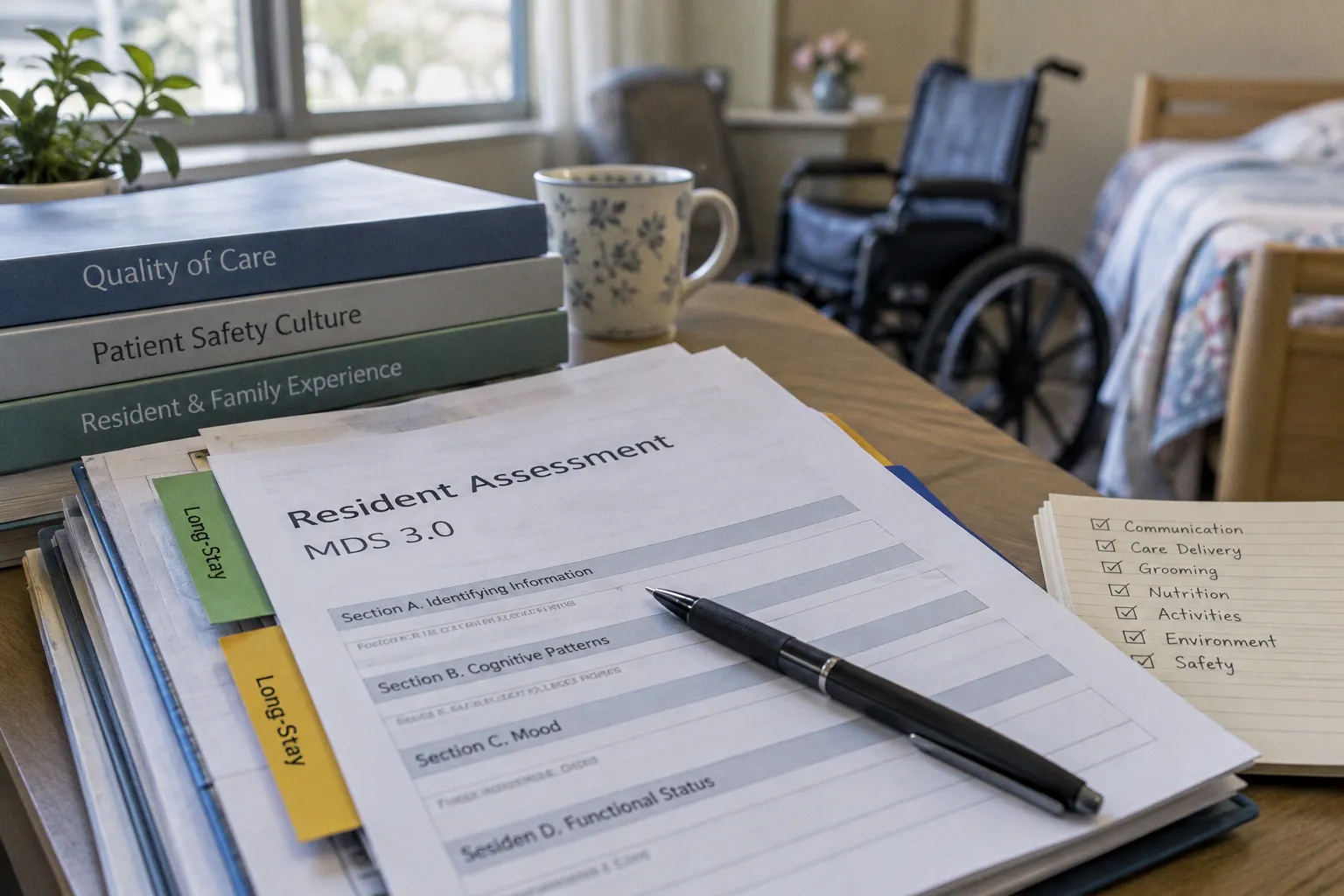
The Centers for Medicare & Medicaid Services now layers four distinct measurement instruments across the post-acute and long-stay populations — a Minimum Data Set that drives reimbursement, a safety-culture survey borrowed from hospital practice, an observational instrument field-tested in 400 facilities, and a resident-experience tool. Each instrument captures a different operational signal. None, individually, produces a complete picture of quality.
No single assessment tool fits every resident need. Clinical instruments, safety-culture surveys, and resident-reported experience measures serve distinct compliance and operational functions.
Standardized Clinical Mandates: The Role of MDS 3.0
The Minimum Data Set 3.0 remains the only federally mandated clinical assessment instrument required of every resident in a Medicare- or Medicaid-certified skilled nursing facility. CMS updated the QM User's Manual to v17.0 in 2025, tightening coding logic across pressure ulcer, antipsychotic, and functional outcome measures. The instrument feeds two parallel pipelines: care planning and case-mix reimbursement.
Facilities that under-document acuity lose money. The MDS assigns Resource Utilization Groups that directly determine per-diem Medicaid rates in most states and influence Medicare PDPM component scores. A skipped section is not a clerical oversight — it is a revenue compression event.
The assessment schedule itself is rigid. Federal Staff Assessment, Comprehensive, and Quarterly reviews run on fixed intervals tied to admission and stay length. Missing a window triggers deficiency citations during survey. Surveyors check the MDS completion calendar before they check the medication cart.
Operators who treat the MDS as a billing artifact rather than a clinical record accumulate drift: care plans stop matching documented acuity, Quality Measure scores slide into the lower quintiles on Care Compare, and the five-star rating follows the data. The 2024 Appendix PP guidance (QSO-24-13-NH) reinforced surveyor focus on assessment-to-care-plan congruence, putting facilities on notice that a clean MDS without a functional care plan is itself a citation trigger.
Measuring Safety Culture with the NHSOPS Framework
Clinical accuracy does not predict resident harm. The Nursing Home Survey on Patient Safety Culture, developed by AHRQ, fills the gap between what facilities chart and what staff actually report about daily operations. The instrument measures how frontline personnel perceive communication, handoffs, staffing adequacy, and non-punitive response to errors.
This matters operationally because safety culture correlates with deficiency patterns. Facilities scoring low on the NHSOPS staffing dimension tend to surface F-tag 725 (nurse staffing) complaints during annual surveys. The survey is voluntary — CMS does not require it — but surveyors can request internal culture data during complaint investigations, and corporate compliance officers increasingly include NHSOPS scores in quarterly performance reviews.
| Tool | Primary Function | Regulatory Weight | Data Source | Frequency |
|---|---|---|---|---|
| MDS 3.0 | Clinical assessment & reimbursement | Federally mandated | Direct resident assessment | Scheduled intervals |
| NHSOPS | Safety culture measurement | Voluntary (AHRQ) | Staff self-report | Annual recommended |
| OIQ Guide | Observational quality indicators | Research-validated | Trained external observer | Variable |
| CAHPS NH Survey | Resident/family experience | Voluntary (CMS-supported) | Resident & family report | Annual |
The NHSOPS distinguishes itself from clinical instruments by capturing what staff believe, not what charts record. A facility can pass every MDS audit and still register NHSOPS scores indicating that nurses fear retaliation for reporting medication errors. That delta is where risk concentrates.
Observational Indicators and the 30-Item OIQ Guide
Clinical charts describe documented care. Observational instruments describe delivered care. The Observable Indicators of Nursing Home Care Quality Guide — refined after field testing in 400 nursing homes across Missouri and Wisconsin — narrowed to 30 discriminating items spanning seven operational factors:
- Communication between staff and residents
- Care delivery competence
- Resident grooming and personal appearance
- Facility odor control
- Environment-basic cleanliness
- Environment-access for residents with mobility limitations
- Environment-homelike atmosphere
The OIQ is not a regulatory tool. It is a research-validated observational framework used by state surveyors in pilot programs, academic researchers, and quality consultants conducting mock surveys. Its value lies in detecting the gap between documentation and practice — the same gap that MDS audits miss.
The OIQ Guide detects what MDS audits miss: the operational delta between documented care and delivered care.
A facility can score well on MDS-based Quality Measures and still rate poorly on OIQ items related to grooming and homelike environment. Surveyors and consultant pharmacists increasingly reference observational gaps when building deficiency narratives, particularly for F-tags related to quality of life (F675), dignity (F675), and accommodation of needs (F656).
Differentiating Short-Stay and Long-Stay Quality Metrics
CMS Care Compare draws a hard line at 100 days. Residents below that threshold are tracked as short-stay — the post-acute rehabilitation cohort — and measured on different Quality Measures than the long-stay population, which is monitored for chronic-care outcomes over stays exceeding 100 days.
The distinction is not administrative. It is clinical. Short-stay measures track successful discharge to community, functional improvement in mobility and self-care, and readmission rates. Long-stay measures track antipsychotic use, pressure ulcer prevalence, physical restraint application, and declines in activities of daily living.
Operators running high-acuity rehabilitation wings cannot use long-stay metrics to evaluate post-acute performance, and vice versa. Mixing the cohorts inflates or suppresses specific QM scores depending on census composition. Facilities with a 60-40 short-to-long census will show different star trajectories than facilities running 20-80, even with identical clinical quality.
This segmentation also affects reimbursement exposure. Short-stay residents drive Medicare Part A revenue under PDPM. Long-stay residents drive Medicaid rate compression or expansion depending on state case-mix methodology. The 100-day threshold cuts both ways — it is simultaneously a clinical marker and a financial dividing line.
Capturing Resident Experience Through CAHPS Surveys
Clinical outcomes, safety culture, and observational indicators do not measure how residents experience daily life. The Consumer Assessment of Healthcare Providers and Systems Nursing Home Surveys fill that gap with two parallel instruments: one for long-stay residents and one for family members of residents in both short- and long-stay settings.
CAHPS responses feed Care Compare star ratings alongside clinical QMs. Resident-reported experience now carries weight equivalent to clinical performance in the five-star algorithm. Facilities that treat CAHPS as a customer-service survey rather than an operational diagnostic miss the underlying signal: residents rate facilities poorly when staffing is inconsistent, when call-light response times lag, and when activities programming fails to match cognitive acuity levels.
The survey is voluntary for facilities but increasingly requested by hospital discharge planners and managed care networks during referral decisions. CAHPS scores now appear in network adequacy filings for Medicare Advantage plans contracting with skilled nursing facilities. Low scores translate into reduced referral volume, which translates into census pressure on facilities already running tight PDPM margins.
FAQ
What is MDS 3.0 used for in a nursing home?
Is the NHSOPS survey required for nursing homes?
What does the OIQ Guide measure?
How are short-stay and long-stay nursing home residents measured differently?
What do CAHPS nursing home surveys measure?
Related articles
 Long-Term CareFall prevention protocols: three clinical approaches compared
 Long-Term CarePressure ulcer prevention tools for skilled nursing facilities
 Long-Term CareInfection Control Audits: What Our 30-Day SNF Review Revealed
 MedPAC Convenes September 2026 Public Meeting Addressing Post-Acute and Skilled Nursing Payments