Neuromuscular electrical stimulation: our clinical efficacy test
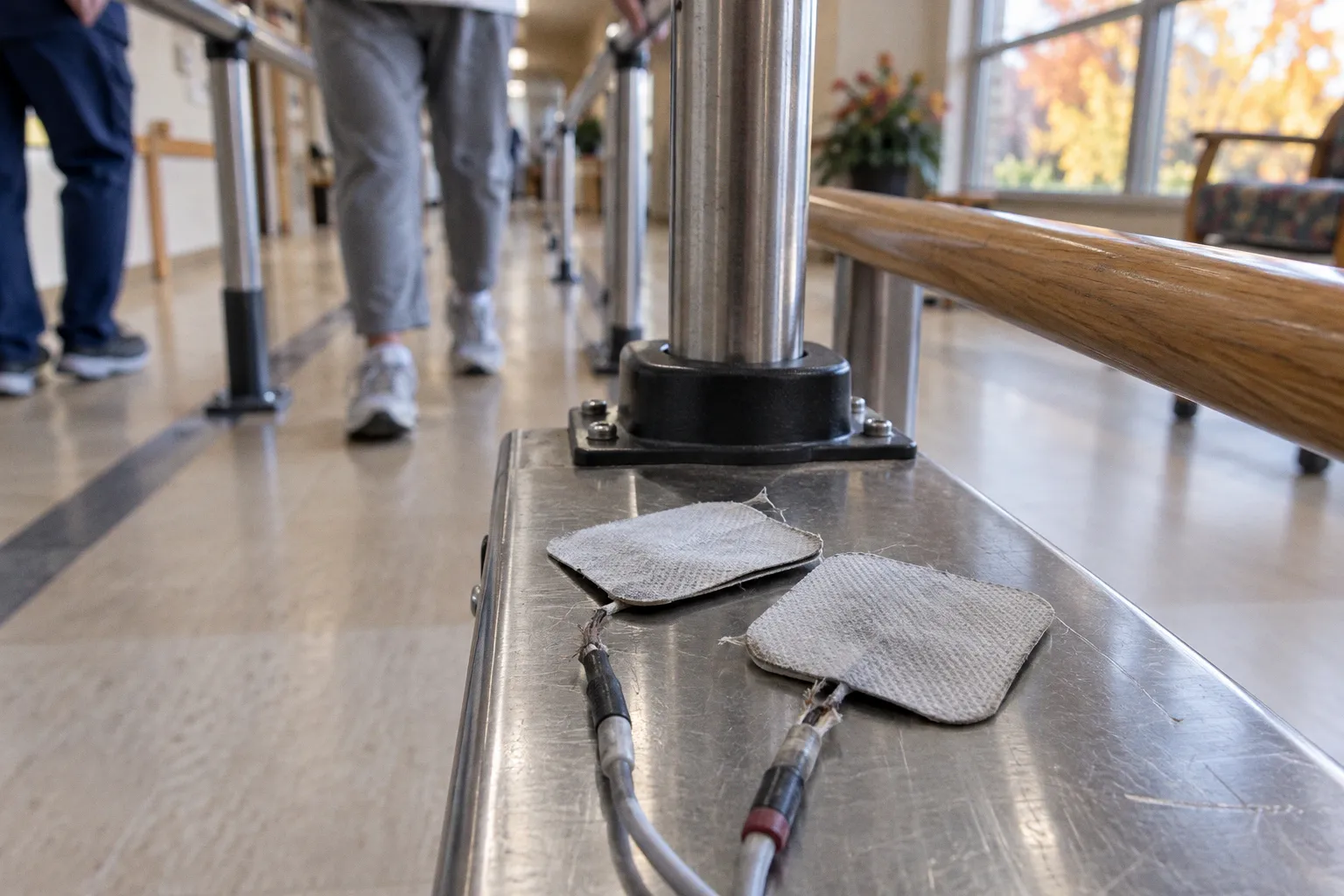
In one immobilization study, the control group lost approximately 3.5% of quadriceps cross-sectional area over five days. That figure describes a study-group result, not a guaranteed outcome for every patient. It does, however, show how quickly disuse can become a clinical problem.
The practical question is not whether a resident should eventually stand, transfer, walk, or exercise. They should, when medically able. The question is what can be done during the period when pain, surgical precautions, weakness, fatigue, or neurological impairment makes meaningful voluntary loading limited. Neuromuscular electrical stimulation, or NMES, is one possible bridge. Used correctly, it can create repeated muscle contractions while a patient is still unable to generate enough force independently.
This review examines neuromuscular electrical stimulation units for geriatric muscle atrophy through a clinical lens: what the physiology supports, which parameters are reasonable for older adults, how to control fatigue, where NMES stops being useful, and how a nursing home or post-acute rehabilitation team can build a safe protocol for bedridden and immobilized patients.
The Physiological Role of NMES in Preserving Muscle Mass
When a senior is immobilized—whether because of post-surgical precautions, a stroke, a hip fracture, or deconditioning after a prolonged hospital stay—the disuse process begins quickly. The quadriceps are particularly vulnerable because they are central to standing, stair negotiation, sit-to-stand transfers, and controlled lowering into a chair. These tasks require more than raw strength, but without sufficient quadriceps tissue, the rest of the rehabilitation program has a weaker foundation.
Age-related sarcopenia makes the starting point less favorable. Older adults may already have reduced muscle mass, lower power, and slower recovery from exertion before the period of bed rest begins. Immobilization adds another layer of loss. Fast-twitch, or type II, fibers are especially important for rapid force production, and they are also among the fibers most affected by aging and disuse.
The exact speed and extent of atrophy vary. A patient’s age, nutritional status, inflammation, illness severity, baseline strength, medication profile, and duration of immobility all matter. It is therefore more accurate to say that measurable change can appear early than to promise a particular percentage of loss on a particular day. The clinical point remains the same: waiting until a resident is strong enough for full exercise may mean waiting until some of the capacity needed for exercise has already disappeared.
NMES works through a different route from voluntary exercise. Surface electrodes deliver controlled electrical pulses through the skin. When the stimulus reaches an excitable peripheral motor nerve, it can depolarize that nerve and produce an involuntary contraction in the associated muscle. Repeated contractions create mechanical work and metabolic demand in tissue that might otherwise remain inactive.
That mechanism is useful, but it is not identical to normal movement. Voluntary contraction begins with the central nervous system and depends on motor planning, descending drive, sensory feedback, coordination, and graded recruitment. Electrical stimulation recruits motor units according to the position and intensity of the stimulus rather than reproducing the full sequence of voluntary control. NMES can therefore help maintain a muscle’s contractile substrate without recreating the whole functional act of standing or walking.
The appropriate indication is specific. NMES is most relevant when:
- the target muscle and its peripheral motor nerve remain electrically excitable;
- voluntary contraction is weak, delayed, painful, or temporarily restricted;
- the patient is expected to spend a meaningful period in bed or with limited loading;
- the treatment goal is to supplement, not replace, an active rehabilitation plan;
- the patient can tolerate the sensation and the care team can monitor the response.
Post-operative patients who cannot yet tolerate weight-bearing, residents on prolonged bed rest, and some stroke survivors with partial motor recovery may fit this profile. The treatment may also be considered for patients whose exercise tolerance is limited by severe deconditioning, provided the medical and rehabilitation teams agree on the indication.
The central distinction is between disuse and denervation. NMES can address a lack of activation when the motor pathway is still sufficiently intact. It cannot simply force a denervated muscle to contract through an ordinary surface stimulation program. If the peripheral motor nerve is no longer able to conduct the signal, the usual NMES approach will not produce a meaningful therapeutic contraction.
NMES preserves muscle mass during disuse. It does not replace voluntary contraction, and it will not reliably rescue a denervated muscle. The indication comes before the electrode placement.
Evidence-Based Parameters: Frequency and Pulse Duration for Seniors
The question asked by nursing staff and therapy teams is usually practical: what settings are most likely to produce a useful contraction without exhausting the resident?
There is no single universal setting for every older adult, every device, or every muscle group. Skin impedance, subcutaneous tissue, electrode position, baseline strength, sensation, pain, cognition, and the condition of the peripheral nerve all affect the result. A protocol should therefore begin with a clinically reasonable range and then be adjusted according to the contraction, the patient’s tolerance, and the response over subsequent sessions.
A systematic review of randomized controlled trials evaluating NMES for muscle preservation reported a statistically significant improvement in muscle mass compared with control conditions, with a pooled standardized mean difference of 0.66 and a 95% confidence interval from 0.30 to 1.02. The strongest consistency was reported in community-dwelling older adults rather than in every possible nursing home population. That distinction matters. Evidence from healthier older adults should not be transferred mechanically to a frail resident with severe neuropathy, advanced neurological disease, profound malnutrition, or unstable medical illness.
Still, the findings support considering NMES for selected inpatient, skilled nursing, and long-term care residents when motor innervation is intact and the treatment is integrated with rehabilitation.
For geriatric muscle-strength applications, a practical starting framework is:
| Parameter | Common clinical range | Why it matters |
|---|---|---|
| Frequency | 50–100 Hz | Higher frequencies can produce a smoother tetanic contraction but generally increase fatigue |
| Pulse duration | 100–400 μs | Longer pulse widths may help recruit a contraction when tissue depth or motor threshold is greater |
| Waveform | Biphasic symmetrical, where supported by the device and protocol | Helps deliver controlled stimulation while limiting net charge accumulation |
| Session length | Approximately 20–40 minutes, including planned rest periods | Allows a useful dose without treating duration as the only measure of quality |
| Intensity | The highest tolerable level that produces a strong visible contraction | A sensation without a meaningful contraction is not the same as therapeutic loading |
The frequency range should not be treated as a pass-fail boundary. At lower frequencies, contractions may be more visibly pulsatile. At higher frequencies, the contraction may appear smoother, but fatigue can accumulate more quickly. A frail resident who tolerates 50 Hz with a strong contraction may receive more useful treatment than a resident placed at 100 Hz who fatigues rapidly and refuses the next session.
Pulse duration also requires individual adjustment. A short pulse may be comfortable but fail to produce the desired contraction. A longer pulse may improve recruitment while increasing discomfort. The correct setting is the one that produces the intended muscle response at a tolerable sensory level, not the setting with the most impressive number on the display.
Electrode placement is just as important as the numerical parameters. The electrode should be positioned to recruit the target muscle effectively, often near a motor point or over the muscle belly according to the device instructions and the clinician’s assessment. A poorly positioned electrode may lead staff to increase intensity unnecessarily, creating more discomfort without improving the contraction. In a quadriceps program, the goal is a broad, visible contraction rather than a small twitch in one portion of the thigh.
In the five-day immobilization study referenced above, daily NMES sessions prevented the quadriceps cross-sectional area loss observed in the control group, which was approximately 3.5% over that period. That result supports NMES as a muscle-preservation strategy during short-term immobilization. It does not prove that every resident will preserve all muscle mass, nor does it establish a guaranteed improvement in a specific later milestone such as walking at week three. Muscle area, force production, transfer ability, and gait recovery are related but separate outcomes.
A sensible outcome plan measures more than one of them. Muscle circumference or ultrasound can help describe tissue change. Strength testing, sit-to-stand performance, transfer assistance, and gait stability show whether that preserved tissue is becoming functional.
Managing Muscle Fatigue During High-Intensity Stimulation
NMES is often described as passive exercise, but passive does not mean effortless for the muscle. A visible contraction consumes metabolic resources. With high-frequency stimulation, the muscle may fatigue before the treatment period is over, particularly when the resident is frail, undernourished, acutely ill, or already weak.
Research indicates that continuous exposure to high-frequency stimulation, including a 100 Hz protocol applied for 20 minutes, can produce severe fatigue under some conditions. That is different from saying it will inevitably cause severe fatigue in every geriatric patient. The outcome depends on the intensity, duty cycle, electrode placement, muscle condition, stimulation history, and the individual’s tolerance.
This distinction is important because categorical warnings can lead teams to avoid an otherwise useful modality, while categorical promises can lead them to overuse it. The correct response is monitoring and titration.
A practical intermittent approach may include:
1. Begin with a conservative duty cycle. Ten seconds of stimulation followed by 20 seconds of rest provides a 1:2 work-to-rest ratio. Some patients may require an even longer rest period at the beginning.
2. Use a longer reassessment break. After a block of approximately 10 minutes, pause for several minutes, check the resident’s symptoms, inspect the contraction, and reassess whether the next block is appropriate.
3. Start at a tolerable frequency. Beginning near the lower end of the selected range can establish tolerance. The frequency can be increased over later sessions only if the contraction remains useful and the resident recovers adequately.
4. Watch the contraction, not just the clock. A contraction that gradually weakens may indicate accumulating fatigue. A contraction that disappears almost immediately may reflect excessive intensity, poor electrode placement, insufficient motor nerve excitability, or an unsuitable target.
5. Ask about the sensation throughout the session. Burning, sharp pain, cramping, anxiety, unusual numbness, or persistent discomfort should prompt a pause and reassessment rather than an automatic increase in intensity.
6. Coordinate NMES with active therapy. If the stimulation leaves the resident fatigued, it may be better scheduled after a demanding therapy session or on a separate treatment block. If the goal is to facilitate voluntary activation, a therapist may deliberately pair stimulation with an active attempt. The timing should serve the rehabilitation objective.
The five-day immobilization study used 40-minute sessions in controlled conditions. A controlled study protocol is not automatically a suitable prescription for a frail nursing home resident with multiple comorbidities. Total treatment time, rest intervals, and intensity should be adapted to the patient rather than copied as a fixed recipe.
The treatment note should record whether the intended contraction was achieved and how the resident responded. Session counts alone are not enough. Ten sessions with poor electrode placement and no meaningful contraction may represent less treatment than three well-tolerated sessions that generated an appropriate response and supported active therapy.
If a resident develops cramping or burning within the first few minutes, do not treat that as a test of willpower. Pause, inspect the setup, reduce the dose, and determine whether the problem is frequency, intensity, electrode placement, or the indication itself.
Clinical Limitations: Why NMES Cannot Replace Voluntary Exercise
NMES earns its place in rehabilitation by doing something specific: creating a controlled contraction when voluntary loading is inadequate. It loses its value when it is presented as a complete substitute for movement.
The immobilization evidence illustrates the difference. A person may retain more quadriceps cross-sectional area and still lose voluntary force. Force production depends on muscle tissue, but also on neural drive, motor-unit coordination, joint mechanics, pain control, balance, confidence, and the ability to organize a movement. NMES can support one part of that system. It cannot train all of it.
These limitations should be explicit in every interdisciplinary care plan:
- NMES does not restore voluntary motor control after stroke by itself. It may support activation and reduce disuse in an affected limb, but task-specific practice remains necessary for motor planning, coordination, transfers, and walking.
- NMES is not aerobic conditioning. Local muscle contractions do not reproduce the cardiovascular and respiratory demands of walking, cycling, or other appropriately prescribed endurance activity.
- NMES does not replicate weight-bearing. Standing and gait training provide joint loading, balance challenges, vestibular input, postural control, and sensory feedback that electrical stimulation cannot reproduce.
- NMES does not overcome peripheral denervation. When the lower motor neuron or peripheral motor nerve is not sufficiently excitable, a standard surface NMES program may fail to produce the contraction required for muscle preservation.
- NMES has limited value when the patient cannot tolerate or participate in the broader plan. Pain, severe cognitive impairment, unstable medical status, untreated spasticity, skin problems, or profound sensory disturbance may make the modality inappropriate or require specialist modification.
- NMES does not turn an unsafe transfer into a safe one. A resident still needs appropriate assistance, equipment, fall precautions, and a functional progression based on current strength and balance.
The neurological exceptions require careful language. A complete spinal cord injury below the lesion is not automatically equivalent to peripheral denervation. Peripheral nerves below the level of a spinal cord lesion may remain electrically excitable, even though voluntary control is absent. Whether NMES is useful depends on the integrity of the lower motor neuron, the specific injury, the target muscle, the treatment goal, and specialist assessment.
The same principle applies to neuromuscular diseases such as ALS. Advanced disease may involve varying combinations of upper motor neuron dysfunction, lower motor neuron loss, weakness, fatigue, respiratory compromise, and altered tolerance. It is not accurate to exclude every patient with a named neurological diagnosis in one sentence, nor is it safe to assume that stimulation is appropriate. The relevant question is whether the target motor unit remains sufficiently excitable and whether the expected benefit outweighs the burden.
This is why device selection should begin with the clinical program rather than with a product brochure. A unit that promises complete rehabilitation in a short daily session is making a marketing claim, not describing the limits of physiology. A clinically useful unit should provide consistent, adjustable stimulation, clear parameter readouts, secure electrode connections, and programming that allows appropriate work and rest cycles.
Implementation Protocols for Bedridden and Immobilized Patients
An NMES program requires more than a device and a prescription. It requires patient selection, staff training, repeatable electrode placement, documentation, and a clear answer to the question: what functional problem is this session intended to support?
Patient selection and pre-treatment review
Before the first session, the team should establish why NMES is being considered and what would count as success. The starting review should include:
- the diagnosis and expected duration of immobility;
- the target muscle group and the functional activity it supports;
- evidence that the target motor nerve and muscle are sufficiently excitable;
- current pain, sensation, skin condition, edema, and joint range of motion;
- cognition, communication ability, and the resident’s capacity to report discomfort;
- implanted electronic devices or other medical conditions requiring specialist review;
- active deep vein thrombosis, untreated infection, malignancy in the treatment area, or other conditions that may change the risk assessment;
- the resident’s goals and willingness to participate.
A pacemaker or implanted defibrillator should not be treated as a minor checkbox. The treating team should follow the device manufacturer’s guidance and obtain appropriate medical clearance where required. The same cautious approach applies to impaired sensation, fragile skin, seizure history, pregnancy when relevant, and any condition for which electrical stimulation may need modification or avoidance.
A planned period of immobility of five days or longer may make muscle-preservation strategies particularly relevant, but duration alone is not an indication. A patient with intact innervation and a realistic rehabilitation goal may benefit from NMES during a shorter period, while a patient with severe denervation may not benefit from it after a longer one.
Setting up the session
The patient should be positioned comfortably with the target joint supported and the muscle accessible. Skin should be clean and dry, and the electrodes should be placed according to the device instructions and the clinician’s assessment of the motor point or muscle belly. Staff should document the placement well enough that another trained clinician can reproduce it at the next session.
For quadriceps stimulation, the goal is a broad and visible contraction that does not pull the knee into a painful position. The exact electrode location will vary with anatomy, body habitus, surgical precautions, and the device. Staff should not compensate for poor placement by continually increasing intensity.
The initial intensity should be low. It can then be increased gradually toward a strong, visible contraction that remains tolerable. The target is not the highest number on the machine. It is a usable contraction without significant pain, panic, cramping, or rapid loss of response.
A session record should include:
- target muscle and electrode placement;
- frequency and pulse duration;
- intensity or amplitude setting;
- work-to-rest cycle;
- total elapsed time and active stimulation time;
- visible contraction quality;
- pain, burning, cramping, or other symptoms;
- skin condition before and after treatment;
- whether the patient completed or stopped the session;
- any changes made for the next treatment.
Connecting NMES with rehabilitation
The electrical contraction should have a place in the overall rehabilitation sequence. For some residents, NMES is primarily a way to limit disuse while voluntary activity is temporarily restricted. For others, it can be paired with an active attempt to tighten the muscle, lift the leg, extend the knee, or perform a functional task under supervision.
The therapist may choose to use stimulation before active exercise to help the resident identify the muscle, during an attempted movement to reinforce activation, or separately to avoid fatigue during gait and transfer practice. There is no universal answer. The choice depends on the resident’s response and the goal of the session.
The team should avoid a common failure mode: treating NMES as a substitute for getting the resident out of bed. Once medically safe, the program must progress toward active movement, sitting balance, transfers, standing, weight shifting, and walking or wheelchair mobility as appropriate.
Tracking outcomes that matter
Muscle preservation is relevant, but it is not the final outcome. A useful program tracks several domains:
- quadriceps circumference or, where available, ultrasound-based cross-sectional area;
- active range of motion and the ability to initiate contraction;
- manual muscle testing or another consistent strength measure;
- sit-to-stand performance;
- level of assistance required for bed-to-chair transfer;
- standing tolerance and postural control;
- gait distance, device use, and supervision level;
- pain, fatigue, skin tolerance, and treatment adherence.
These measures should be interpreted together. A stable circumference with no improvement in transfers may mean that NMES preserved tissue but did not address the limiting factor. Conversely, functional progress with little change in circumference may still represent a successful rehabilitation outcome. The purpose of measurement is to identify whether the treatment is contributing to the resident’s plan, not to force every patient into one expected trajectory.
NMES should be reconsidered when the resident is independently participating in enough voluntary loading to maintain the target muscle, when the treatment produces no meaningful contraction despite appropriate adjustment, or when discomfort and fatigue outweigh the likely benefit. The transition away from NMES is not a failure. It is often the intended progression from assisted activation to independent function.
Reimbursement and documentation
Some facilities may investigate reimbursement for a neuromuscular stimulator under HCPCS code E0745 when the patient meets applicable coverage requirements. Coding alone does not establish medical necessity. Documentation should connect the diagnosis, functional limitation, expected period of immobility, intact or assessable motor innervation, treatment plan, response, and ongoing need. Coverage rules can vary, so the facility should verify current payer requirements rather than relying on a code in isolation.
The clinical test
Neuromuscular electrical stimulation units for geriatric muscle atrophy are most useful when the clinical question is narrow and honest: can controlled stimulation help preserve a usable muscle while the resident cannot yet load it voluntarily?
The evidence supports a role for NMES in selected older adults, particularly when disuse is the main threat and the motor pathway remains sufficiently intact. Studies have reported preservation of muscle area during short periods of immobilization, and a review of randomized trials found a moderate effect on muscle mass outcomes. Those findings justify using NMES as an adjunct. They do not justify promising complete preservation for every patient, guaranteed strength recovery, or a fixed return-to-walking date.
A reasonable starting framework is biphasic stimulation in a frequency range around 50–100 Hz, pulse durations around 100–400 microseconds, visible contraction at the highest tolerable intensity, and intermittent work-rest cycles adjusted to the resident’s fatigue response. The settings must be individualized. A number on the display is not a treatment outcome.
The modality also has firm boundaries. It does not replace voluntary movement, aerobic conditioning, weight-bearing, motor learning, transfer practice, or gait training. It is not a general treatment for all forms of muscle wasting. Spinal cord injury must be distinguished from peripheral denervation, and complex neuromuscular disease requires individualized assessment rather than a categorical exclusion or approval.
The best device is not the one with the most aggressive marketing. It is the one that lets trained staff control the parameters, reproduce electrode placement, program appropriate rest periods, monitor the resident’s response, and document what happened. The best protocol is not the one that produces the longest session. It is the one that preserves a useful contraction without undermining the next day of rehabilitation.
The destination remains functional: a safer transfer, a stronger sit-to-stand, improved standing tolerance, and movement under the resident’s own control. NMES can help protect the muscle while those abilities are being rebuilt. It is a bridge, not the road itself.
FAQ
Can NMES replace physical therapy for bedridden patients?
Is NMES effective for patients with nerve damage?
What are the recommended settings for geriatric patients?
How long should an NMES session last?
Does NMES help with stroke recovery?
Related articles
 Rehabilitation & RecoveryMobility aids for seniors: top recovery tools after surgery
 Rehabilitation & RecoveryPhysical therapy frequency for stroke recovery in seniors
 Rehabilitation & RecoveryWeighted Utensils for Tremors: Testing Three Designs
 Rehabilitation & RecoveryVitalStim Dysphagia Therapy for Seniors: Is It Worth It?