Balance training platforms: our clinical assessment of stability
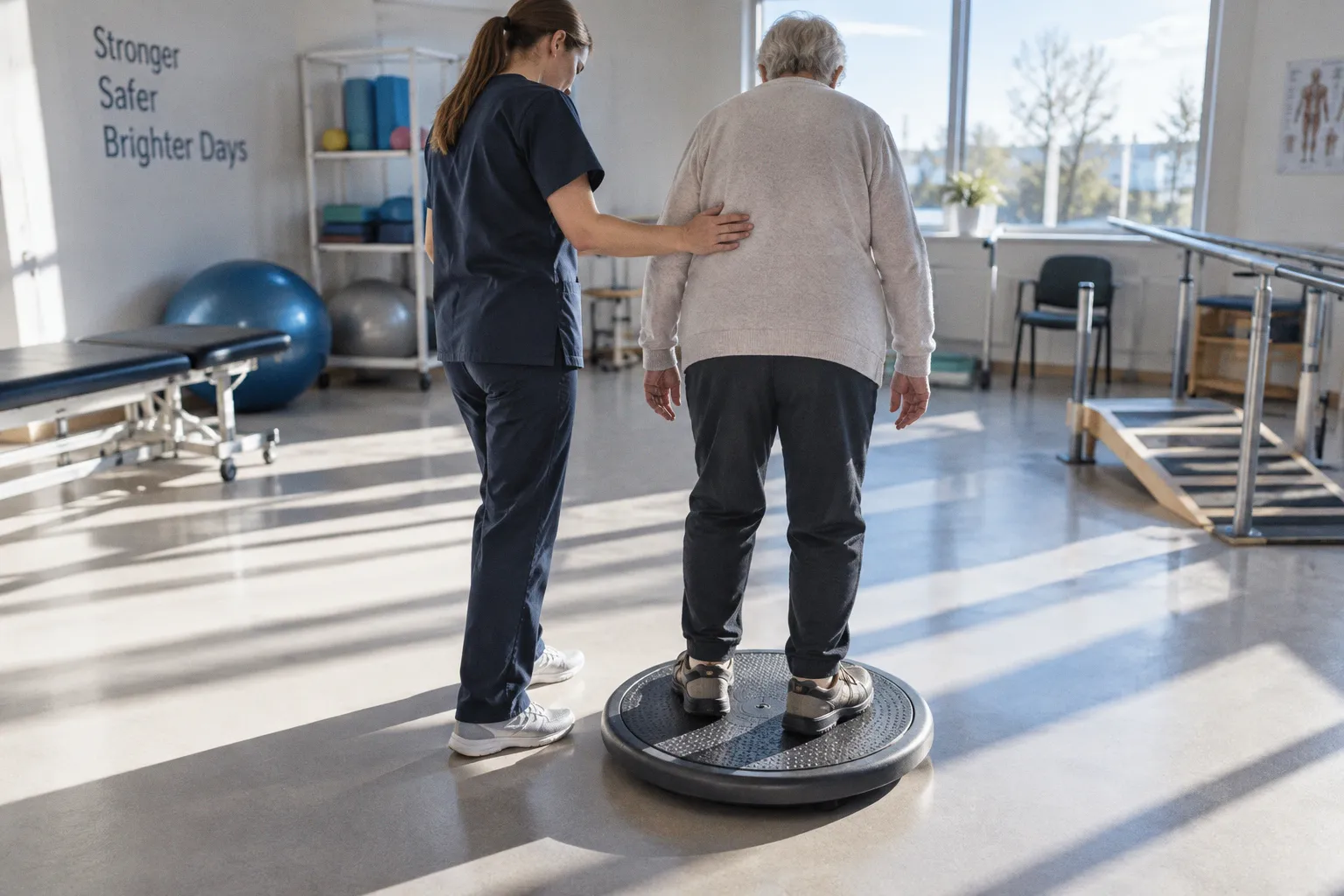
By a routine bedside checklist, he may look close to discharge.
Then he stands on a force plate.
The platform shows that he is loading the operated side cautiously, shifting his center of pressure when the surface becomes less stable, and losing control when he has to lean beyond the narrow range he can manage in a hallway. He may be able to complete familiar tasks under supervision, but that does not automatically mean he is ready for an uneven sidewalk, a crowded kitchen, or a bathroom turn at night.
That gap — between what a patient can do in a controlled hallway and what their nervous system can do when the ground shifts under them — is exactly what balance training platforms are built to expose and, with the right program, to narrow.
I have spent the last several years running geriatric patients through sensor-based balance platforms as part of post-acute rehabilitation. These are not gimmicks, and they are not simply the wobble boards from a physical therapy textbook. They are computerized force plates, sometimes combined with motorized perturbation, multi-axial tilt control, and visual biofeedback displays that quantify postural stability in ways a clinician can act on.
The question I keep hearing from administrators, family members, and other therapists is straightforward: do these platforms actually improve rehabilitation decisions and mobility, or are they an expensive way to generate attractive reports? The answer depends less on the machine than on how the clinical team uses its measurements.
Quantifying Postural Stability: The Role of Force Plate Analysis
A standard gait belt tells you whether a patient can ambulate. A force plate tells you more about how they are doing it: how they distribute weight, where their center of pressure drifts when challenged, and whether they can correct a loss of balance before they need to step.
That distinction matters because many geriatric falls do not occur during a rehearsed walking test. They occur during a transition — turning to reach for a cane, stepping over a threshold, shifting weight to pull open a door, or reaching into a cupboard. In those moments, the postural control system has to integrate visual, somatosensory, and vestibular information quickly enough to keep the center of gravity within a manageable area of support.
A force plate does not remove the need for clinical judgment. It makes some of the hidden parts of that judgment visible.
The platform sits flush with the floor or mounts on a tilting mechanism. When the patient stands or steps on it, embedded transducers measure the forces passing through the feet. Software then reconstructs the trajectory of the center of pressure, or COP: the point at which the combined ground reaction force acts on the support surface.
Depending on the system and protocol, the report may include:
- anteroposterior and mediolateral sway;
- sway velocity;
- COP path length and displacement;
- variability across repeated trials;
- weight-bearing asymmetry;
- limits of stability;
- performance under different visual or surface conditions;
- responses to perturbation or a moving target.
The value is not in collecting every available metric. It is in selecting the measurements that answer a clinical question.
If the question is whether a patient can maintain quiet stance, a static COP assessment may be enough to establish a baseline. If the concern is a fall during turning or reaching, a limits-of-stability test or dynamic task is more relevant. If the patient appears stable until asked to count, carry an object, or respond to a visual cue, a dual-task or biofeedback protocol may reveal the problem more clearly than another straight-line walk.
COP data are useful only when they change what the therapist does next.
In practice, I read a COP trace as a pattern rather than a verdict. A broad, slow drift that becomes worse when visual input is reduced may suggest heavy reliance on vision or difficulty using somatosensory information. Fast corrective movements may indicate that the patient is working hard to remain upright but has little reserve. A sudden breakdown during a cognitive task may point to limited capacity for divided attention rather than a simple weakness in the legs.
These observations still need to be checked against pain, fatigue, medication effects, cognition, footwear, vision, and the patient’s usual environment. A force plate cannot tell you whether a person will be distracted by a ringing phone at home or whether a loose rug will catch their foot. It can, however, show that the patient’s margin for error is already narrow before those environmental factors are added.
Dynamic Assessment Protocols: From Static Sway to 12-Level Control
Static stance testing on a fixed force plate has been used for years, but it reveals only one part of balance. Daily mobility is dynamic. The surface changes, the body turns, the eyes move, and the patient has to make a correction before the loss of balance becomes a fall.
This is where dynamic balance platforms earn their place in a rehabilitation gym.
The Biodex Balance System SD, for example, uses a circular platform mounted on a motorized base. The platform can be progressively destabilized, allowing the therapist to adjust the challenge rather than asking the patient to manage the same fixed surface at every visit. Its commonly used settings range from a locked or relatively stable level to a highly mobile level. The system provides live COP information, numerical scores, and visual feedback during testing and training.
The important feature is not the number attached to a setting. It is the ability to control the task. A therapist can begin with a patient who needs a broad margin of safety, then gradually introduce more movement as control improves. The progression may involve a change in platform instability, a smaller visual target, a longer task, reduced reliance on hand support, or the addition of a simple cognitive demand.
Many systems also include short standardized screening protocols. A brief screen can be useful in a skilled nursing setting because it gives the team a repeatable starting point for newly admitted patients. It can help identify who needs a more detailed assessment, who may tolerate a dynamic challenge, and who should first receive treatment for pain, weakness, fear, or an acute medical issue.
The screen is not a discharge decision. It is triage information.
For facilities running longer training blocks, interactive platforms such as the HUR SmartBalance take a complementary approach. The patient stands on a force plate while a screen displays sway metrics, target-tracking tasks, or other visual challenges. The patient can see the COP moving outside a target zone and attempt to bring it back under control.
That visual loop changes the character of the exercise. Instead of receiving only the therapist’s verbal instruction to shift weight or hold position, the patient receives an immediate external signal. The task becomes concrete: move toward the target, reduce unnecessary movement, maintain control, and repeat.
Platform Comparison at a Glance
| Parameter | Biodex Balance System SD | HUR SmartBalance |
|---|---|---|
| Primary use | Assessment and progressive perturbation training | Biofeedback-driven training and assessment |
| Dynamic control | Adjustable platform instability with multi-axial movement | Force-plate tasks with reactive visual targets |
| Screening role | Useful for structured fall-risk and stability screening | More dependent on the selected protocol |
| Output | Stability measures, comparative scores, and visual reports | Sway measures, COP displacement, and target-tracking performance |
| Best fit | Triage, graded instability, and higher-risk patients who can follow instructions | Repeated training blocks and patients who respond well to visual feedback |
Neither system replaces the other, and neither replaces a skilled therapist interpreting the output. A dynamically tilting platform may be particularly useful when the clinical question concerns perturbation and reactive control. A biofeedback-centered system may be more useful when the goal is repeated motor practice and sustained engagement.
In a budget-constrained facility, the better purchase is not automatically the machine with the longest feature list. The decision should follow the caseload. A unit admitting many medically complex patients may benefit from a fast, repeatable screening process. A unit with longer rehabilitation stays may place greater value on a system that supports progressive training and patient engagement. Equipment that is rarely used, or used without a defined protocol, is expensive regardless of how sophisticated it looks.
Interpreting Center of Pressure Data in Geriatric Care
Raw numbers from a force plate do not help a patient unless the clinician can translate them into a treatment plan. The most useful reports answer three questions:
1. What is limiting the patient right now?
2. Can the limitation be trained safely?
3. Has the patient changed in a way that matters outside the laboratory-style task?
COP displacement
COP displacement describes how far the pressure point moves during a defined task. Greater movement is not automatically a sign of failure. Some movement is normal, and a patient may deliberately explore the available range during a limits-of-stability task.
The clinical concern is excessive or poorly controlled movement, especially when it is accompanied by delayed correction, repeated stepping, or a visible fear response. Displacement should be interpreted alongside the task conditions. A patient may perform adequately with eyes open on a firm surface but become unstable when visual input is reduced or the surface is less predictable.
Pain can also alter the result. After hip surgery or a fracture, a patient may limit weight-bearing because the limb hurts or because they do not trust it. That is different from a purely sensory deficit, even though both may appear as asymmetrical movement on a report.
Sway velocity
Sway velocity is often more informative than distance alone because it reflects how actively the patient is correcting movement. A short COP path with frequent, rapid corrections may indicate that the patient is using considerable effort to stay within a narrow control margin.
This is one reason a patient can appear stable during a brief observation and still be vulnerable during a longer day of activity. The patient may be compensating effectively in a quiet room but have little reserve left when fatigue, distraction, or an unexpected movement is added.
Across an episode of care, I want to know whether the patient is becoming calmer and more efficient, not merely whether they can finish the same task. A lower correction burden may indicate that the patient is using a more sustainable strategy. It does not prove that falls will not occur, but it can support a broader judgment about readiness and endurance.
Limits of stability
Limits-of-stability testing asks the patient to lean or shift as far as possible in several directions without stepping or losing control. The system records the direction and extent of the movement, as well as the speed and quality of the return.
This matters because many everyday activities require controlled movement beyond quiet standing. Reaching for a shelf, stepping around a pet, moving from a chair toward a walker, or recovering after a slight trip all require the patient to manage the body’s center of mass as it approaches the edge of the base of support.
A patient may have acceptable quiet stance but a poor forward or backward limit. Another may manage forward movement but struggle to shift toward the operated or weaker side. The direction of the deficit often matters more than a single composite score because it can be connected to specific tasks in the care plan.
These three categories — displacement, velocity, and limits of stability — provide a practical framework:
- Displacement helps show where the patient’s pressure shifts and how much movement occurs.
- Velocity helps show how hard the patient is working to control that movement.
- Limits of stability help show how far the patient can move without needing a step or losing the task.
A fourth piece is context. The same result can mean something different in a person with vestibular dysfunction, a person recovering from hip surgery, and a person whose main limitation is attention. That is why force-plate analysis is an assessment tool, not an automatic diagnosis.
The 10-Session Threshold: Translating Platform Metrics into Mobility Gains
This is where platform testing meets the discharge meeting, and where clinical claims need to remain modest.
A short exposure to a platform may teach a patient what the task feels like. It may also reveal whether the patient can understand visual feedback, tolerate movement, and participate safely. Meaningful change in postural control usually requires repeated practice, progressive challenge, and enough time for the patient to use the new strategy outside the device.
In many rehabilitation programs, a block of roughly ten sessions is treated as a practical minimum for looking for measurable change. It is not a universal biological threshold, and it should not be presented as a guarantee. Some patients respond earlier. Others need a longer course because of stroke, Parkinson’s disease, vestibular hypofunction, pain, cognitive impairment, or severe deconditioning.
The more useful question is not whether every patient completes the same number of sessions. It is whether the training produces a change that transfers to mobility.
A patient may improve COP control during a visual target task but remain unsafe when walking while carrying an object. Another may show better weight distribution on the platform but continue to avoid the operated leg during a toilet transfer. A third may improve on a quiet-stance measure while still losing balance whenever attention is divided.
That is why platform work has to be paired with functional practice. The patient still needs to walk over uneven surfaces, negotiate door thresholds, turn in a narrow space, step onto a curb cut, and recover from a small stumble. Those skills cannot be inferred from a single platform score.
A session count is a planning tool, not a discharge criterion.
I track several types of progress rather than relying on one target value:
1. Quality of control. Is the COP path becoming less erratic, or is the patient simply moving faster?
2. Amount of support. Can the patient complete the task with less hand contact, fewer therapist cues, or a narrower base?
3. Direction of control. Has the patient improved in the direction that matters for their home environment?
4. Tolerance. Can the patient maintain control after walking, transferring, or performing a cognitive task?
5. Transfer. Does the platform improvement appear during stairs, turning, reaching, and other functional tasks?
These measures support a more honest discharge conversation. A patient who improves on the platform but still cannot turn safely with a walker may need continued therapy. A patient whose platform score changes only modestly but who now performs essential transfers independently may have achieved a clinically important gain.
The platform should help the team distinguish those situations instead of hiding them behind a single composite score.
Integrating Biofeedback Systems into Fall-Prevention Regimens
The most common mistake in nursing facilities is treating the balance platform as a standalone intervention. It is not. It is a precise measurement tool and a useful training environment, but it sits inside a broader fall-prevention program.
That program may include:
- lower-extremity and trunk strengthening;
- gait training over real obstacles;
- transfer practice;
- stair work;
- medication review;
- vision and footwear assessment;
- management of pain and dizziness;
- environmental modification;
- education for the patient, family, and care staff.
The platform adds objectivity and feedback. A patient doing strengthening exercises usually has a visible external measure: more repetitions, greater resistance, or a longer walk. Balance is less intuitive. A patient may not feel that their control is improving, and a clinician may not see small changes during a brief hallway observation.
A live COP display gives both of them another reference point. The patient can see whether movement is drifting outside the target area. The therapist can adjust the challenge, identify a direction of weakness, and document how the patient responds to repetition.
The feedback is most useful when it is connected to a functional goal. Instead of asking a patient to improve an abstract stability score, the therapist can explain that the training is intended to make it easier to stand from a low chair, turn safely in the bathroom, or carry a plate from the counter to the table.
A practical program may begin with a brief balance and fall-risk screen after admission. Patients who can follow instructions and tolerate the task can then receive a more detailed assessment. Training may begin on a relatively stable setting, with the therapist adding instability, visual targets, reduced hand support, longer duration, or a dual task as control improves.
A session might include:
- a short review of symptoms, fatigue, pain, and recent falls;
- a static or dynamic assessment to establish the day’s starting point;
- biofeedback-driven practice;
- a functional task that uses the same balance strategy;
- documentation of the cueing, support, and environmental conditions required.
Reassessment should occur at meaningful points in the episode of care, not simply because a calendar reminder appears. The team should compare the patient with their own baseline and examine whether the changes transfer to daily tasks.
Measure first. Train with feedback. Re-measure. Then test the skill where the patient actually needs it.
This is what separates a balance platform from a wobble board. The wobble board gives the patient something unstable to stand on. The platform gives the clinician information about the type and direction of the challenge, gives the patient a visible target, and makes progression easier to document. Both the measurement and the practice matter.
The Clinical Verdict
Balance training platforms are not miracle devices. They do not eliminate fall risk in older adults, and no single score can predict how a patient will behave in every home or community environment.
What they can do is make postural stability more measurable, expose deficits that a short hallway test may miss, and provide a structured environment for repeated practice. They are particularly valuable when the assessment is connected to a broader rehabilitation plan rather than used as a technology demonstration.
For a skilled nursing facility or rehabilitation unit deciding whether to invest, the clinical case is strongest when the facility has:
- therapists trained to interpret COP and stability data;
- a defined screening and reassessment protocol;
- enough treatment time for repeated practice;
- space and staffing for safe progression;
- a plan for transferring platform gains to gait, transfers, stairs, and community mobility.
The device itself is only one part of that system. A sophisticated platform used without a treatment hypothesis is just an expensive surface. A simpler system used consistently, with clear goals and functional follow-through, may be more useful.
For patients and families, the practical questions are equally direct. Ask which measurements the therapist is tracking, what change would count as meaningful, and how the result connects to the specific skills required at home: stairs, uneven ground, turning in the bathroom, getting up from a low chair, or walking while carrying something.
If the answers remain at the level of a score on a report, the platform is being underused. If the measurements lead to a clearer treatment plan and are checked against real mobility, the technology can close an important gap between looking ready for discharge and actually being ready for the demands of daily life.
FAQ
Do balance training platforms actually prevent falls?
What is the difference between a balance platform and a standard wobble board?
How many sessions are needed to see results on a balance platform?
What do center of pressure (COP) metrics tell a therapist?
Can a balance platform assessment predict if a patient is ready for discharge?
Related articles
 Rehabilitation & RecoveryMobility aids for seniors: top recovery tools after surgery
 Rehabilitation & RecoveryPhysical therapy frequency for stroke recovery in seniors
 Rehabilitation & RecoveryWeighted Utensils for Tremors: Testing Three Designs
 Rehabilitation & RecoveryVitalStim Dysphagia Therapy for Seniors: Is It Worth It?